
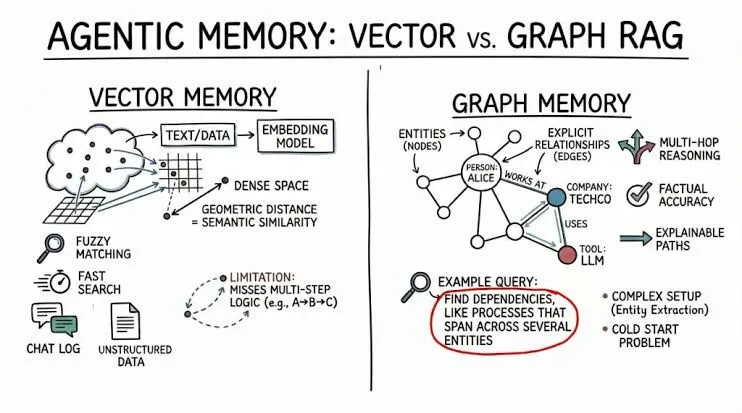
Agentic RAG vs. GraphRAG: Why Vector Search Alone Is Failing Your LLM in Production
Vector search works well for simple RAG use cases, but production questions often require more than finding similar documents. In this article, I explain the difference between Agentic RAG and GraphRAG using AWS services like Amazon Bedrock Knowledge Bases, Amazon S3, and Neptune Analytics.

RAG has become one of the most common ways to connect LLMs with enterprise data. The basic idea is simple: retrieve relevant information from your data, provide that context to the LLM, and generate an answer. This works very well for simple questions, but production questions are often more complicated.
For example, imagine someone asks, “Why did our AWS Glue pipeline fail yesterday, which downstream jobs were affected, and has the same issue happened before?” This is not just a document-search problem. The system needs to find the failure, understand the pipeline dependencies, search historical incidents, and then combine everything into one answer. This is where Agentic RAG and GraphRAG become useful.
Where Traditional RAG Starts
A traditional RAG architecture usually looks like this:
1
2
3
4
5
6
7
8
9
User Question
      ↓
Vector Search
      ↓
Relevant Documents
      ↓
LLM
      ↓
Answer
On AWS, Amazon Bedrock Knowledge Bases can be used to build managed RAG applications. Your enterprise documents can be stored in Amazon S3, and the knowledge base can handle much of the ingestion and retrieval process.
For example, an S3 bucket might contain Glue documentation, pipeline configurations, incident reports, and deployment history:
1
2
3
4
5
6
s3://company-data/

glue_job_architecture.pdf
pipeline_dependencies.pdf
incident_2026_09.pdf
deployment_history.pdf
If a user asks, “Why did the customer pipeline fail?”, vector retrieval can find the relevant incident information and provide it to the LLM. For this type of question, traditional RAG can work very well.
The problem appears when the question requires multiple searches or depends heavily on relationships between different entities.
Why Vector Search Alone Can Become Difficult
Consider a simple data pipeline:
1
2
3
4
5
6
7
Glue Job A
    ↓
Glue Job B
    ↓
S3 Dataset
    ↓
Athena Dashboard
Now imagine the user asks, “If Glue Job A fails, which dashboards could be affected?”
A vector search might find documentation about Glue Job A, but that alone doesn't necessarily tell us the complete dependency chain. We need to understand that Job A affects Job B, Job B writes to a dataset, and that dataset is consumed by an Athena dashboard.
This is no longer just a similarity-search problem. It is a relationship problem.
That's where Agentic RAG and GraphRAG take different approaches.
Agentic RAG
Agentic RAG adds a reasoning loop around the retrieval process. Instead of performing one search and immediately generating an answer, the system can determine what information is required, retrieve it, evaluate the results, and perform additional searches when necessary.
For the earlier question:
“Why did our AWS Glue pipeline fail yesterday, which downstream jobs were affected, and has the same issue happened before?”
An agent could break the question into several smaller tasks:
1
2
3
4
5
1. Find yesterday's Glue failure.
2. Identify the root cause.
3. Find downstream dependencies.
4. Search previous incidents.
5. Combine the results.
The important difference is that the system is no longer relying on a single retrieval operation. It can decide what to look for next based on what it has already discovered.
Amazon Bedrock Knowledge Bases supports Agentic Retrieval, which can decompose complex questions into multiple queries and iteratively retrieve information. Conceptually, the process looks like this:
1
2
3
4
5
6
7
8
9
10
11
12
13
14
15
User Question
      ↓
Agent
      ↓
Break into Sub-Questions
      ↓
Retrieve Information
      ↓
Evaluate Results
      ↓
Need More Information?
      ↓
Retrieve Again
      ↓
Generate Answer
A simplified Python example of the idea could look like this:
1
2
3
4
5
6
7
8
9
10
11
12
13
14
15
16
17
question = """
Why did the Glue pipeline fail yesterday,
which downstream jobs were affected,
and has this happened before?
"""

sub_questions = [
    "What caused the Glue pipeline failure?",
    "Which jobs depend on the failed job?",
    "Were there similar incidents in the past?"
]

for query in sub_questions:
    results = retrieve_from_knowledge_base(query)

    if results:
        print(results)
The actual Bedrock implementation can manage the retrieval process, but the important concept is the iterative retrieval loop.
GraphRAG
GraphRAG takes a different approach. Instead of only asking which documents are similar to a question, it also considers how entities are connected.
For example, a data platform might have relationships such as:
1
2
3
4
5
6
7
Glue Job A
    ↓
Glue Job B
    ↓
S3 Dataset
    ↓
Athena Dashboard
These relationships can be represented as a graph:
1
2
3
(Job A) ──depends_on──> (Job B)
(Job B) ──writes_to──> (Dataset)
(Dataset) ──used_by──> (Dashboard)
Now the question “What can be affected if Job A fails?” becomes a graph traversal problem. Instead of only searching for similar text, we can follow the relationships from Job A to its downstream systems.
AWS supports GraphRAG with Amazon Bedrock Knowledge Bases and Amazon Neptune Analytics. This allows organizations to combine vector retrieval with graph-based relationships.
This can be particularly useful for data engineering use cases such as data lineage, pipeline dependencies, impact analysis, troubleshooting, and understanding relationships between datasets.
A Simple Graph Example
We can represent a small pipeline using Python and NetworkX:
1
2
3
4
5
6
7
8
9
10
11
import networkx as nx

graph = nx.DiGraph()

graph.add_edge("Glue Job A", "Glue Job B")
graph.add_edge("Glue Job B", "S3 Dataset")
graph.add_edge("S3 Dataset", "Athena Dashboard")

affected = nx.descendants(graph, "Glue Job A")

print(affected)
The result gives us the downstream components connected to Glue Job A.
In a real AWS implementation, the graph would be managed using a graph service such as Neptune Analytics rather than an in-memory Python graph.
Agentic RAG vs GraphRAG
The easiest way to understand the difference is to think about what each approach is trying to solve.
Traditional RAG is mainly focused on finding relevant information. Agentic RAG focuses on deciding what information needs to be retrieved and retrieving it in multiple steps. GraphRAG focuses on understanding relationships between entities.
For example, if the question is:
“What caused yesterday's Glue failure?”
Traditional RAG may be enough.
If the question becomes:
“Find the failure, compare it with previous incidents, and explain whether the same problem happened before.”
Agentic RAG becomes more useful because the system needs to perform multiple retrieval operations.
But if the question is:
“Which dashboards are affected if this Glue job fails?”
GraphRAG becomes attractive because the answer depends on the relationships between jobs, datasets, and dashboards.
Why Not Use Both?
In many production systems, there is no reason to choose only one approach.
A more advanced architecture can combine vector retrieval, agentic retrieval, and graph retrieval:
1
2
3
4
5
6
7
8
9
10
11
12
13
14
15
                    User
                      ↓
               Amazon Bedrock
                      ↓
               Retrieval Router
                 ↙          ↘
        Vector Retrieval   Graph Retrieval
              ↓                  ↓
        Documents          Relationships
                 ↘          ↙
                    Context
                       ↓
                      LLM
                       ↓
                    Answer
For example, a user could ask:
“Why did the customer pipeline fail and which reports were affected?”
The system could first use vector retrieval to find the incident details. Agentic retrieval could then search previous incidents or additional documentation. Graph retrieval could follow the lineage from the failed Glue job to downstream datasets and dashboards. Finally, the LLM could combine all of that context into one answer.
This is much closer to the type of reasoning required by enterprise data platforms.
A Practical AWS Architecture
For a data engineering environment, you could store Glue documentation, pipeline configurations, CloudWatch error summaries, incident reports, lineage information, and deployment history in Amazon S3.
Amazon Bedrock Knowledge Bases can provide the retrieval layer, while Neptune Analytics can be used when relationships and graph-based retrieval become important.
The architecture could look like:
1
2
3
4
5
6
7
8
9
10
11
12
13
14
                 Amazon S3
                    ↓
          Bedrock Knowledge Base
                    ↓
          ┌─────────┴─────────┐
          ↓                   ↓
   Vector Retrieval      Graph Retrieval
                              ↓
                       Neptune Analytics
          └─────────┬─────────┘
                    ↓
              Amazon Bedrock
                    ↓
               Final Answer
This could support questions such as:
“Why did this pipeline fail?”
“Which datasets depend on this Glue job?”
“Which dashboards could be impacted?”
“Have we seen this failure before?”
“What changed before the failure?”
These are much more valuable questions than simply searching for a document.
How I Would Build It
I wouldn't start with GraphRAG just because it is a newer architecture. I would start with a simple RAG implementation and understand where it starts falling short.
The first version could be:
1
2
3
4
5
6
7
S3
 ↓
Bedrock Knowledge Base
 ↓
Vector Retrieval
 ↓
LLM
Once that works, improve the retrieval quality through better chunking, metadata, filtering, hybrid search, reranking, and evaluation.
After that, introduce agentic retrieval when questions require multiple searches. Finally, introduce GraphRAG when relationships such as data lineage, dependencies, or impact analysis become important.
This incremental approach keeps the initial architecture simple while providing a clear path toward more advanced retrieval.
Final Thoughts
Vector search is not failing. It is solving a specific problem.
The problem is expecting one retrieval strategy to answer every type of enterprise question.
Traditional RAG is good at finding relevant information. Agentic RAG is better when the system needs to figure out what information should be retrieved next. GraphRAG is useful when the answer depends on how different entities are connected.
For AWS data engineering teams, this becomes especially interesting when you combine services such as Amazon Bedrock, S3, AWS Glue, Neptune Analytics, and your existing data lineage.
The future of RAG may not be about finding one perfect retrieval method.
It may be about building systems that know when to search, where to search, and how the information is connected.
Enjoyed reading this content? Let the author know!
Your likes, comments, shares, and saves help creators reach more builders.

Loading recommendations
Loading article