
AWS Cloud Computing: A Beginner’s Guide to Building Scalable Applications
Amazon Web Services (AWS) is one of the most widely used cloud computing platforms. This article explains the basics of AWS, its important services, benefits, and how beginners can use AWS to build, deploy, and manage modern applications.

Introduction
Cloud computing has changed the way applications and websites are developed and hosted. Instead of purchasing and maintaining physical servers, organizations can use cloud platforms to access computing power, storage, databases, networking, and many other services.
Amazon Web Services (AWS) is a leading cloud platform that provides a large collection of cloud services. AWS allows developers, students, startups, and organizations to build and deploy applications without managing physical infrastructure.
1. What is AWS?
AWS is a cloud computing platform provided by Amazon. It offers services that can be used for:
Hosting websites and applications
Storing files and data
Running virtual servers
Managing databases
Building APIs
Data analytics
Artificial intelligence and machine learning
Security and monitoring
Users can select only the services they need and generally pay according to their usage.
2. Important AWS Services
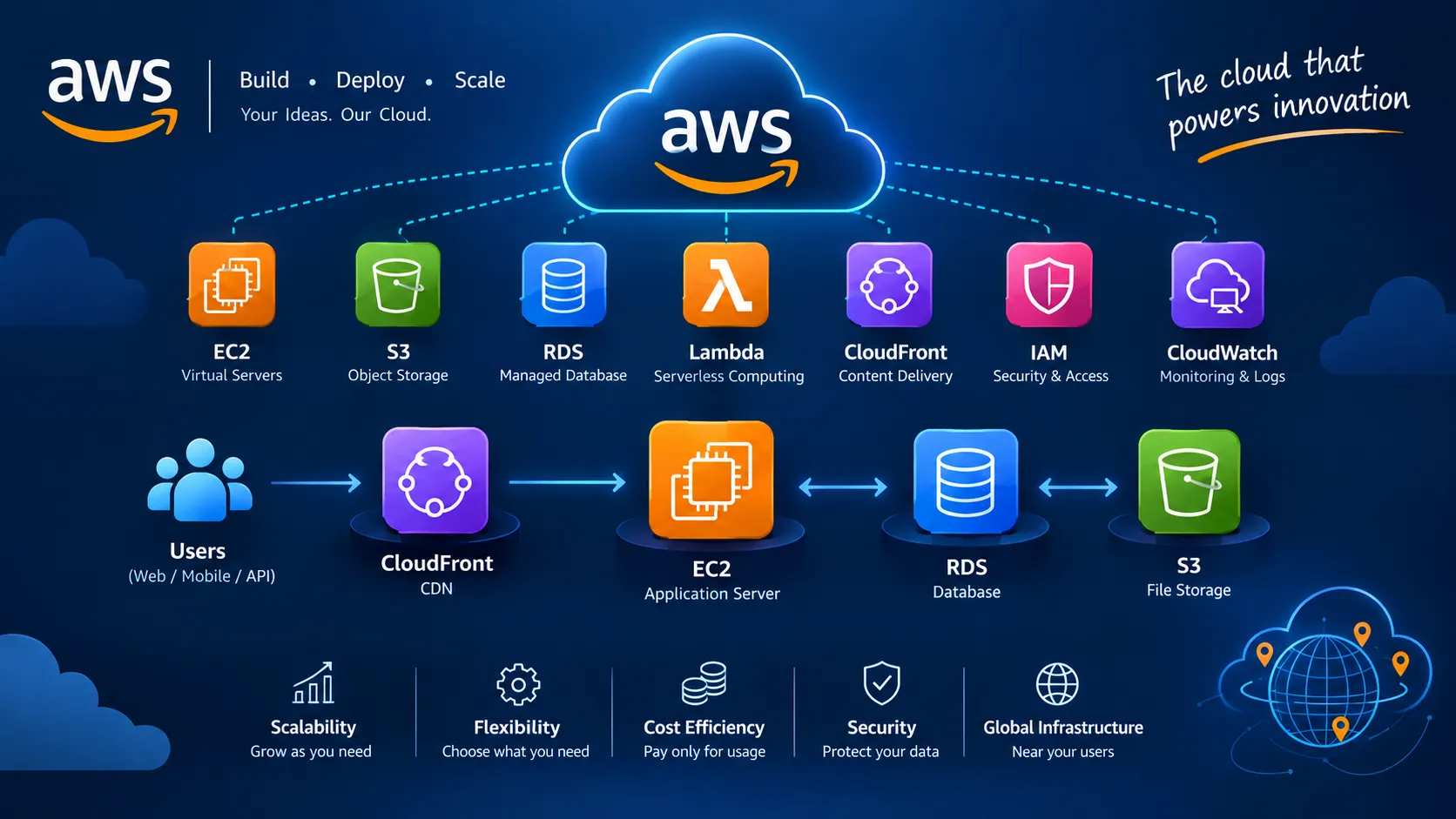
Amazon EC2
Amazon Elastic Compute Cloud (EC2) provides virtual servers in the cloud. Developers can use EC2 to run applications, websites, backend systems, and other workloads.
Amazon S3
Amazon Simple Storage Service (S3) is used to store files and objects such as images, videos, documents, backups, and application data.
Amazon RDS
Amazon Relational Database Service (RDS) makes it easier to create and manage relational databases. It can be used by applications that need structured database storage.
AWS Lambda
AWS Lambda allows developers to run code without managing servers. It is useful for event-driven applications and backend functions.
Amazon CloudFront
CloudFront is a content delivery network (CDN) that helps deliver websites, APIs, videos, and other content to users with lower latency.
3. How AWS Application Deployment Works
A simple AWS application architecture can work like this:
User → CloudFront → Application Server → Database
For example, when a user opens a website:
1. The user sends a request.
2. CloudFront can deliver content from a nearby location.
3. The application server processes the request.
4. The application communicates with the database when required.
5. The response is returned to the user.
This architecture can be expanded as the application grows.
4. Benefits of AWS
AWS provides several important advantages:
Scalability: Applications can increase or decrease resources according to demand.
Flexibility: Developers can choose from many services and technologies.
Cost Efficiency: Organizations can avoid large investments in physical infrastructure.
Security: AWS provides various security services and controls to protect applications and data.
Global Infrastructure: AWS provides infrastructure across multiple geographic regions and availability zones.
5. AWS for Beginners
Beginners can start learning AWS by understanding these concepts:
1. Cloud computing basics
2. AWS Regions and Availability Zones
3. IAM and user permissions
4. EC2
5. S3
6. RDS
7. VPC and networking
8. Lambda
9. CloudWatch
10. Basic AWS security
After learning the fundamentals, beginners can create small projects such as hosting a website, deploying a web application, creating a serverless API, or storing application files in S3.
6. Example Project
A beginner-friendly AWS project could be a Student Management System.
A possible architecture is:
Frontend: HTML, CSS, JavaScript
Backend: Node.js / Java / Python
Server: Amazon EC2
Database: Amazon RDS
File Storage: Amazon S3
Monitoring: Amazon CloudWatch
This project can help students understand how different AWS services work together in a real application.
Conclusion
AWS provides a powerful environment for developing, deploying, and managing applications in the cloud. By learning services such as EC2, S3, RDS, Lambda, IAM, and CloudWatch, beginners can build a strong foundation in cloud computing.
Learning AWS through practical projects is one of the best ways to understand cloud technology and prepare for modern software development and cloud-related careers.
Enjoyed reading this content? Let the author know!
Your likes, comments, shares, and saves help creators reach more builders.

Loading recommendations
Loading article