
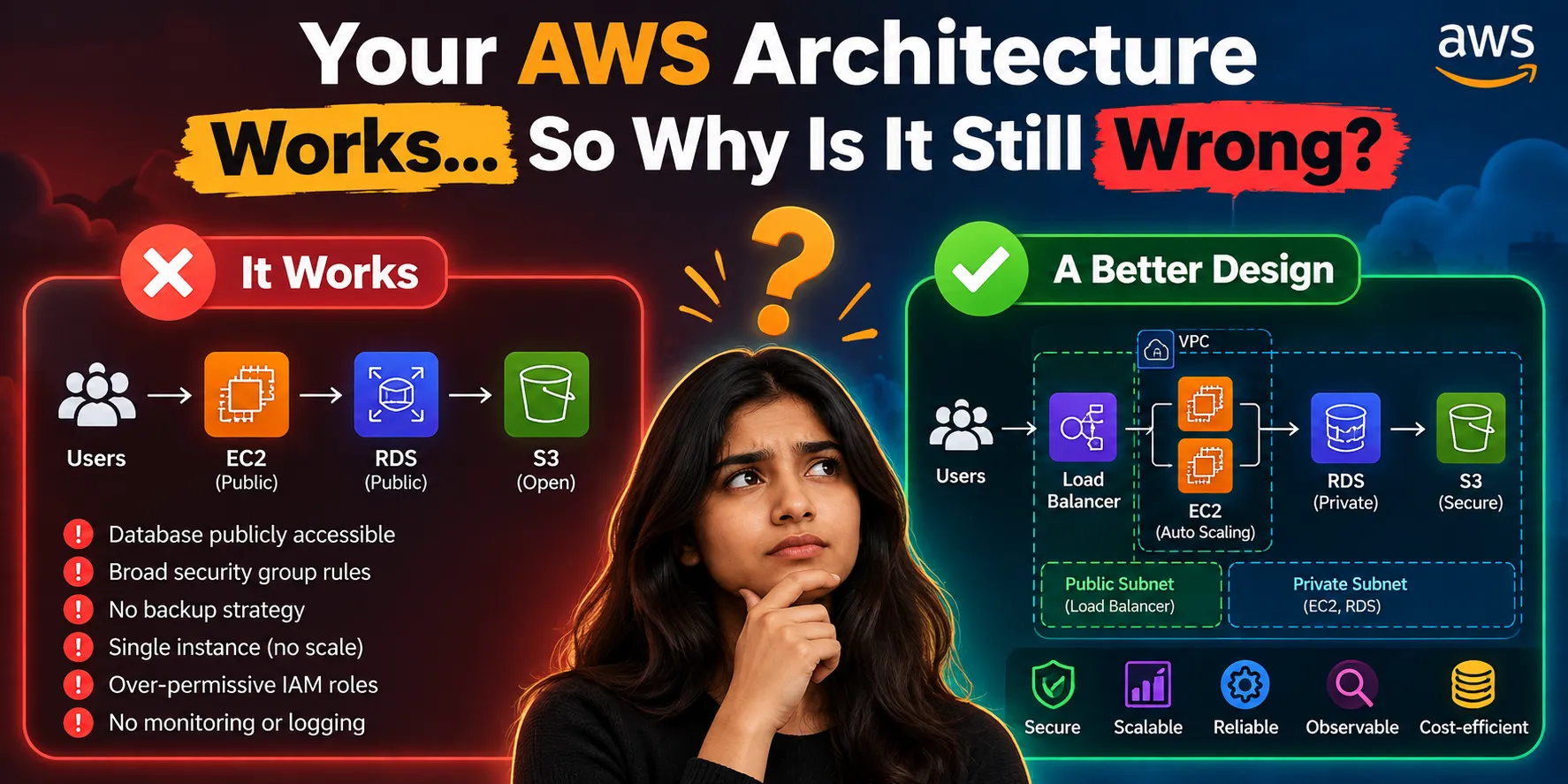
Your AWS Architecture Works… So Why Is It Still Wrong?
A practical look at why an AWS architecture can be fully functional and still be poorly designed. Explore the key questions every cloud engineer should ask about security, networking, scalability, reliability, observability, and cost—and test your AWS architecture knowledge with a real-world scenario.

Your AWS Architecture Works… So Why Is It Still Wrong?
Imagine this:
You have deployed an application on AWS.
It works.
Users can access it.
The database responds.
There are no obvious errors.
You open the AWS Console and everything looks perfectly fine.
So… is the architecture actually good?
Not necessarily.
This is one of the biggest things I’ve started realizing while learning AWS:
“Working” and “well-designed” are two completely different things.
A cloud architecture can work perfectly and still have serious problems with security, availability, scalability, networking, or cost.
And sometimes, the most dangerous AWS mistakes are the ones that don't produce an error.
🚨 Scenario: A small company's AWS application
Let's say a company has a web application with:
- EC2 for the application
- Amazon RDS for the database
- Amazon S3 for storing files
- Users accessing the application over the internet
The developer says:
“Everything is working. We're ready for production.”
But then you look at the architecture.
You discover:
❌ The database is publicly accessible.
❌ The EC2 instance has an unnecessarily broad security group rule.
❌ The application and database are sitting in the same public subnet.
❌ There is no backup strategy.
❌ One EC2 instance is handling all traffic.
❌ IAM permissions are much broader than necessary.
❌ Nobody is monitoring important security events.
The application still works.
But would you call this a good cloud architecture?
I wouldn't.
☁️ The AWS lesson I keep coming back to
Cloud computing isn't simply:
“Put your application on AWS.”
It's about answering questions such as:
🔐 Is it secure?
Who can access the resource?
Does the database really need to be reachable from the internet?
Are IAM permissions limited to what is actually required?
🌐 Is the network designed correctly?
Should this resource be public or private?
What subnet should it live in?
How does traffic reach it?
Which security group rules are necessary?
📈 Can it scale?
What happens if 10 users become 10,000?
What happens if one EC2 instance fails?
💰 Is it cost-efficient?
Are we paying for resources we don't need?
Could a managed or serverless service make more sense?
🛡️ Can we detect problems?
If someone obtains suspicious access, will we know?
Are logs being collected?
Can we investigate what happened?
🧠 Here's the interesting part
Two architectures can both work.
But one can be dramatically better.
For example:
Architecture A
Internet → EC2 → RDS
Simple.
It works.
But now ask:
- Is RDS publicly accessible?
- What happens if EC2 fails?
- How is traffic distributed?
- Where are the backups?
- How are permissions controlled?
Architecture B
Internet → Load Balancer → EC2 instances → private RDS
Now we have a much stronger foundation.
We can introduce:
- Multiple Availability Zones
- Auto Scaling
- Private subnets
- Security groups
- IAM least privilege
- Monitoring and logging
- Automated backups
Suddenly, we're not just running an application.
We're designing infrastructure.
🔥 The mindset shift
This is the mindset I think every beginner learning AWS should develop:
Don't ask only:
“How do I make this work?”
Start asking:
“How do I make this secure, reliable, scalable, observable, and cost-efficient?”
That one change completely changes how you approach AWS.
🎯 A challenge for you
Imagine you are designing an online shopping application.
You have:
Users → Web application → Database
Where would you place the database?
A
Public subnet because the application needs to access it.
B
Private subnet because the database shouldn't need direct internet access.
C
It doesn't matter as long as the security group is configured correctly.
D
Put everything in one subnet to keep the architecture simple.
Which one would you choose?
Don't just give me the letter.
Tell me WHY.
I'm genuinely curious how other builders approach this.
🚀 Final thought
I'm learning that AWS isn't really about memorizing hundreds of services.
It's about learning to make good engineering decisions.
And sometimes the best cloud engineer isn't the person who knows the most AWS services.
It's the person who looks at a working system and asks:
“What could go wrong?”
That's where the real cloud engineering begins.
What is the first thing YOU would check when reviewing someone else's AWS architecture: Security, Networking, Cost, Scalability, or Reliability?
Drop your answer below 👇
#AWS #AWSBuilder #CloudComputing #AWSCloud #CloudSecurity #Networking #Cybersecurity #AWSCommunity #StudentBuilders
Enjoyed reading this content? Let the author know!
Your likes, comments, shares, and saves help creators reach more builders.

Loading recommendations
Loading article