
AI for DevOps and Data at PTIT: Exploring AWS DevOps Agent and Amazon Quick
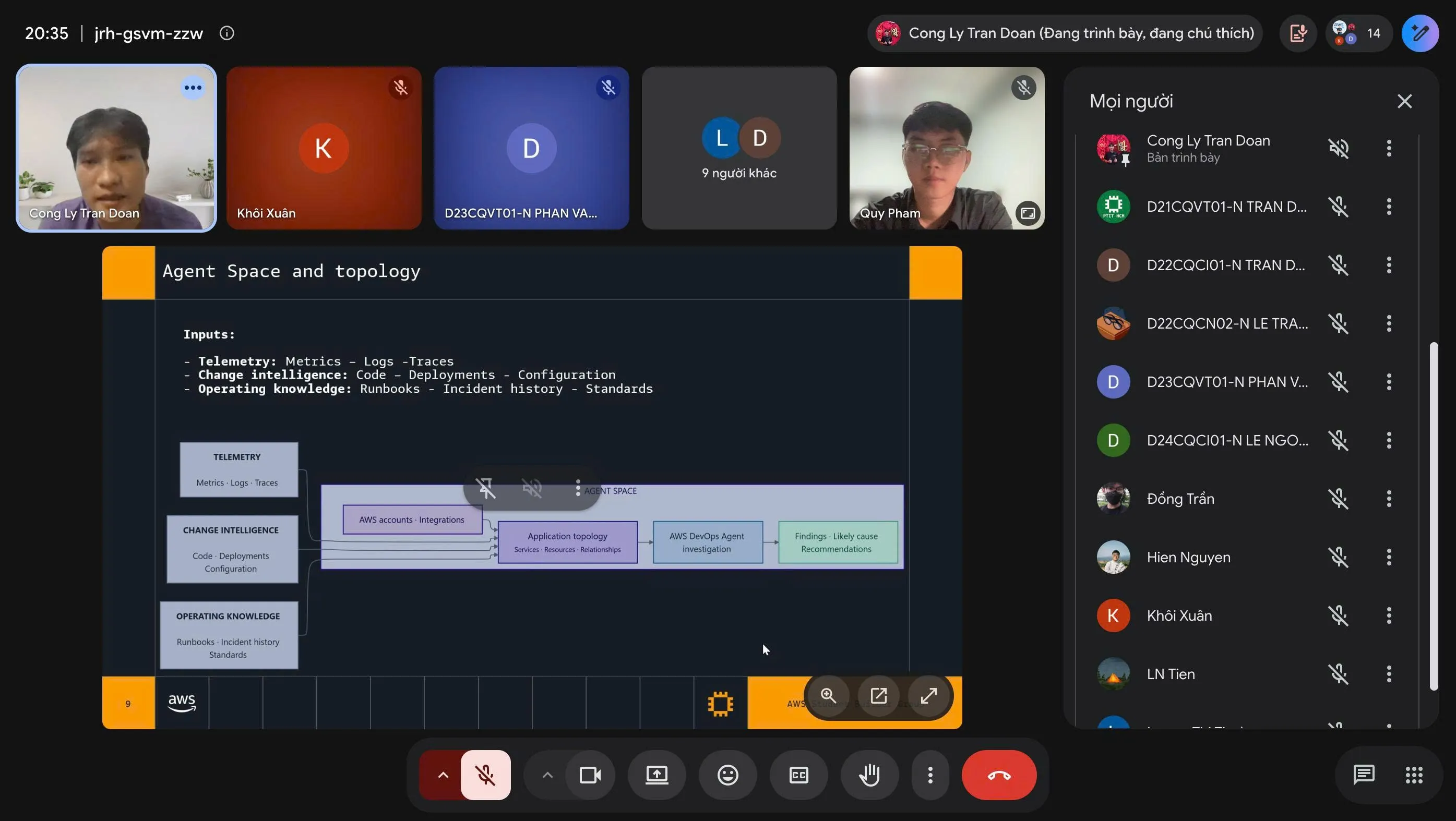
AWS Student Builder Groups at Posts and Telecommunications Institute of Technology hosted a hands-on session exploring how agentic AI can support incident investigation, data analysis, and business decisions with AWS DevOps Agent and Amazon Quick.

Modern technology teams work with two very different kinds of signals.
DevOps teams need to understand alerts, logs, deployments, dependencies, and production incidents. Business teams need to turn datasets into insights and decide what to do next. In both situations, the challenge is similar: there is plenty of information, but finding the right answer still takes time.
On October 5, 2026, AWS Student Builder Groups at Posts and Telecommunications Institute of Technology hosted AI for DevOps & Data, a learning session focused on two AWS services:
- AWS DevOps Agent for incident investigation and operational reliability
- Amazon Quick for analytics, research, automation, and data-driven action
The goal was not only to introduce new AI capabilities, but also to show how students can begin with a clear problem, use AI to explore the available context, and keep human judgment at the center of the decision.
AWS DevOps Agent: understanding incidents with context
When a production incident occurs, engineers often need to examine monitoring data, recent deployments, application dependencies, and previous incidents at the same time.
AWS DevOps Agent acts as an operational teammate that can help investigate incidents, identify possible root causes, recommend mitigation steps, and highlight patterns that may help prevent similar issues.
During the session, we discussed how an AI agent can support the incident-response process:
- Collect evidence from observability and deployment systems.
- Correlate changes with the affected services.
- Build an investigation timeline.
- Suggest likely causes and mitigation steps.
- Help engineers document what happened and reduce repeated incidents.
The important lesson was that AI does not remove the need for engineering knowledge or operational ownership. Engineers still need to validate the evidence, assess the risk of each recommendation, and approve production changes.
The value of an agent comes from reducing the time spent searching across disconnected tools and helping the team build a clearer understanding of the incident.
Amazon Quick: moving from data to insight
The second part of the event focused on Amazon Quick , an AI-powered workspace that combines analytics, research, automation, and application building.
Amazon Quick includes capabilities such as Quick Sight for data visualization, Quick Research for cited research, Quick Flows for routine automation, Quick Automate for longer business processes, and Apps in Quick for building internal applications through natural-language descriptions.
For the hands-on activity, we used a synthetic dataset containing 200 Campus Café sales records. The data included:
- Product and category
- Quantity and unit price
- Revenue, cost, and profit
- Transaction time
- Sales channel
Instead of beginning with a list of charts, the lab started with business questions:
- Which product generated the highest revenue?
- Which hour generated the highest revenue?
- Which sales channel generated the highest profit?
- Which product should the café consider for a promotion?
Students could describe the visual they wanted in natural language. For example:
Show total Revenue by Product as a horizontal bar chart, sorted from highest to lowest.
This converted a business question into a visual analysis without requiring every user to begin by writing SQL.
What we discovered from the Campus Café data
The dataset produced several useful findings:
- Matcha Latte generated the highest revenue at approximately 3.84 million VND.
- Milk Tea generated slightly more total profit than Matcha Latte.
- The highest-revenue hour was 08:00.
- The highest-profit hour was 09:00.
- Counter generated the highest total profit among the sales channels.
- Americano had the highest profit margin, despite not having the highest revenue.
These results created an important discussion: the product with the highest revenue is not always the product with the highest profit.
A promotion decision should therefore consider more than sales volume. The café may also need to examine profit margin, channel behavior, available inventory, customer demand, and operational capacity.
This is where analytics becomes valuable. A dashboard should not be the final objective. It should help someone make a better decision.
One event, one shared AI pattern
AWS DevOps Agent and Amazon Quick operate in different domains, but the learning pattern is similar.
For DevOps, the process begins with an operational question:
What changed, what failed, and what should we do next?
For data analytics, it begins with a business question:
What is happening in the data, why does it matter, and what action should we consider?
In both cases, useful AI needs reliable context. For AWS DevOps Agent, that context may include telemetry, deployments, dependencies, and previous incidents. For Amazon Quick, it includes datasets, business definitions, documents, and connected applications.
The quality of the result still depends on the quality of that context.
Key takeaways
The event ended with four main lessons:
- Start with a clearly defined problem instead of starting with a tool.
- Give AI reliable data and relevant operational context.
- Validate AI-generated findings before taking action.
- Use insights to support decisions, not to replace human responsibility.
For students, these services provide an opportunity to explore how agentic AI is changing both software operations and business analytics.
The next step is simple: choose a small dataset or a well-defined operational scenario, ask a specific question, inspect the evidence, and continue refining the result.
Thank you to everyone who joined AI for DevOps & Data and contributed questions, ideas, and discussions throughout the session.
Keep building, keep experimenting, and keep asking better questions.
Enjoyed reading this content? Let the author know!
Your likes, comments, shares, and saves help creators reach more builders.

Loading recommendations
Loading article