
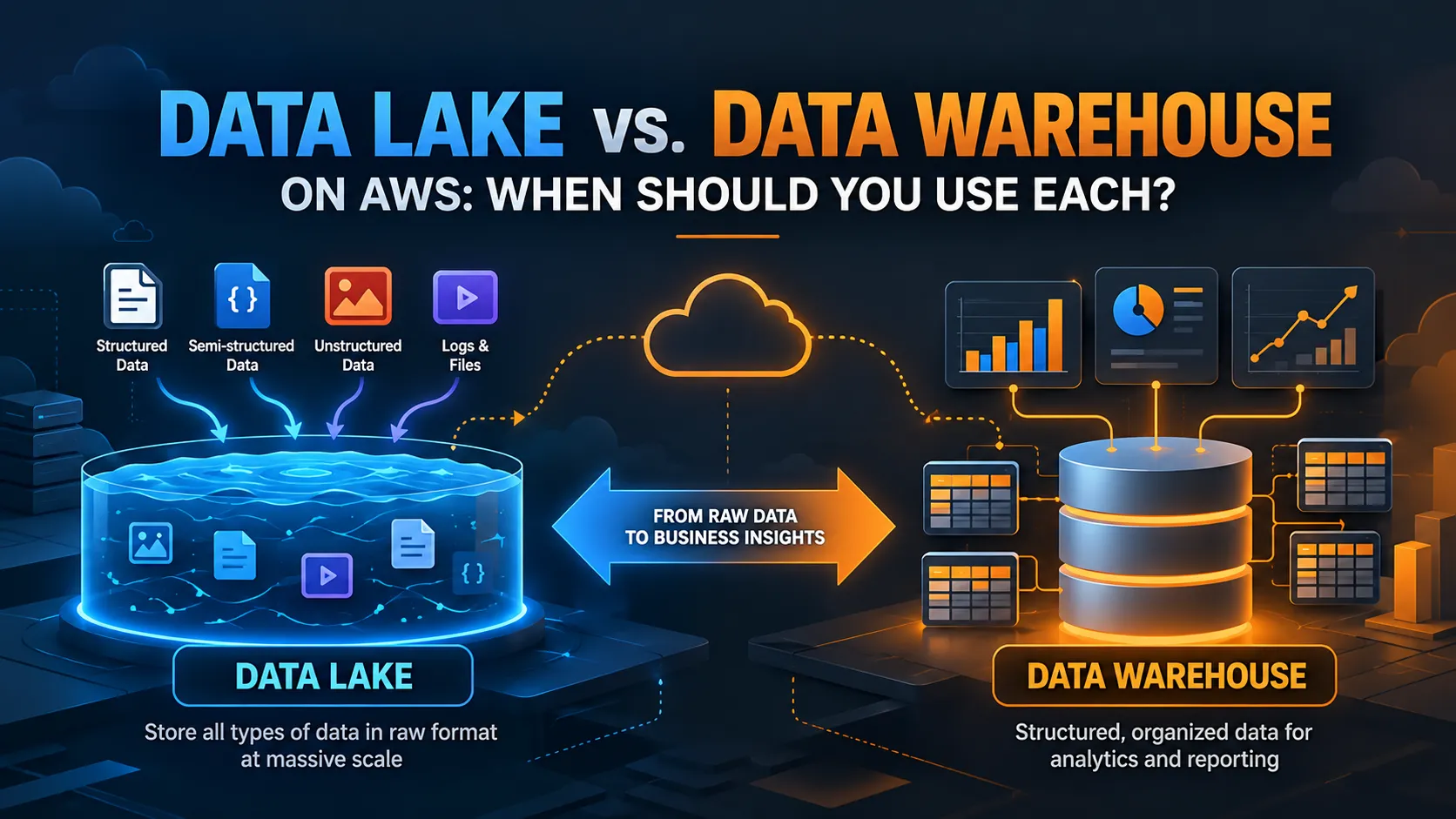
Data Lake vs. Data Warehouse on AWS: When Should You Use Each?
Data lakes and data warehouses solve different data analytics problems. This guide explains the key differences between Amazon S3-based data lakes and AWS data warehouses, their use cases, architecture, cost considerations, and how to choose the right approach for your analytics needs.

Data Lake vs. Data Warehouse on AWS: When Should You Use Each?
Modern businesses generate massive amounts of data from applications, websites, transactions, IoT devices, customer interactions, and business systems. Turning this data into useful insights requires the right data architecture.
Two commonly used approaches are data lakes and data warehouses. While both are designed to store and analyze data, they serve different purposes.
On AWS, organizations can build flexible data lakes using services such as Amazon S3, AWS Glue, and Amazon Athena, while Amazon Redshift provides a powerful data warehouse platform for structured analytics.
So, which one should you use?
The answer depends on your data, workload, scalability requirements, and business goals.
What Is a Data Lake?
A data lake is a centralized repository that can store large amounts of data in its original or raw format.
Unlike traditional databases, a data lake can store:
- Structured data such as relational tables
- Semi-structured data such as JSON and XML
- Unstructured data such as documents, images, and logs
On AWS, Amazon S3 is commonly used as the foundation for a data lake because it provides highly scalable object storage.
A typical AWS data lake architecture can include:
Data Sources → Amazon S3 → AWS Glue → Amazon Athena → BI/Analytics
AWS Glue can help discover and transform data, while Amazon Athena can query data directly in Amazon S3 using SQL.
What Is a Data Warehouse?
A data warehouse is designed primarily for structured, organized, and analytics-ready data.
It is commonly used for:
- Business intelligence
- Reporting
- Dashboards
- Historical analysis
- KPI monitoring
- Aggregated business reporting
On AWS, Amazon Redshift is a fully managed cloud data warehouse designed to analyze large datasets using SQL.
A simplified architecture can look like:
Business Applications → ETL/ELT → Amazon Redshift → BI Dashboards
Data is generally transformed and structured before being used for analytical queries.
Data Lake vs. Data Warehouse
The biggest difference is how each system handles data.
| Feature | Data Lake | Data Warehouse |
|---|---|---|
| Data type | Structured, semi-structured, unstructured | Primarily structured |
| Data format | Raw or processed | Processed and structured |
| Schema | Schema-on-read | Schema-on-write |
| Flexibility | Very high | More controlled |
| Main purpose | Exploration, data science, large-scale analytics | BI, reporting, business analytics |
| AWS example | Amazon S3 | Amazon Redshift |
| Typical users | Data scientists, engineers, analysts | BI analysts, business users, analysts |
When Should You Use a Data Lake?
A data lake is a strong choice when your organization needs to store large volumes of different types of data.
For example, imagine an e-commerce company collecting:
- Customer transactions
- Website clickstream data
- Product images
- Application logs
- Customer reviews
- Marketing campaign data
Storing all of this information in a traditional warehouse may require significant preprocessing.
A data lake allows the organization to collect and store the data first and decide how to process or analyze it later.
Data lakes are particularly useful for:
- Data science and machine learning
- Large-scale data exploration
- Log and event analysis
- IoT data
- Clickstream analytics
- Long-term data storage
- Building modern analytics platforms
When Should You Use a Data Warehouse?
A data warehouse is a better fit when your primary goal is structured business reporting and analytics.
Consider a company that wants dashboards showing:
- Monthly revenue
- Sales by region
- Customer acquisition
- Product performance
- Profit margins
- Year-over-year growth
These datasets are usually structured and have clearly defined business metrics.
A data warehouse such as Amazon Redshift can provide an optimized environment for these analytical workloads.
Can You Use Both?
Yes.
In many modern architectures, organizations don't have to choose only one.
A common approach is to use a data lake and data warehouse together.
For example:
Data Sources → Amazon S3 Data Lake → AWS Glue → Amazon Redshift → QuickSight
The data lake can act as a scalable repository for raw and diverse data, while the warehouse can provide curated datasets for business intelligence.
This approach allows organizations to keep the flexibility of a data lake while providing business users with structured analytical data.
Example: E-Commerce Analytics
Consider an online retailer.
The company collects:
- Website events
- Customer orders
- Product information
- Payment records
- Customer reviews
- Marketing data
The company could store raw data in Amazon S3.
AWS Glue could then discover and transform the data.
Amazon Athena could be used for ad-hoc SQL analysis directly against the data lake.
Curated business data could then be loaded into Amazon Redshift for high-performance reporting.
Finally, a BI tool such as Amazon QuickSight could visualize the results.
This creates an analytics flow from raw data to business decisions.
Key Decision Factors
When deciding between a data lake and data warehouse, consider these questions:
1. What type of data do you have?
If you have many different data formats, a data lake provides greater flexibility.
If your data is already structured and organized, a warehouse may be more appropriate.
2. Who will use the data?
Data scientists and engineers may benefit from the flexibility of a data lake.
Business analysts and reporting teams may benefit more from curated warehouse datasets.
3. What type of analysis do you need?
For experimentation, exploration, machine learning, and large-scale raw data processing, consider a data lake.
For dashboards, KPIs, reporting, and recurring business analysis, consider a data warehouse.
4. Do you need both?
For many organizations, the answer is yes.
A lakehouse or integrated architecture can combine flexible storage with structured analytical workloads.
Final Thoughts
A data lake and a data warehouse are not necessarily competing technologies. They are tools designed to solve different problems.
Choose a data lake when flexibility, scale, and diverse data are important.
Choose a data warehouse when structured data, reporting, and business intelligence are the priority.
For many organizations, combining both approaches can provide the best of both worlds.
The most important decision is not simply choosing between a data lake and a data warehouse. It is designing an architecture that matches your organization's data, users, workloads, cost requirements, and business objectives.
With AWS services such as Amazon S3, AWS Glue, Amazon Athena, Amazon Redshift, and Amazon QuickSight, organizations can build scalable analytics platforms that transform raw data into meaningful business insights.
Enjoyed reading this content? Let the author know!
Your likes, comments, shares, and saves help creators reach more builders.

Loading recommendations
Loading article