
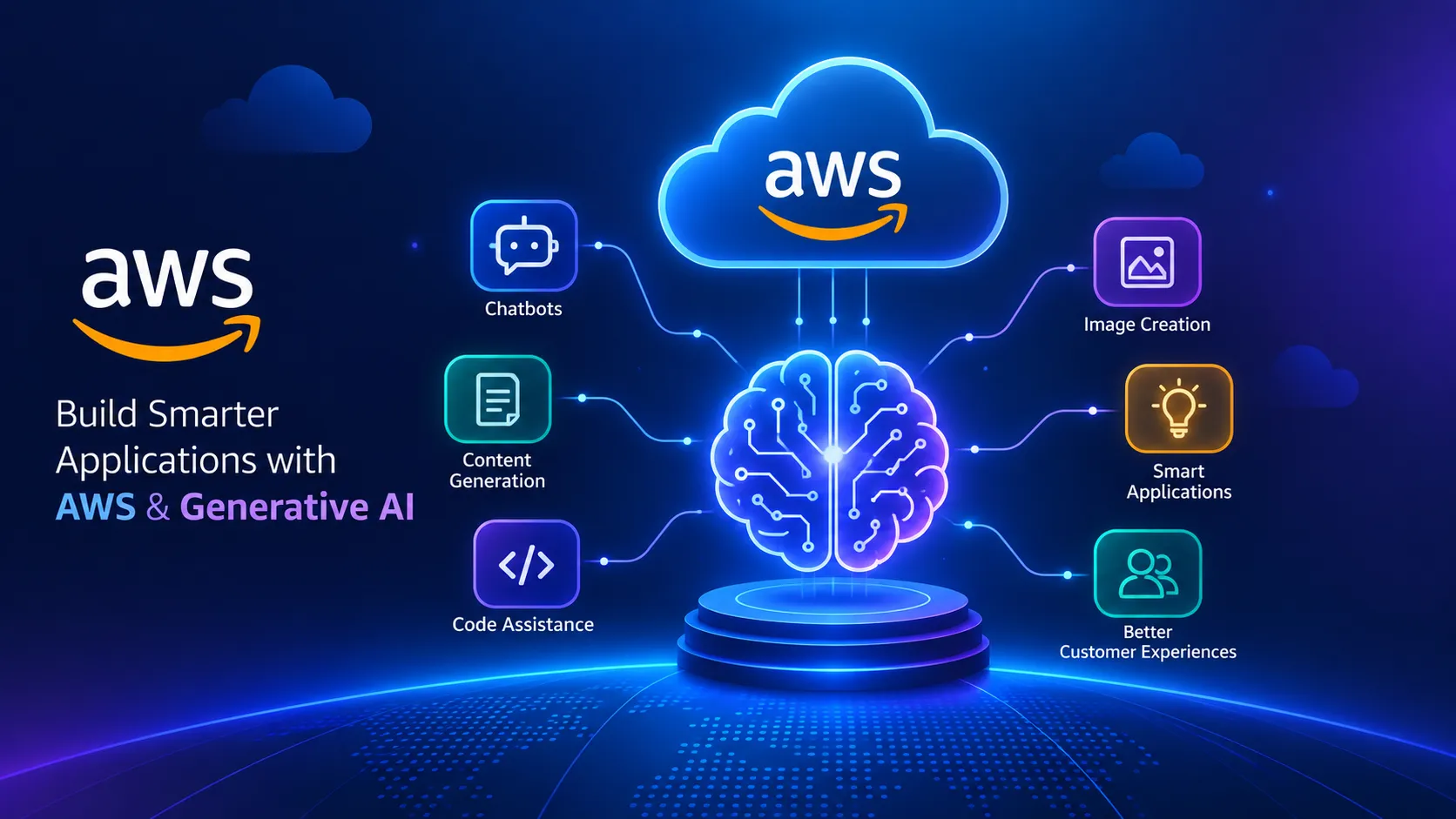
Building Smarter Applications with AWS and Generative AI
Learn how AWS and Generative AI can work together to build intelligent, scalable, and user-friendly applications. This article explains the key concepts, AWS services, and practical use cases in simple terms.

Building Smarter Applications with AWS and Generative AI
Introduction
Artificial Intelligence is changing the way applications are designed and developed. From chatbots and recommendation systems to content generation and intelligent assistants, AI is becoming an important part of modern applications.
Amazon Web Services (AWS) provides a wide range of cloud services that help developers build, deploy, and scale AI-powered applications without managing complex infrastructure.
When AWS cloud capabilities are combined with Generative AI, developers can create smarter and more useful applications efficiently.
What is Generative AI?
Generative AI is a type of artificial intelligence that can create new content based on the input provided by a user.
It can generate:
- Text
- Images
- Code
- Summaries
- Answers to questions
- Creative content
For example, a user can ask an AI application to summarize a long document, and the application can generate a short and meaningful summary.
Why Use AWS for Generative AI?
AWS provides cloud infrastructure and AI services that make it easier to develop intelligent applications.
Some important benefits include:
1. Scalability
AWS allows applications to handle increasing numbers of users and requests without requiring developers to maintain physical servers.
2. Flexibility
Developers can choose different AWS services based on their application requirements.
3. Security
AWS provides security features such as identity management, encryption, and access control to help protect applications and data.
4. Cost Efficiency
Cloud-based applications can use resources when required, helping organizations avoid the cost of maintaining large physical infrastructures.
Amazon Bedrock
Amazon Bedrock is an AWS service that provides access to foundation models for building Generative AI applications.
Developers can use foundation models through APIs instead of building and training a large AI model completely from scratch.
A simple workflow can be:
User → Application → Amazon Bedrock → Foundation Model → Generated Response → User
This makes it easier to integrate Generative AI capabilities into applications.
Example: AI-Powered Study Assistant
Consider a simple AI study assistant for students.
A student could enter:
"Explain cloud computing in simple words."
The application sends the request to an AI model and receives an easy-to-understand explanation.
The application could also provide features such as:
- Question answering
- Summarization
- Notes generation
- Quiz creation
- Study recommendations
AWS services can provide the infrastructure needed to build and deploy such an application.
Other Useful AWS Services
Different AWS services can be combined to create a complete AI application.
| AWS Service | Possible Use |
|---|---|
| Amazon Bedrock | Generative AI and foundation models |
| AWS Lambda | Run application code without managing servers |
| Amazon S3 | Store files and documents |
| Amazon DynamoDB | Store application data |
| Amazon API Gateway | Create and manage APIs |
| Amazon CloudWatch | Monitor applications |
Simple Architecture
A basic AI application can follow this architecture:
1
2
3
4
5
6
7
8
9
10
11
12
13
14
15
16
17
18
19
20
21
22
              USER
                |
                ↓
        Web / Mobile App
                |
                ↓
        Amazon API Gateway
                |
                ↓
           AWS Lambda
                |
                ↓
        Amazon Bedrock
                |
                ↓
       Foundation Model
                |
                ↓
          AI Response
                |
                ↓
              USER
This architecture separates different parts of the application and allows developers to scale individual components when necessary.
Real-World Applications
AWS and Generative AI can be used in many areas.
Education
AI can help students generate summaries, practice questions, and explanations.
Healthcare
AI applications can assist with information processing and document summarization while following appropriate security and privacy requirements.
Business
Organizations can use AI assistants to analyze information, summarize documents, and improve customer support.
Software Development
Generative AI can assist developers with code explanations, documentation, and development tasks.
Customer Support
AI-powered assistants can answer frequently asked questions and provide support at any time.
Best Practices
When building Generative AI applications, developers should consider:
- Protect user data
- Use proper authentication and authorization
- Monitor application performance
- Validate AI-generated responses
- Control access to cloud resources
- Optimize cloud costs
- Design for scalability
AI-generated information should also be reviewed when accuracy is important because AI models can sometimes produce incorrect or incomplete information.
Conclusion
AWS provides powerful cloud services that make it easier to build modern AI applications. With services such as Amazon Bedrock, Lambda, S3, API Gateway, and DynamoDB, developers can create scalable and intelligent solutions without managing complex infrastructure themselves.
The combination of AWS + Generative AI opens many opportunities for students, developers, startups, and organizations to build innovative applications.
For beginners, the best way to learn is to start with a small project, understand the basic AWS services, and gradually add AI capabilities.
Cloud computing and Generative AI are becoming important technologies for the future of software development.
Enjoyed reading this content? Let the author know!
Your likes, comments, shares, and saves help creators reach more builders.

Loading recommendations
Loading article