
The Architecture That Wasn’t There: Building Zero-Code Event Pipelines with AWS Glue DataBrew & EventBridge
A practical architectural guide to building zero-code serverless event pipelines using native AWS orchestration and data-cleaning services—reducing code clutter and operational drag.

The best lines of code are the ones you never write.
When designing high-throughput data pipelines, our default instinct as engineers is almost always the same: throw a Lambda function at it. Need to parse an incoming payload? Lambda. Need to clean an S3 upload before dumping it into Aurora? Lambda. Need to format JSON for an analytics dashboard? Lambda.
Before you know it, you’re maintaining dozens of custom runtime scripts, battling cold starts, managing IAM policies across isolated execution roles, and paying for compute time spent on repetitive data preparation.
What if your pipeline didn't require custom compute code at all?
The "Code-Free" Pipeline Pattern
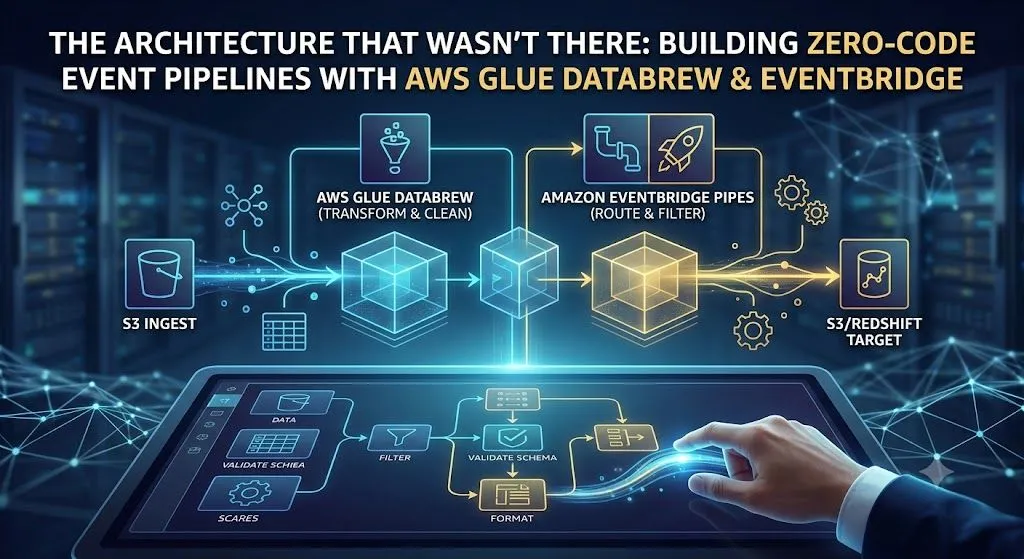
Instead of stringing together serverless functions to orchestrate and transform incoming files, we can leverage built-in cloud orchestration and native data-cleaning services.
Here is the flow:
- Amazon S3 (Event Trigger): A raw CSV or JSON landing file triggers an Amazon S3 Event Notification.
- Amazon EventBridge Pipes: Intercepts the event instantly. Using built-in filtering, it discards malformed file triggers or irrelevant prefixes before any downstream processing begins.
- AWS Glue DataBrew Job: EventBridge triggers a pre-configured DataBrew recipe. DataBrew handles schema validation, missing-value imputation, deduplication, and formatting natively at scale.
- Target S3 / Redshift / DynamoDB: Cleaned, structured data is written directly to the target storage destination.
Why This Pattern Changes the Game
- Zero Custom Runtime Maintenance: No runtime upgrades (e.g., Python or Node version deprecations), no third-party package dependency security alerts, and no custom error-handling wrappers.
- Cost Predictability: You pay purely for the data transformed via DataBrew and the EventBridge routing, avoiding runaway Lambda invocation costs during unexpected traffic spikes.
- Audit-Ready Data Lineage: Because DataBrew uses explicit visual recipes rather than scattered custom code scripts, non-technical stakeholders and audit teams can inspect data transformations visually without diving into raw code repositories.
Key Learnings & Edge Cases
While this pattern excels at structured ingestion, keep these nuances in mind:
- Startup Overhead: Glue DataBrew jobs have a slight initialization delay compared to warm Lambda functions, making this pattern ideal for mini-batch or bulk file uploads rather than sub-second real-time streaming.
- Recipe Granularity: For highly complex, dynamic nested JSON transformations, a hybrid approach (using AWS Glue ETL or Step Functions) may still be necessary.
Over to You
Are you shifting toward zero-code/low-code cloud patterns in your stack, or do you still prefer the granular control of custom Lambda functions for data pipelines? Let’s discuss in the comments!
Enjoyed reading this content? Let the author know!
Your likes, comments, shares, and saves help creators reach more builders.

Loading recommendations
Loading article