
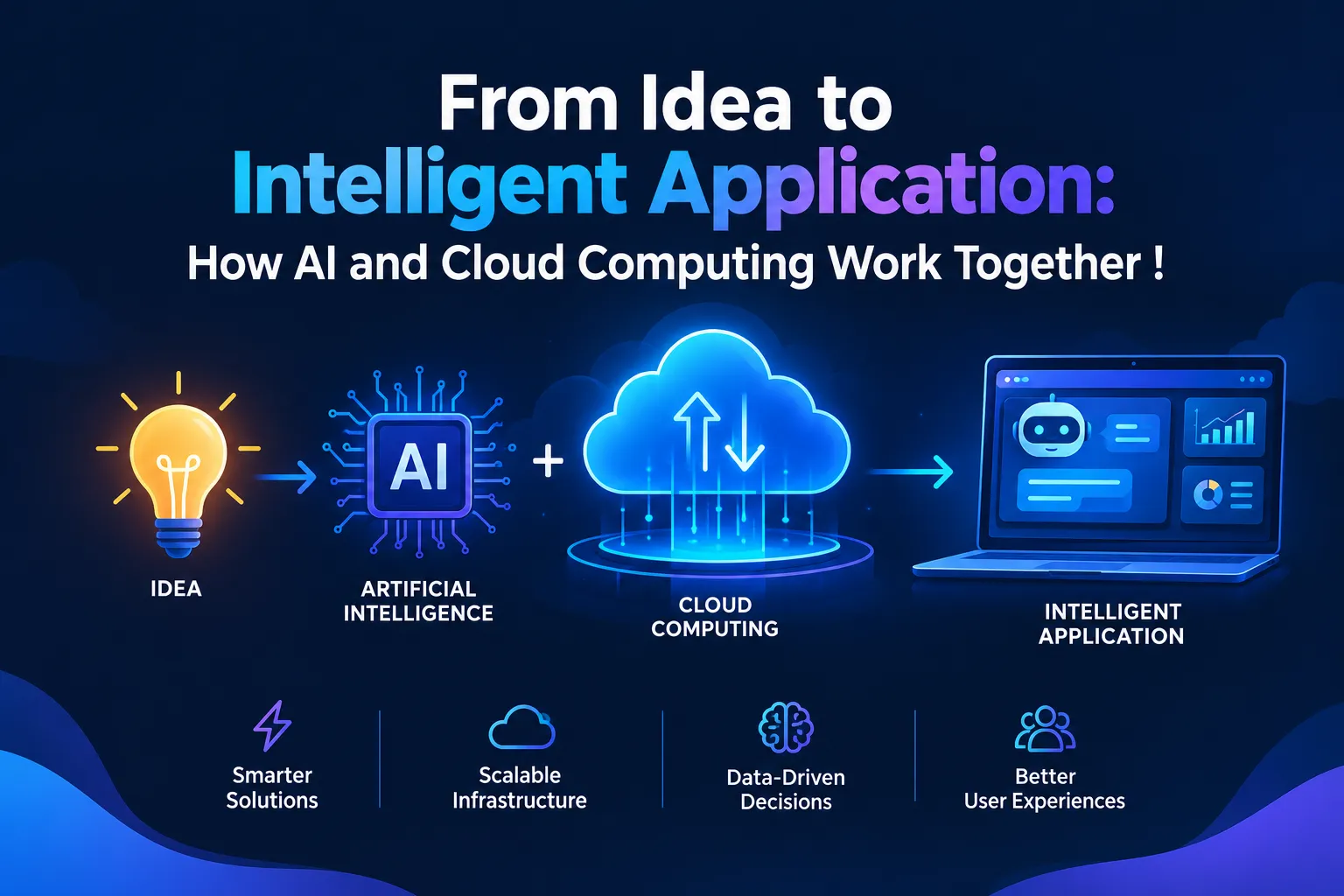
From Idea to Intelligent Application: How AI and AWS Cloud Work Together
Explore how AI and AWS cloud technologies come together to transform ideas into scalable, secure, and intelligent applications. This article covers cloud architecture, AI integration, storage, compute, security, scalability, and the key lessons I’m learning as a student and aspiring cloud developer.

From Idea to Intelligent Application: How AI and Cloud Computing Work Together !
Artificial Intelligence can make an application intelligent, but intelligence alone is not enough to build a real-world product.
An AI application also needs a place to run, a way to store data, secure access, monitoring, and the ability to handle increasing users.
That is where cloud computing becomes an important part of the AI journey.
As a Computer Science Engineering student, I have been exploring how AI and cloud technologies can work together to turn an idea into a usable application.
💡 An Idea Is Only the Beginning
Many projects start with a simple idea:
“What if an application could understand a user's problem and automatically suggest a solution?”
Building the AI model is only one part of the problem.
A practical application might need to:
- Receive requests from users
- Process and analyze information
- Store application data
- Call AI services or models
- Manage authentication and permissions
- Monitor application performance
- Scale when the number of users increases
This made me realize that AI and cloud computing are not separate worlds. They complement each other.

☁️ Where AWS Fits In
AWS provides a large ecosystem of cloud services that can support different components of an AI-powered application.
For example, an application architecture could conceptually look like:
User → Application → API → AI/Processing Layer → Database/Storage
Different AWS services can be selected depending on the requirements of each layer.
For example:
Amazon S3 can provide scalable object storage.
AWS Lambda can run application logic without requiring a continuously running server.
Amazon EC2 can provide flexible compute capacity when more control over the environment is required.
Amazon DynamoDB can provide a scalable NoSQL database for applications that need fast access to data.
And AWS AI/ML services can help developers add intelligence to applications without having to build every AI capability from scratch.
🧠 The Interesting Part: Architecture
One of the most interesting things I have learned is that building a cloud application is not simply about choosing the maximum number of services.
It is about asking the right questions:
Do I need a server?
How much traffic will the application receive?
Where should the data be stored?
Who should be allowed to access it?
What happens if one component fails?
How can I control the cost?
These questions change the way I think about software development.
Instead of thinking only about writing code, I am beginning to think about the entire system.

🔐 Security Should Come First
An intelligent application also needs to be a secure application.
Cloud security should not be something added at the end of development.
Access control, permissions, authentication, encryption, and monitoring should be considered from the beginning.
AWS IAM, for example, provides a way to control who can access AWS resources and what actions they can perform.
This introduced me to an important principle:
Give users and applications only the permissions they actually need.
Small security decisions can make a significant difference when an application grows.
📈 What Happens When the Application Grows?
Imagine a student project initially has only 10 users.
Everything works perfectly.
Then it gets shared online and suddenly receives 10,000 users.
A system designed only for the original 10 users may struggle.
Cloud architecture allows developers to think about scalability from the beginning.
Instead of purchasing and maintaining physical infrastructure for the maximum possible load, cloud resources can be designed around the application's requirements.
This is one of the reasons I find cloud computing so interesting.
🤖 AI + Cloud = More Than a Trend
AI is rapidly becoming part of software applications, but successful AI products require more than an AI model.
They need:
AI + Data + Compute + Storage + Security + APIs + Monitoring + Scalability
Cloud platforms bring many of these building blocks together.
For students and beginners, this creates an exciting opportunity: we can learn software development, cloud computing, and AI together instead of treating them as completely separate skills.

🚀 My Next Step
My goal is to continue building small projects and gradually make them more production-oriented.
Instead of asking only:
“Can I make this application work?”
I want to start asking:
“Can I make this application secure, scalable, observable, and cost-efficient?”
That change in mindset is what I believe separates a simple project from a real-world system.
Final Thoughts
My AWS journey is still in its early stages, but one lesson is already clear:
Cloud computing is not just about deploying an application. It is about learning how to design systems that can grow.
And when cloud computing is combined with AI, even a simple idea can become the foundation for something much more powerful.
I am excited to keep learning, keep building, and keep sharing what I discover along the way.
Build small. Learn continuously. Think big. ☁️🤖
Enjoyed reading this content? Let the author know!
Your likes, comments, shares, and saves help creators reach more builders.

Loading recommendations
Loading article