
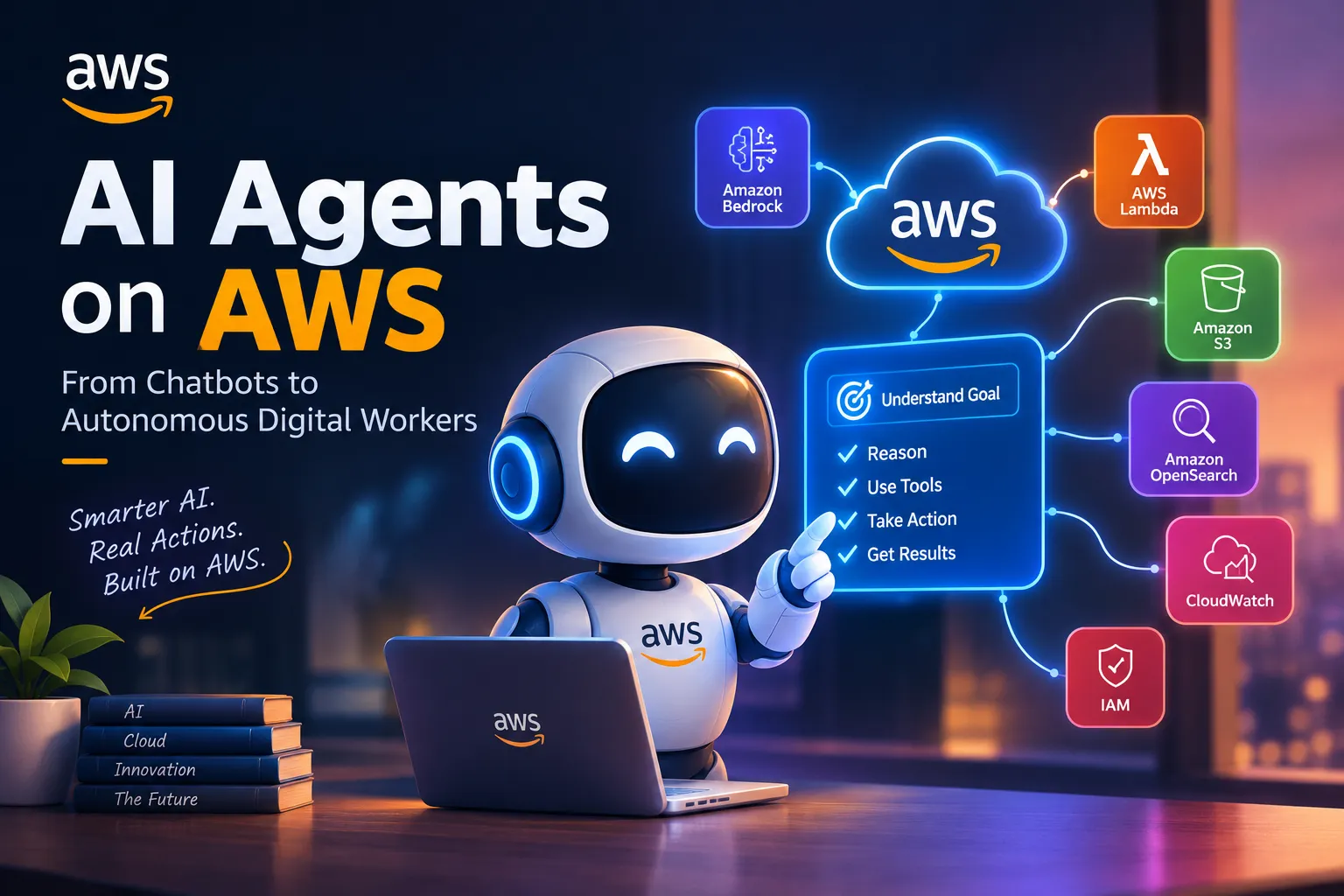
AI Agents on AWS: From Chatbots to Autonomous Digital Workers
AI is no longer limited to answering questions. The next evolution is AI agents—systems that can understand a goal, make decisions, use tools, interact with applications, and complete tasks with minimal human intervention. With AWS services such as Amazon Bedrock, AWS Lambda, Amazon S3, Amazon API Gateway, Amazon OpenSearch Service, and Amazon CloudWatch, developers can build intelligent applications that don't just generate responses—they can actually take action.

🤖 From Chatbots to AI Agents
Traditional chatbots usually follow a simple pattern:
User → Question → AI → Answer
AI agents introduce another layer:
User → Goal → AI Agent → Reason → Use Tools → Take Action → Result
For example, instead of asking an AI:
"What is the status of my order?"
an AI agent could potentially:
- Identify the customer's order.
- Retrieve information from a database.
- Check the shipping system.
- Analyze the latest delivery status.
- Decide whether an action is required.
- Notify the customer automatically.
The AI is no longer simply generating text. It is working toward a goal.
☁️ Why AWS Is Important for AI Agents
Building an AI agent requires much more than an AI model.
An agent may need:
- A foundation model for reasoning and generation
- APIs and tools to interact with applications
- Databases and storage
- Authentication and permissions
- Monitoring and logging
- Scalable compute infrastructure
This is where AWS becomes interesting.
🧠 Amazon Bedrock — The Intelligence Layer
Amazon Bedrock provides access to foundation models and capabilities for building generative AI applications.
An AI agent can use a foundation model to understand a user's request, determine what needs to be done, and decide which tools or actions are required.
This creates a powerful architecture:
User → Bedrock → Agent → Tools/APIs → AWS Services → Response
⚡ AWS Lambda — Let the Agent Take Action
An AI agent becomes much more useful when it can actually perform actions.
AWS Lambda can execute backend functions without requiring developers to manage servers.
For example, an agent could trigger a Lambda function to:
- Generate a report
- Process a document
- Retrieve customer information
- Send a notification
- Update application data
- Start an automated workflow
This creates a bridge between AI reasoning and real-world actions.
🗄️ Amazon S3 — Giving AI Access to Information
AI agents often need access to organizational data.
Amazon S3 can store:
- Documents
- Reports
- PDFs
- Images
- Logs
- Knowledge bases
- Application data
An agent can be designed to retrieve relevant information from stored data and use it when generating a response.
This makes AI applications much more useful than systems that rely only on the model's training data.
🔎 Amazon OpenSearch — Finding the Right Information
Imagine an AI agent working for a company with thousands of documents.
The agent shouldn't need to read everything.
Search and retrieval systems can help identify the most relevant information before the model generates an answer.
This can support architectures based on Retrieval-Augmented Generation (RAG), where an AI system retrieves relevant information and then uses it to produce a grounded response.
🔐 IAM — The Most Important Part People Forget
Giving an AI agent the ability to perform actions also introduces an important question:
What should the AI be allowed to do?
An agent that can access everything could become a serious security risk.
AWS Identity and Access Management (IAM) can help control permissions and restrict what AWS resources an application can access.
The principle should be simple:
Give the agent only the permissions it actually needs.
AI autonomy without proper security can quickly become AI chaos.
📊 CloudWatch — Don't Let Your Agent Become a Black Box
When an AI application starts making decisions and triggering actions automatically, monitoring becomes extremely important.
Amazon CloudWatch can help developers monitor applications, collect logs, and identify problems.
For production AI agents, developers should be able to understand:
- What happened?
- Which tool was called?
- Did the action succeed?
- How long did it take?
- Did something fail?
- How much did the operation cost?
The future of AI isn't just about making agents smarter.
It is also about making them observable and controllable.
🌍 Where Could AI Agents Be Used?
The possibilities are huge.
🏥 Healthcare
Agents could help organize information, summarize documents, and automate administrative workflows.
💳 Banking
Agents could assist with customer requests, fraud investigation workflows, and financial operations.
🛒 E-commerce
An agent could understand a customer's problem and potentially check orders, inventory, shipping information, and returns.
💻 Software Development
AI agents could analyze issues, inspect code, suggest fixes, run tests, and create development workflows.
🎓 Education
Agents could act as personalized learning assistants that adapt to a student's progress.
🏢 Enterprise
Agents could automate repetitive tasks across multiple internal systems.
⚠️ But Should We Give AI This Much Control?
This is where things become interesting.
If an AI agent can make decisions and execute actions, several questions arise:
Who is responsible if it makes a mistake?
How much autonomy should an AI have?
Should every important action require human approval?
How do we prevent an agent from accessing information it shouldn't see?
These aren't just technical questions anymore.
They are questions about security, trust, responsibility, and the future of work.
🚀 The Future: Human + AI, Not Human vs AI
I don't think the future will simply be:
Humans OR AI
Instead, it could become:
Humans + AI Agents + Cloud Infrastructure
Humans define goals and boundaries.
AI agents handle reasoning and repetitive workflows.
Cloud platforms provide the infrastructure, security, scalability, and tools required to execute those workflows.
AWS is already providing many of the building blocks needed to make this architecture possible.
💭 Final Thought
We've spent years teaching computers how to execute instructions.
Then we built AI that could understand language.
Now we're building systems that can potentially understand goals and take actions.
That could be one of the biggest shifts in software development.
The interesting question isn't:
"Will AI replace software developers?"
Maybe the better question is:
"How will software developers build applications when AI itself can become an active part of the application?"
What do you think?
Would you trust an AI agent to perform important tasks without human approval?
Share your thoughts in the comments! 👇
Enjoyed reading this content? Let the author know!
Your likes, comments, shares, and saves help creators reach more builders.

Loading recommendations
Loading article