
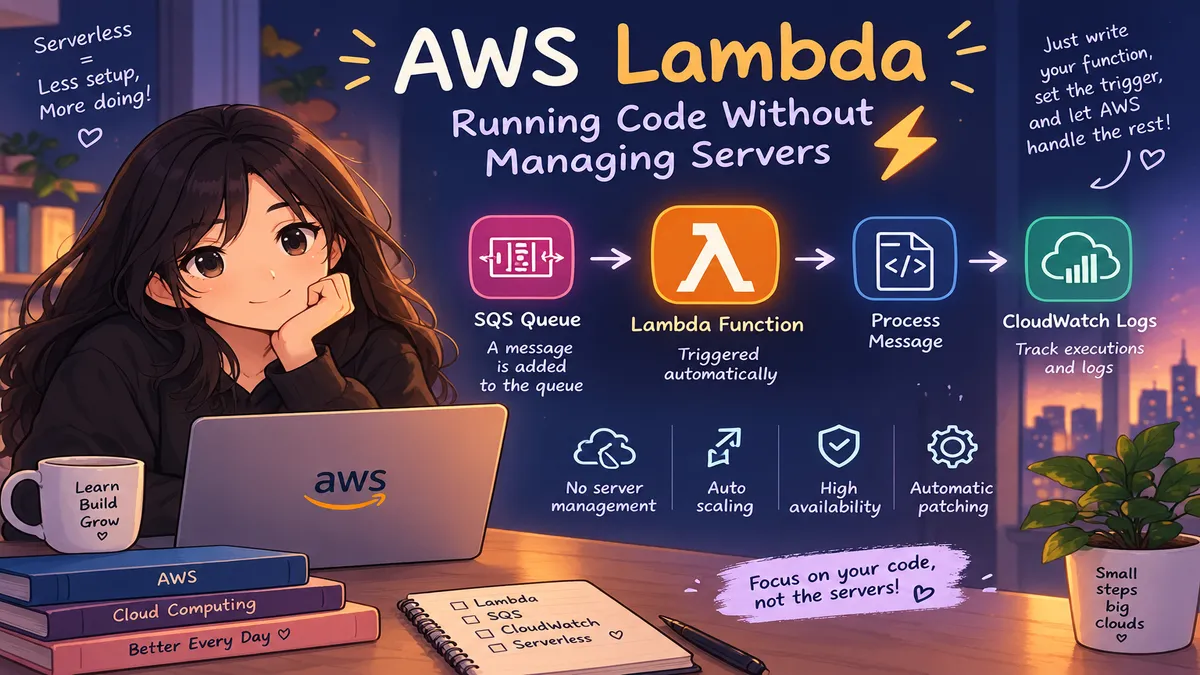
AWS Lambda: Running Code Without Managing Servers ⚡
A beginner-friendly look at AWS Lambda—what serverless really means, how Lambda works with triggers, and how SQS and CloudWatch fit into the picture. ⚡☁️

AWS Lambda: Running Code Without Managing Servers ⚡
While learning AWS compute services, I came across a concept that made serverless computing much easier to understand for me: AWS Lambda.
What is AWS Lambda?
AWS Lambda is a serverless compute service that lets you run code without managing the underlying servers. It is also known as Function as a Service (FaaS).
Instead of provisioning a server and keeping it running, you create a Lambda function and configure what should trigger it.
The basic idea is:
Event → Lambda Function → Code Executes → Action
For example, when a user uploads an image, a Lambda function can automatically run to process that image.
Why is Lambda useful?
With Lambda, AWS takes care of much of the infrastructure management, including:
- Provisioning
- Scaling
- High availability
- Patching and updates
This allows developers to focus more on the application logic instead of managing servers.
Lambda can also automatically scale according to incoming requests, making it useful for event-driven applications.
Lambda + SQS
One example that helped me understand Lambda better was connecting it with Amazon SQS.
The flow is simple:
SQS Queue → Lambda → Process Message → CloudWatch Logs
When a message is added to an SQS queue, it can trigger Lambda. The Lambda function reads and processes the message, while CloudWatch can be used to monitor its execution and logs.
Of course, Lambda functions also need the appropriate IAM permissions to interact with AWS services such as SQS.
One important limitation
Lambda is designed mainly for short-running tasks. A single Lambda function can run for a maximum of 15 minutes.
So, Lambda is a great fit for quick, event-driven workloads, but it isn't the right choice for every type of application.
My takeaway
The biggest thing I learned is that serverless doesn't mean there are no servers. It means I don't have to manage the underlying servers myself.
For me, Lambda can be summarized as:
Write the function. Define the trigger. Let AWS handle the infrastructure. ⚡
#AWS #AWSLambda #Serverless #CloudComputing #AWSCommunity
Enjoyed reading this content? Let the author know!
Your likes, comments, shares, and saves help creators reach more builders.

Loading recommendations
Loading article