
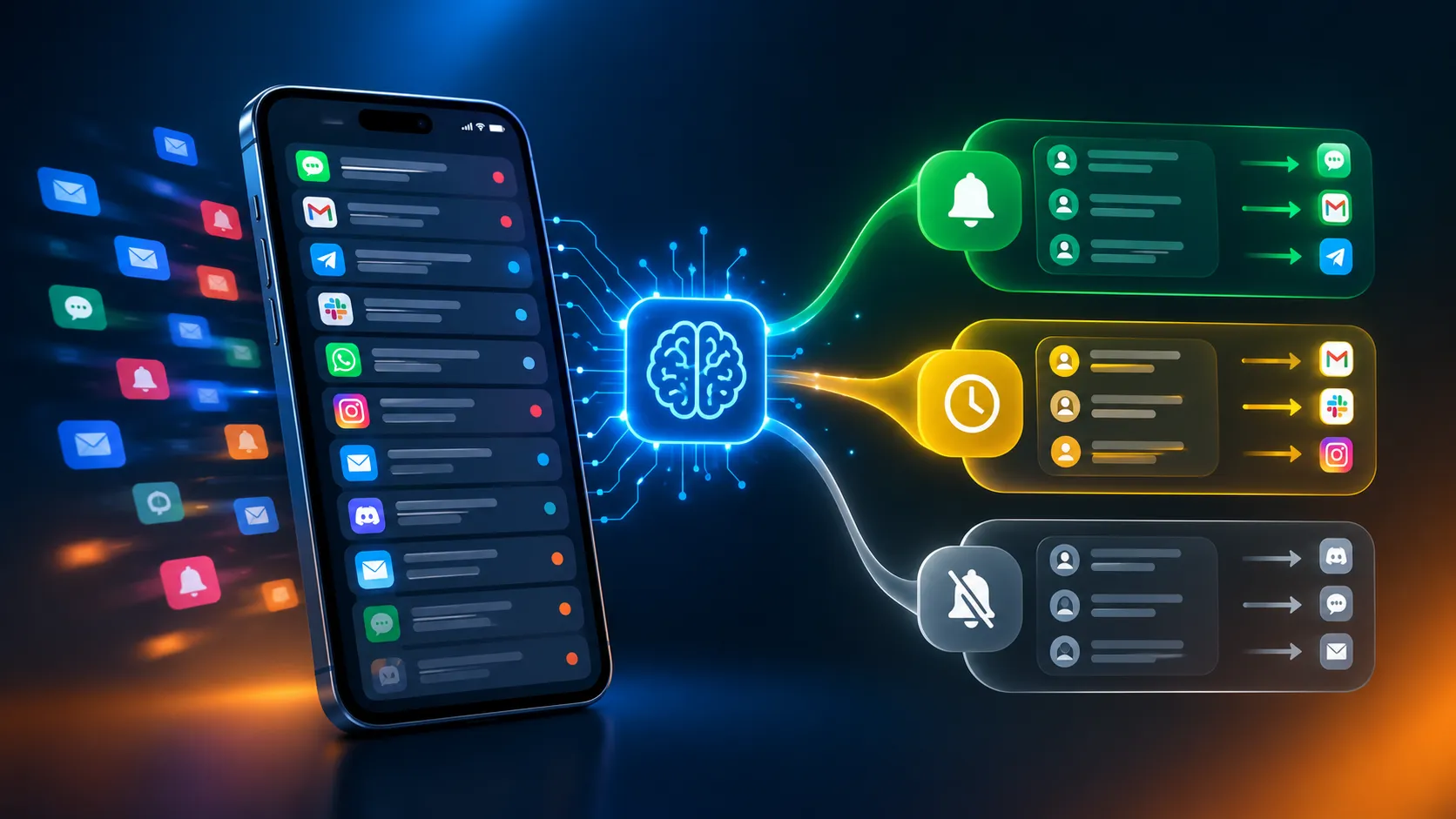
How I Used AI to Stop Notification Overload — A Multimodal Approach
A practical guide to building an intelligent notification router that decides which messages deserve your attention. Learn how I combined text, image, and voice analysis to classify WhatsApp messages into Notify, Digest, or Mute — and how AWS services can power it.

Introduction
Every day, we get hundreds of WhatsApp messages — group chats, promotions, forwards, urgent work pings, family updates. Some matter. Most don't.
But your phone treats them all the same. It buzzes for a 2 AM "Good Morning" forward and for a real emergency. That's not smart. That's noise.
So I built SmartNotify AI — an intelligent notification router that analyzes every incoming message and decides:
- Notify — urgent, important, from trusted senders
- Digest — useful but not urgent, bundle for later
- Mute — spam, scams, forwards, low-value content
And it doesn't just read text. It also looks at images (screenshots, receipts, memes) and voice notes.
Why This Problem Matters
Notification overload is real. Studies show the average person checks their phone 100+ times a day. Most of those checks are triggered by notifications that didn't need to interrupt us.
The cost isn't just time. It's attention, focus, and mental peace.
An intelligent router solves this by making decisions before the notification reaches you.
How SmartNotify AI Works
The system uses a multimodal pipeline:
| Input Type | How It's Analyzed |
|---|---|
| Text | NLP models detect urgency, sentiment, and spam patterns |
| Images | OCR extracts text from screenshots and receipts |
| Voice Notes | Whisper transcribes audio to text for analysis |
| Sender History | Trust score based on past interactions |
| Group Context | Is this a family group, work group, or random forward? |
All signals are combined into a decision engine that outputs:
- A classification (Notify / Digest / Mute)
- A confidence score (0–100%)
- A human-readable reason ("This is a forwarded message from an unknown sender.")
Architecture on AWS
Here is how the system could run on AWS:
| Component | AWS Service | Purpose |
|---|---|---|
| API Layer | AWS Lambda | Handles incoming message analysis requests |
| AI Models | Amazon Bedrock | Text and image analysis using foundation models |
| Speech-to-Text | Amazon Transcribe | Converts voice notes to text |
| Storage | Amazon S3 | Stores message history and metadata |
| Database | Amazon DynamoDB | Stores sender trust scores and user preferences |
| Messaging | Amazon SNS | Sends notifications for high-priority messages |
| Monitoring | Amazon CloudWatch | Tracks model performance and errors |
Sample Code: Classifying a Message with Bedrock
python
1
2
3
4
5
6
7
8
9
10
11
12
13
14
15
16
17
18
19
20
21
import boto3
import json

def classify_message(message_text, sender_trust):
    bedrock = boto3.client('bedrock-runtime')

    prompt = f"""
    Analyze this WhatsApp message and classify it as Notify, Digest, or Mute.

    Message: {message_text}
    Sender Trust Score: {sender_trust}

    Return: classification, confidence, and a one-line reason.
    """

    response = bedrock.invoke_model(
        modelId='anthropic.claude-v2',
        body=json.dumps({"prompt": prompt, "max_tokens": 150})
    )

    return json.loads(response['body'].read())['completion']
What Makes This Different
Most notification managers use simple keyword filters. SmartNotify AI goes further:
- Multimodal — text, image, and voice
- Explainable — every decision has a reason
- Adaptive — learns sender trust over time
- Confidence-based — not binary, uses probability
What I Learned
- Multimodal AI is powerful. Text alone misses context. Images and voice notes carry real signals.
- Explainability matters. A classification without a reason feels like black magic. A reason builds trust.
- AWS makes it scalable. Lambda + Bedrock + S3 = a full AI pipeline without managing servers.
- Start small. I began with text-only classification. Images and voice came later.
Future Plans
- Deploy on AWS Lambda for real-time processing
- Add a mobile dashboard using AWS Amplify
- Integrate with WhatsApp Business API
- Train custom models on user feedback
Conclusion
Notifications are supposed to help us. Instead, they overwhelm us. AI can fix that — not by blocking everything, but by intelligently deciding what deserves your attention.
If you're a student building with AI, this is a great project to start. It's practical, multimodal, and solves a problem everyone faces.
Happy Building! 🚀
Enjoyed reading this content? Let the author know!
Your likes, comments, shares, and saves help creators reach more builders.

Loading recommendations
Loading article