
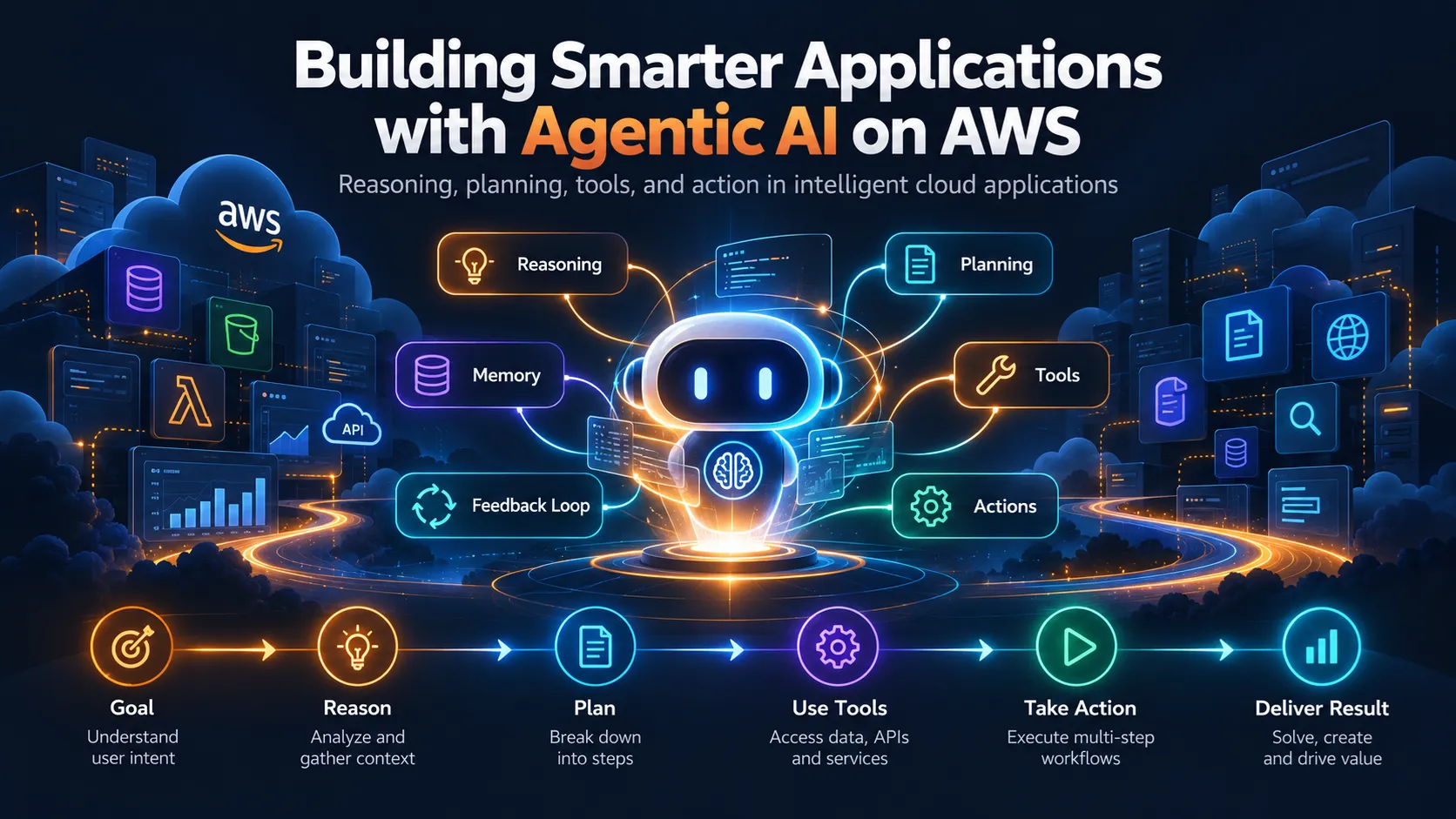
Building Smarter Applications with Agentic AI on AWS
Agentic AI is changing how applications interact with users, data, and tools. This article explains what Agentic AI is, how it differs from traditional generative AI, and how AWS services can be used to build intelligent systems that reason, plan, use tools, and complete multi-step tasks.

Title
Building Smarter Applications with Agentic AI on AWS
Building Smarter Applications with Agentic AI on AWS
Description
Agentic AI is changing how applications interact with users, data, and tools. This article explains what Agentic AI is, how it differs from traditional generative AI, and how AWS services can be used to build intelligent systems that reason, plan, use tools, and complete multi-step tasks.
Agentic AI is changing how applications interact with users, data, and tools. This article explains what Agentic AI is, how it differs from traditional generative AI, and how AWS services can be used to build intelligent systems that reason, plan, use tools, and complete multi-step tasks.
Body
Building Smarter Applications with Agentic AI on AWS
Artificial Intelligence has evolved rapidly from systems that simply classify data or generate text into systems capable of reasoning, planning, using tools, and performing actions.
One of the most interesting developments in this evolution is Agentic AI.
Instead of only answering a question, an AI agent can understand a goal, decide what steps are required, interact with external tools or APIs, evaluate the results, and continue working until the task is completed.
This makes Agentic AI especially useful for building intelligent assistants, automated workflows, enterprise applications, and decision-support systems.
What is Agentic AI?
Agentic AI refers to AI systems that can operate with a certain level of autonomy to achieve a defined objective.
A traditional generative AI system usually follows a simple pattern:
User Prompt → AI Model → Response
An AI agent can follow a more advanced process:
Goal → Reasoning → Planning → Tool Selection → Action → Observation → Final Result
For example, imagine asking an AI system:
"Find the major issues affecting my project and prepare a summary."
A basic language model may generate a generic answer.
An AI agent could instead:
- Retrieve project information.
- Analyze project data.
- Identify delays or risks.
- Call APIs or databases for additional information.
- Generate recommendations.
- Prepare a structured report.
This ability to combine reasoning with actions is what makes Agentic AI powerful.
Core Components of an AI Agent
Most AI agents contain several important components.
1. Large Language Model
The language model acts as the reasoning engine of the agent.
It interprets the user's request, understands context, generates plans, and decides what action should happen next.
2. Tools
Agents become significantly more useful when they can interact with external systems.
Tools may include:
- APIs
- Databases
- Search systems
- Calculators
- Cloud services
- Business applications
Instead of relying only on information stored inside the model, the agent can retrieve real-time information when required.
3. Memory
Memory allows an agent to remember useful context from previous interactions.
For example, an AI assistant may remember previous tasks, preferences, or results and use them when handling future requests.
4. Planning
Complex tasks usually require multiple steps.
An agent can break a large goal into smaller tasks and determine the correct sequence for completing them.
For example:
User Goal: Analyze application performance.
The agent may create the following plan:
Collect metrics → Detect anomalies → Identify possible causes → Recommend actions → Generate report
5. Feedback Loop
One important capability of Agentic AI is the ability to observe the result of an action.
The agent can then decide whether the goal has been achieved or whether another action is required.
This creates a loop:
Think → Act → Observe → Improve
Agentic AI with AWS
AWS provides several services that can help developers create intelligent AI-powered applications.
Amazon Bedrock
Amazon Bedrock provides access to foundation models through managed APIs.
Developers can use these models to build generative AI applications without managing the underlying model infrastructure.
Bedrock can act as the intelligence layer behind an AI agent.
Agents for Amazon Bedrock
Agents for Amazon Bedrock help applications perform multi-step tasks by combining foundation models with APIs, data sources, and business logic.
An agent can interpret a request, determine which action is required, call the appropriate service, and return a useful result.
This makes it possible to build applications such as:
- Customer support agents
- Enterprise knowledge assistants
- Automated research assistants
- IT operations assistants
- Intelligent workflow systems
Amazon Bedrock Knowledge Bases
Agents often need access to organization-specific information.
Knowledge Bases for Amazon Bedrock can connect foundation models with enterprise data and retrieve relevant information when answering questions.
This approach is commonly associated with Retrieval-Augmented Generation (RAG).
A simplified workflow looks like:
User Question → Retrieve Relevant Data → Foundation Model → Context-Aware Response
AWS Lambda
AI agents frequently need to perform actions.
AWS Lambda can execute backend logic when an agent decides that a specific operation is required.
For example, an agent could call a Lambda function to:
- Query a database
- Process data
- Call another API
- Trigger a workflow
- Generate a report
Amazon API Gateway
API Gateway can expose application functionality as APIs that an AI agent can interact with.
This allows the agent to communicate securely with external services and backend systems.
Example Agentic AI Architecture
A simple Agentic AI application on AWS could follow this architecture:
User
↓
Web or Mobile Application
↓
Amazon Bedrock Agent
↓
Foundation Model
↓
Knowledge Base + Tools
↓
AWS Lambda / APIs / Databases
↓
Result returned to the user
The important idea is that the model is no longer only generating text. It becomes part of a larger system capable of interacting with real services.
Example: Intelligent Project Monitoring Agent
Consider a project management system containing information about milestones, risks, documents, and schedules.
A user asks:
"Which projects are most likely to be delayed this month?"
An AI agent could perform the following steps:
- Understand the user's request.
- Retrieve active project information.
- Analyze milestones and deadlines.
- Check available risk indicators.
- Rank projects based on potential delays.
- Explain the major causes.
- Recommend possible actions.
Instead of forcing the user to manually search multiple dashboards, the agent coordinates these steps automatically.
Agentic AI vs Generative AI
Generative AI primarily focuses on creating content such as text, images, code, or summaries.
Agentic AI goes one step further by using AI-generated reasoning to perform actions.
A simple comparison is:
Generative AI:
"Here is how you could solve the problem."
"Here is how you could solve the problem."
Agentic AI:
"I will determine the steps, use the available tools, and help complete the problem."
"I will determine the steps, use the available tools, and help complete the problem."
This transition from generation to action is one of the most important developments in modern AI systems.
Challenges
Although Agentic AI offers powerful capabilities, developers must design these systems carefully.
Important considerations include:
- Security
- Access permissions
- Data privacy
- Accuracy
- Cost management
- Monitoring
- Human approval for critical actions
AI agents should not automatically receive unlimited access to systems.
The principle of least privilege should be followed so that agents can only perform actions that are necessary for their assigned tasks.
For high-impact decisions, human review should remain part of the workflow.
The Future of Agentic AI
Agentic AI could significantly change how users interact with software.
Instead of navigating multiple menus and dashboards, users may increasingly describe their goals in natural language.
The system can then determine how to complete those goals using available tools and services.
This can lead to applications that are more intelligent, adaptive, and easier to use.
The combination of foundation models, cloud services, APIs, enterprise data, and autonomous reasoning creates many possibilities for developers.
Conclusion
Agentic AI represents an important shift from AI systems that simply generate responses to systems that can reason, plan, interact with tools, and take actions.
AWS provides several building blocks that developers can use to experiment with these architectures, including Amazon Bedrock, Bedrock Agents, Knowledge Bases, Lambda, and API-driven services.
For developers learning cloud and AI technologies, understanding how these components work together is an excellent step toward building the next generation of intelligent applications.
The future of AI may not simply be about asking machines questions.
It may be about giving them goals and allowing them to intelligently determine how to help us achieve them.
Enjoyed reading this content? Let the author know!
Your likes, comments, shares, and saves help creators reach more builders.

Loading recommendations
Loading article