
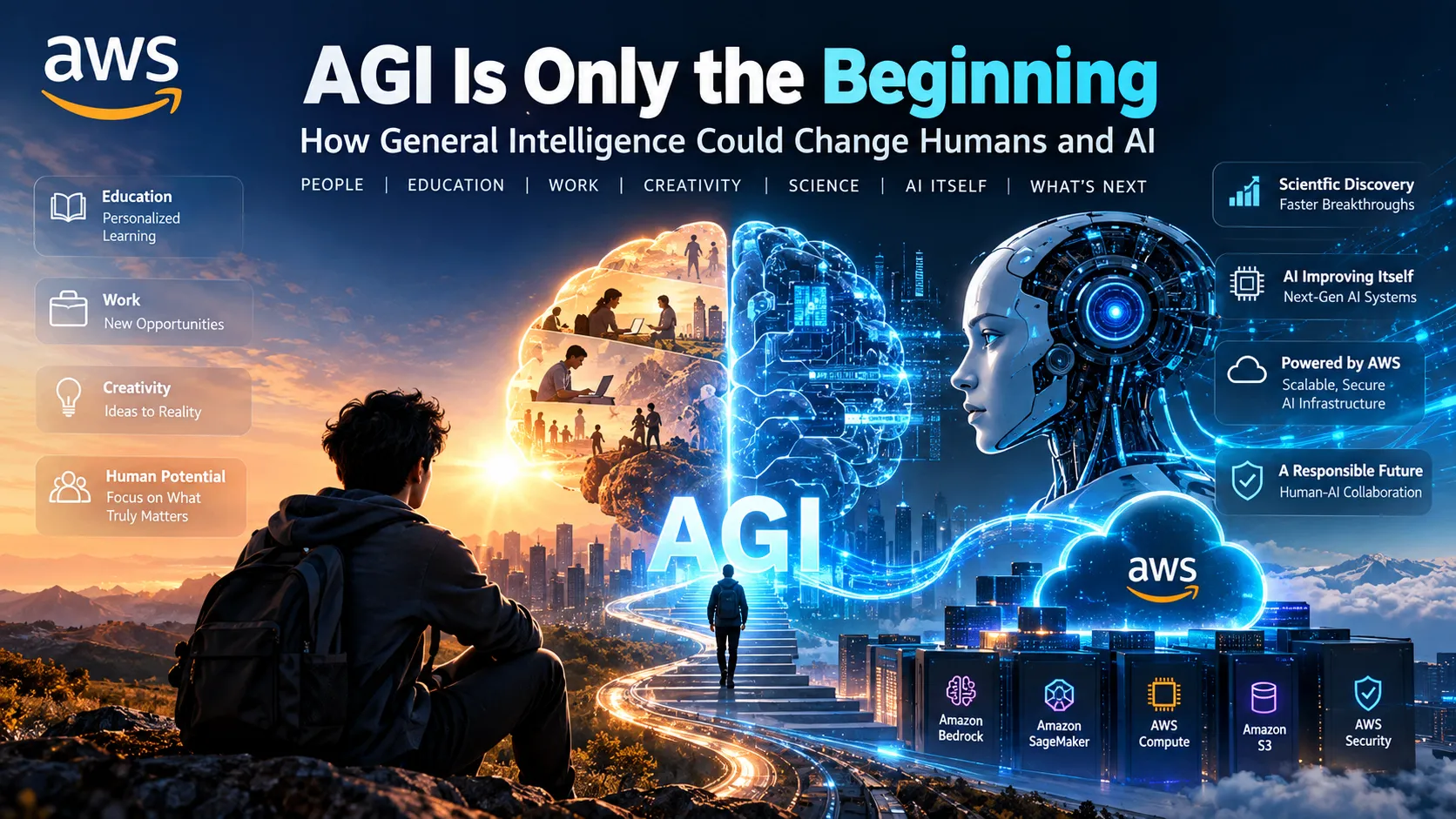
AGI Is Only the Beginning: How General Intelligence Could Change Humans and AI
AI models are becoming increasingly capable, but today’s systems may only be an early step toward AGI. This article explores how general intelligence could transform human work, education, creativity, scientific discovery, and even the way future AI systems are developed.

AGI Is Only the Beginning: How General Intelligence Could Change Humans and AI
Artificial intelligence has changed dramatically in just a few years.
Models such as GPT, Claude, and other advanced AI systems can now write code, analyze complex information, generate content, reason through problems, and assist developers with tasks that previously required significant human effort.
But these capabilities may still be only the beginning.
The bigger question is not simply:
How powerful can AI become?
The bigger question is:
What happens when intelligence itself becomes scalable?
That is where Artificial General Intelligence (AGI) enters the conversation.
What Is AGI?
Artificial General Intelligence generally refers to an AI system capable of performing a broad range of intellectual tasks rather than being designed for only a narrow domain.
Today's AI systems are highly capable, but capability in many tasks does not automatically mean that they are AGI.
AGI remains a goal and an area of active research.
However, the rapid progress of modern foundation models gives us a glimpse of what increasingly general-purpose AI could eventually look like.
And that raises an important question:
What happens to humans when machines can perform a large portion of intellectual work?
1. AGI Could Change Human Work
The Industrial Revolution transformed physical labor through machines.
The computer revolution transformed information processing.
AGI could potentially transform cognitive work.
Programming, research, data analysis, design, education, business operations, and many other knowledge-based activities could become heavily AI-assisted.
This does not necessarily mean that humans will simply lose their jobs.
Instead, the nature of many jobs could change.
A developer might spend less time writing repetitive code and more time designing systems.
A researcher might spend less time searching through information and more time deciding which questions are worth investigating.
A student might have an AI tutor available at any time.
The important transition may therefore be:
AI replacing tasks → AI augmenting humans → humans working alongside highly capable AI.
2. Education Could Become Personal
Imagine every student having an AI tutor that understands their learning style.
Instead of giving every student the same explanation, an AI system could adapt its teaching approach based on the student's mistakes and understanding.
For example:
"You understand the formula, but the underlying concept is unclear. Let's approach it using a real-world example."
This could make high-quality personalized education much more accessible.
But there is also a risk.
If students depend completely on AI to solve problems, they may stop developing independent reasoning skills.
The goal should not be to create students who know how to ask AI for every answer.
The goal should be to create students who know when to use AI, how to question it, and how to think independently.
3. Creativity Could Become Abundant
AI is already lowering the barrier to creation.
A single person can use AI tools to generate software, images, videos, designs, documentation, and prototypes.
With more capable systems, the amount of content and software that one person can produce could increase dramatically.
This could create a new kind of creator:
the individual who combines human ideas with machine execution.
In such a world, creativity may become less about manually producing every component and more about having good ideas, making decisions, understanding people, and directing intelligent tools.
Human taste and judgment could become more valuable, not less.
4. AGI Could Accelerate Scientific Discovery
One of the most exciting possibilities is scientific research.
Humans have limited time.
A researcher can only read a certain number of papers, analyze a limited amount of data, and perform a limited number of experiments.
Highly capable AI systems could potentially help researchers:
- Analyze scientific literature
- Generate hypotheses
- Write simulations
- Analyze experimental results
- Search large datasets
- Design experiments
- Discover relationships humans may overlook
If AI becomes capable enough to participate meaningfully in scientific research, the speed of discovery could increase substantially.
This could have consequences for medicine, energy, materials science, climate research, mathematics, robotics, and many other fields.
5. The Interesting Part: AI Could Help Build Better AI
This is where the AGI discussion becomes even more interesting.
Today, humans are responsible for designing AI systems, improving architectures, creating training pipelines, evaluating models, and optimizing infrastructure.
But increasingly capable AI systems can already assist developers and researchers with many of these activities.
Imagine a future where AI systems can contribute significantly to the development of the next generation of AI.
That could create a feedback loop:
AI → better AI development → more capable AI → better AI development
This does not automatically mean that AI will suddenly become uncontrollable or reach superintelligence.
There are still major limitations involving computing resources, data, algorithms, physical infrastructure, economics, and safety.
However, AI participating in its own improvement would represent a major change in the way technological progress happens.
6. The AI Infrastructure Problem
AGI will not be only a model problem.
It will also be an infrastructure problem.
Advanced AI requires enormous amounts of:
- Compute
- Storage
- Networking
- Data
- Security
- Monitoring
- Distributed systems
- Model-serving infrastructure
This is where cloud platforms become increasingly important.
AWS provides infrastructure and services that developers can use to build and deploy modern AI applications.
Services such as Amazon Bedrock provide access to foundation models and capabilities for building generative AI applications, while AWS compute, storage, networking, databases, and security services provide the infrastructure surrounding those applications.
As AI becomes more capable, the surrounding infrastructure becomes just as important as the model itself.
7. The Risk of Human Dependence
There is another side to this progress.
The more capable AI becomes, the more humans may depend on it.
We already rely on software for navigation, communication, calculations, recommendations, and information retrieval.
If AI eventually handles a large portion of our reasoning, humans could gradually lose some cognitive skills through overdependence.
This creates an important principle for the AGI era:
The smarter our tools become, the more important it may be for humans to remain capable of thinking without them.
AI should increase human capability, not eliminate human agency.
8. Who Controls AGI?
Another difficult question is control.
If AGI becomes extremely powerful, who should control it?
A small number of companies?
Governments?
Open-source communities?
Researchers?
Or should advanced intelligence become widely accessible?
There may not be a simple answer.
Making powerful AI completely unrestricted could create serious risks.
Concentrating it in the hands of a few organizations could create another type of risk: excessive concentration of technological and economic power.
The future of AGI will therefore require more than better models.
It will require responsible engineering, security, governance, transparency, and international cooperation.
9. Humans May Need to Redefine Their Role
For centuries, humans have connected identity with work.
We often introduce ourselves by saying:
"I am a developer."
"I am a doctor."
"I am an engineer."
But what happens if AI can perform many of the tasks associated with those professions?
Human value may increasingly come from areas that are difficult to reduce to automated output:
- Judgment
- Empathy
- Leadership
- Relationships
- Curiosity
- Ethics
- Creativity
- Personal experience
- Decision-making
The future may not be about humans competing against AI.
It may be about humans deciding what AI should help us accomplish.
The AGI Era Is Bigger Than a Race Between Models
It is easy to think of AGI as a competition to build the smartest model.
But that is only part of the story.
The bigger challenge is building a society and technological ecosystem capable of using powerful intelligence responsibly.
We need better infrastructure.
We need better AI education.
We need better security.
We need better governance.
And we need a better understanding of the relationship between humans and intelligent machines.
Today's frontier AI systems may appear incredibly powerful.
But they may eventually look like early milestones in a much larger technological journey.
There could be far more ahead.
The next generation of AI may combine reasoning, memory, tools, robotics, autonomous planning, scientific discovery, and real-world interaction.
That combination could be far more transformative than today's chat-based AI systems.
Conclusion
AGI should not only be viewed as a technology that could replace jobs.
It could change how humans learn, work, create, research, and make decisions.
It could also change AI itself.
If increasingly capable AI systems begin contributing substantially to the development of future AI systems, the rate of technological progress could change dramatically.
That is why the AGI conversation should not only ask:
"Can we build AGI?"
We should also ask:
"How do we build a world that is ready for it?"
The most important part of the AGI era may not be creating artificial general intelligence.
It may be learning how humans and intelligent machines can work together without losing what makes human intelligence valuable.
We may not be approaching the end of AI.
We may only be approaching the beginning.
Enjoyed reading this content? Let the author know!
Your likes, comments, shares, and saves help creators reach more builders.

Loading recommendations
Loading article