
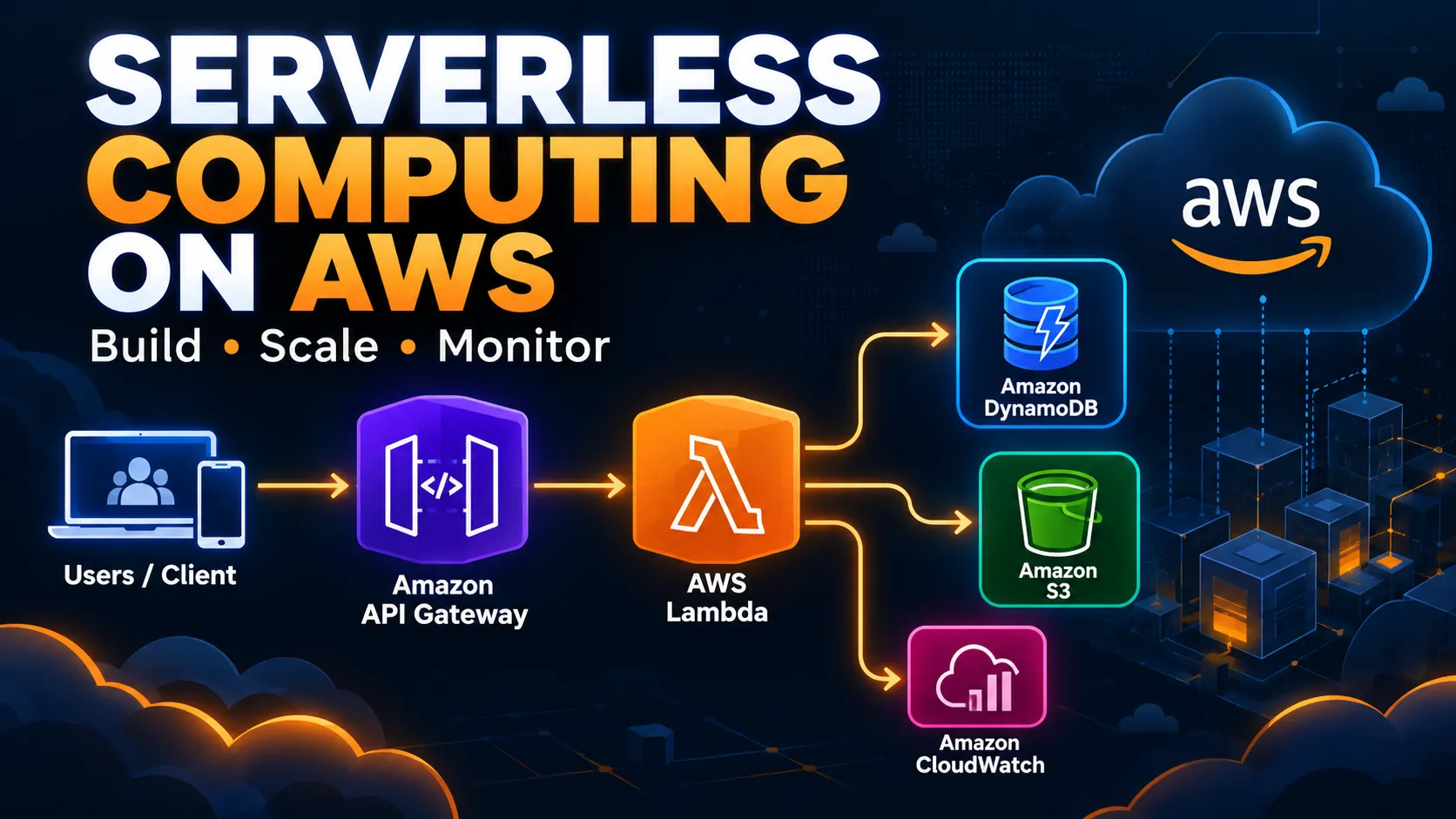
Serverless Computing on AWS: Building Scalable Applications Without Managing Servers
Learn how AWS Lambda, API Gateway, DynamoDB, S3, and CloudWatch work together to build scalable, event-driven applications without managing traditional servers.

1
2
3
4
5
6
7
8
9
10
11
12
13
14
15
16
17
18
19
20
This makes serverless particularly useful for APIs, web applications, automation, data processing, and event-driven workloads.
AWS Lambda lets you run code without provisioning or managing servers.
You upload your code, define the required permissions and configuration, and Lambda executes your function when an event occurs.
For example:
```text
User Request
↓
API Gateway
↓
AWS Lambda
↓
Application LogicLambda can automatically scale based on incoming requests.
Amazon API Gateway
Amazon API Gateway provides an entry point for applications and APIs.
A client can send an HTTP request to API Gateway, which can then invoke a Lambda function.
1
2
3
4
5
Client
  ↓
API Gateway
  ↓
Lambda
This combination is commonly used to build serverless REST APIs.
Amazon DynamoDB
DynamoDB is a fully managed NoSQL database designed for applications that require consistent performance and scalability.
A Lambda function can read and write application data in DynamoDB without requiring database servers to be managed manually.
Amazon S3
Amazon S3 provides highly durable object storage.
In a serverless application, S3 can be used for:
- Images
- Documents
- Static websites
- Application files
- Backups
- Data processing inputs
S3 can also generate events that trigger Lambda functions.
Amazon CloudWatch
CloudWatch provides monitoring and observability for AWS applications.
For serverless applications, CloudWatch can help developers monitor:
- Lambda invocations
- Errors
- Execution duration
- Logs
- Metrics
- Alarms
Monitoring is essential when building production-ready serverless applications.
Serverless Application Architecture
A simple serverless application can be designed like this:
1
2
3
4
5
6
7
8
9
10
11
12
13
14
15
16
17
18
19
20
21
22
23
24
25
26
27
                    ┌──────────────┐
                    │     User     │
                    └──────┬───────┘
                           │
                           ▼
                 ┌──────────────────┐
                 │  API Gateway     │
                 └────────┬─────────┘
                          │
                          ▼
                 ┌──────────────────┐
                 │   AWS Lambda     │
                 └───────┬──────────┘
                         │
              ┌──────────┼──────────┐
              ▼          ▼          ▼
        ┌──────────┐ ┌────────┐ ┌────────────┐
        │ DynamoDB │ │   S3   │ │ EventBridge│
        └──────────┘ └────────┘ └─────┬──────┘
                                      │
                                      ▼
                                  AWS Lambda

                         ┌─────────────────┐
                         │  CloudWatch     │
                         │ Logs & Metrics  │
                         └─────────────────┘
The user sends a request to API Gateway. API Gateway invokes Lambda, where the application logic is executed.
Lambda can then interact with DynamoDB, S3, or other AWS services.
CloudWatch provides logs and metrics for monitoring the application.
Real-World Example: Serverless E-Commerce Order Processing
Consider an e-commerce application where a customer places an order.
The workflow could look like this:
1
2
3
4
5
6
7
8
9
10
11
12
13
Customer
   ↓
API Gateway
   ↓
Lambda
   ↓
DynamoDB
   ↓
EventBridge / SQS
   ↓
Processing Lambda
   ↓
CloudWatch
When the customer places an order:
- API Gateway receives the request.
- Lambda validates and processes the order.
- Order information is stored in DynamoDB.
- An event can be published for downstream processing.
- Another Lambda function can process tasks such as notifications or order updates.
- CloudWatch collects logs and metrics.
This architecture separates application components and allows different parts of the system to scale independently.
Serverless vs Traditional Server-Based Applications
| Serverless | Traditional Server-Based |
|---|---|
| AWS manages infrastructure | Developer manages servers |
| Automatic scaling | Scaling often requires configuration |
| Event-driven | Often continuously running |
| Less infrastructure maintenance | More infrastructure management |
| Pay-per-use for many services | Pay for provisioned resources |
| Faster deployment | More infrastructure setup |
Serverless does not eliminate infrastructure. Instead, it shifts much of the infrastructure management responsibility to the cloud provider.
Important Serverless Best Practices
1. Follow the Principle of Least Privilege
Use IAM permissions that provide only the access required by each Lambda function.
2. Monitor Your Application
Use CloudWatch Logs, metrics, and alarms to identify errors and performance issues.
3. Design for Failure
Use services such as Amazon SQS when asynchronous processing and decoupling are beneficial.
4. Optimize Lambda Functions
Keep functions focused and avoid unnecessary dependencies or processing.
5. Control Costs
Monitor usage and regularly review AWS costs to identify unexpected consumption.
Challenges of Serverless
Serverless architecture also has trade-offs.
Some challenges include:
- Cold starts for certain workloads
- Distributed application debugging
- Service limits
- Vendor-specific architecture
- More complex distributed workflows
- Cost can become difficult to predict for poorly designed workloads
Therefore, serverless should be selected based on application requirements rather than simply assuming it is always the best architecture.
Conclusion
Serverless computing changes how we build cloud applications by allowing developers to focus more on application logic and less on infrastructure management.
AWS provides a powerful ecosystem of serverless services including Lambda, API Gateway, DynamoDB, S3, EventBridge, SQS, and CloudWatch.
When these services are combined thoughtfully, they can create applications that are scalable, resilient, and easier to operate.
The key is not simply to remove servers, but to design an architecture that uses managed services effectively to solve real business problems.
What's Next?
A natural next step is to build an event-driven serverless architecture using:
API Gateway → Lambda → EventBridge/SQS → Lambda → DynamoDB → CloudWatch
This approach helps demonstrate how serverless services can work together in a real-world AWS architecture.
1
2
3
4
5
6
7
8
9
10
11
12
13
14
15
16

### Tags

Use exactly these 5:

**AWS**
**Serverless**
**AWS Lambda**
**Cloud Computing**
**Event-Driven Architecture**

### Cover image

For the cover, use a clean **1200 × 675** AWS/serverless architecture illustration with very little text. Don't put the entire article title on the image.

This article would fit nicely into the AWS portfolio you're building because it shows **architecture thinking**, raEnjoyed reading this content? Let the author know!
Your likes, comments, shares, and saves help creators reach more builders.

Loading recommendations
Loading article