
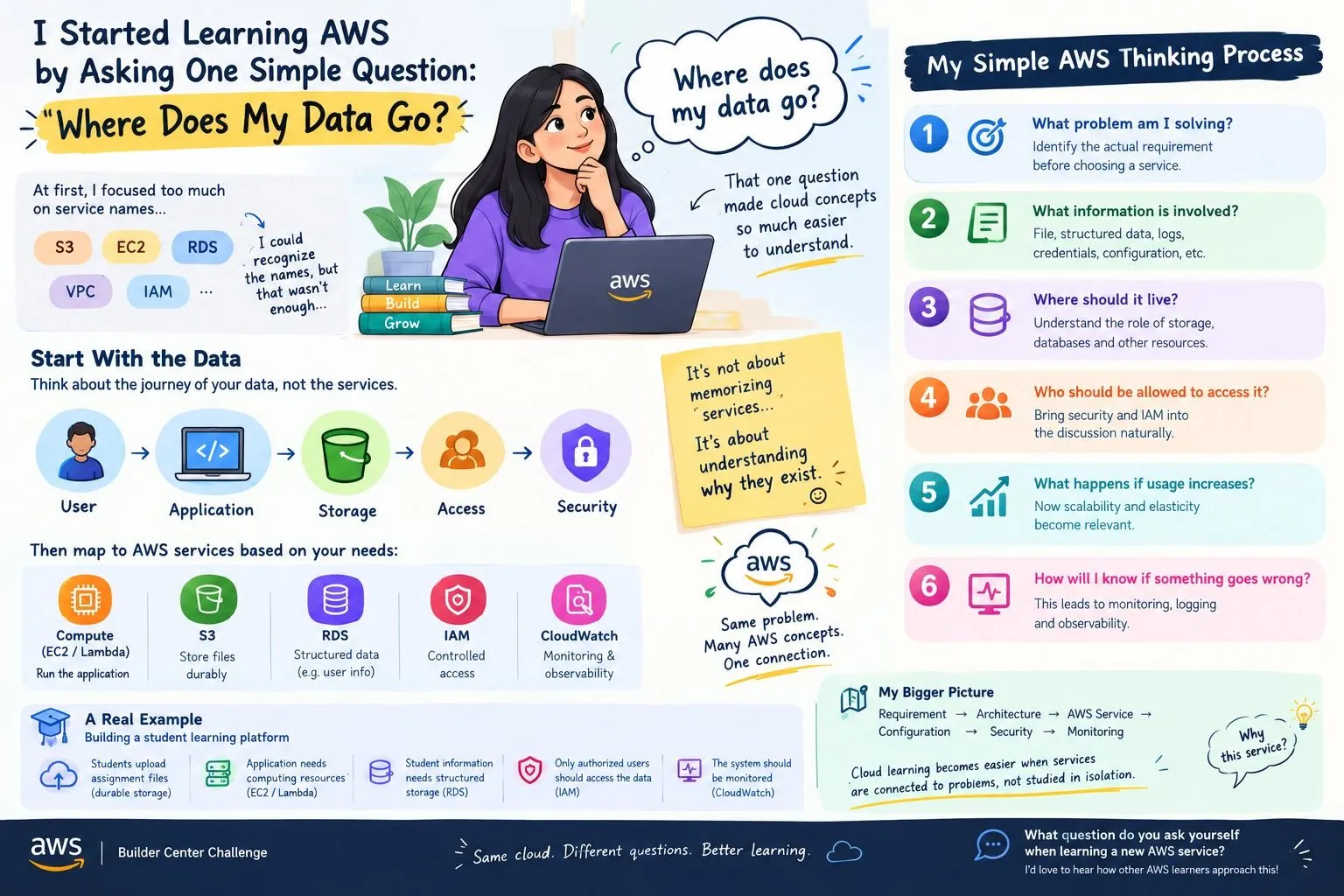
I Started Learning AWS by Asking One Simple Question: Where Does My Data Go?
When I first started learning AWS, I focused too much on service names. S3. EC2. RDS. VPC. IAM.

I could recognize the names, but recognizing a service is very different from understanding why it exists.
So I changed my approach.
Instead of asking:
“What does this AWS service do?”
I started asking:
“Where does my data go, and what happens to it?”
That one question made cloud concepts much easier to understand.
Start With the Data
Imagine I have a simple application where a user uploads a photo.
The first thing I think about is not AWS services.
I think about the journey of that photo:
User → Application → Storage → Access → Security
Now I can start mapping AWS services to the problem.
For example:
- The application needs somewhere to run.
- The photo needs somewhere durable to be stored.
- Users need controlled access.
- The application may need a database for related information.
- Monitoring is needed to understand what is happening.
Only after understanding these requirements do I think about specific AWS services.
This feels much more logical than trying to memorize a list of services.
My Simple AWS Thinking Process
I am now trying to follow a simple sequence whenever I learn a new AWS concept:
1. What problem am I solving?
Before choosing a service, I identify the actual requirement.
2. What information is involved?
Is it a file, structured data, logs, credentials, configuration, or something else?
3. Where should it live?
This helps me understand the role of storage, databases, and other AWS resources.
4. Who should be allowed to access it?
This brings security and IAM into the discussion naturally.
5. What happens if usage increases?
Now scalability and elasticity become relevant.
6. How will I know if something goes wrong?
This leads me toward monitoring, logging, and observability.
The interesting part is that I am learning several AWS concepts through one problem, instead of learning every service separately.
A Small Example
Suppose I want to build a simple student learning platform.
Students upload assignment files.
Instead of immediately trying to remember which AWS services I need, I break the requirement down.
The assignment files need durable storage.
The application needs computing resources.
Student information needs structured storage.
Only authorized users should access the data.
The system should be monitored.
Now AWS services become answers to specific requirements rather than random names to memorize.
That distinction has made my learning much easier.
I’m Also Learning to Ask “Why?”
One question I want to keep asking while preparing for AWS certifications is:
“Why would I choose this?”
For example, knowing that Amazon S3 provides object storage is useful.
But understanding why object storage is suitable for files such as images, documents, backups, and other objects is much more valuable.
Similarly, knowing that IAM controls access is only the beginning.
Understanding that AWS resources should be accessed according to appropriate permissions helps connect IAM with real security decisions.
For me, this is where memorization starts turning into understanding.
What I Want to Do Differently
I don't expect to remember every AWS service immediately.
Instead, I want to become comfortable with the bigger picture:
Requirement → Architecture → AWS Service → Configuration → Security → Monitoring
That is the mental model I am trying to develop.
I am still learning, and I know there is a lot more to understand.
But I have realized something important:
Cloud learning becomes much easier when services are connected to problems instead of studied as isolated definitions.
So the next time I learn an AWS service, I am going to ask myself:
“What problem would make me need this?”
That question might be more useful than memorizing another service name.
What question do you ask yourself when learning a new AWS service?
I'd love to hear how other AWS learners approach this.
Enjoyed reading this content? Let the author know!
Your likes, comments, shares, and saves help creators reach more builders.

Loading recommendations
Loading article