
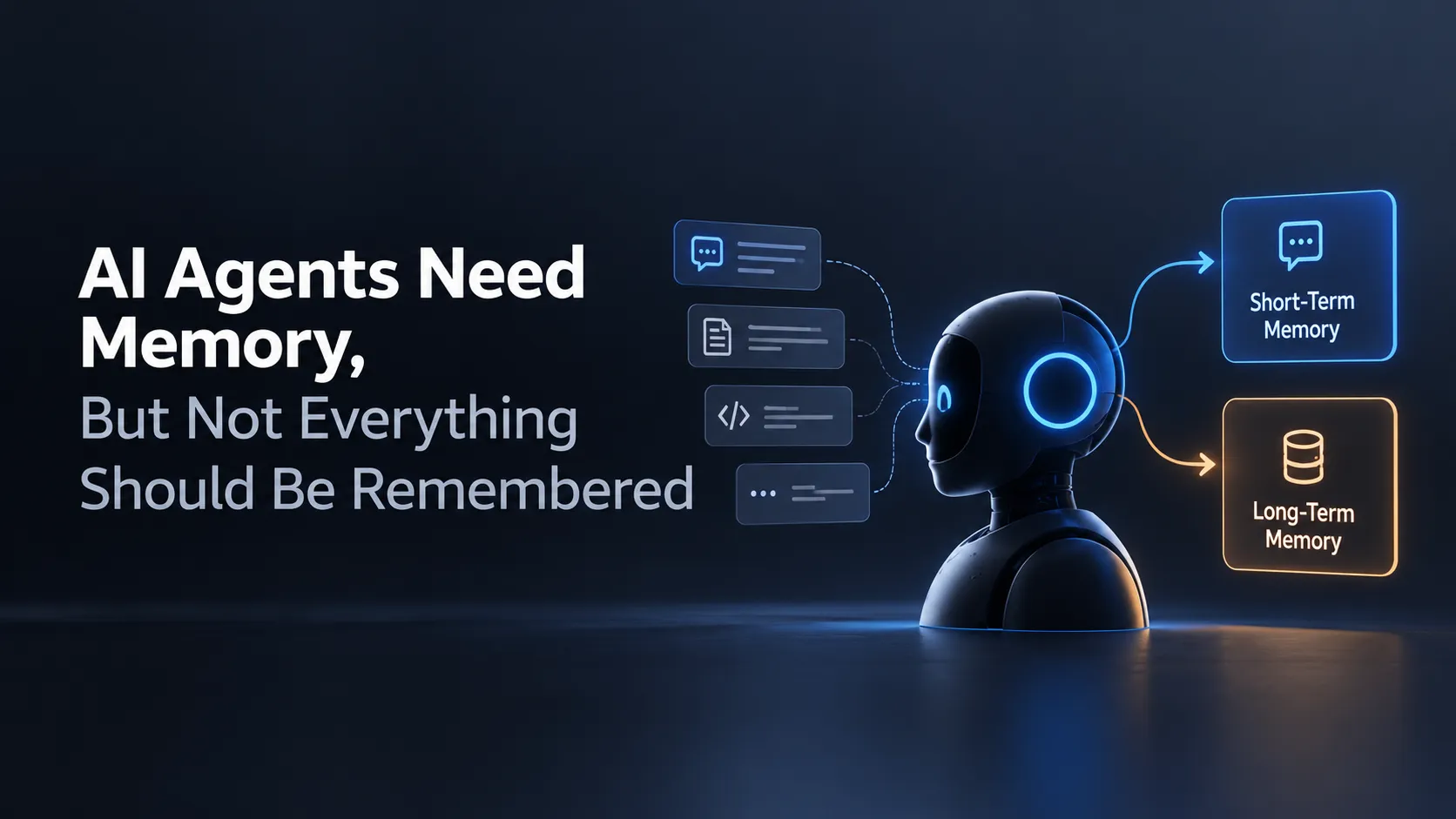
AI Agents Need Memory, But Not Everything Should Be Remembered
AI agents need memory to maintain context, personalize interactions, and complete long-running tasks. But storing everything creates noise, cost, privacy, and security challenges. This article explores short-term and long-term memory, relevance-based retrieval, memory lifecycle, and practical memory design for AI agents.

AI Agents Need Memory, But Not Everything Should Be Remembered
AI agents are becoming more capable of maintaining conversations, completing tasks, using tools, and adapting their responses based on previous interactions.
But this raises an important question:
What should an AI agent actually remember?
If an agent remembers nothing, every interaction starts from zero. If it remembers everything, the system can become noisy, expensive, difficult to manage, and potentially unsafe.
The real challenge is not giving an agent memory. It is deciding what is worth remembering, when to retrieve it, and when to forget it.
Why Do AI Agents Need Memory?
Without memory, an AI agent may repeatedly ask for information that the user has already provided.
For example, a user might previously mention:
"My project uses Python, FastAPI, and PostgreSQL."
If the agent remembers this information, future technical discussions can immediately use the same context instead of asking the user to repeat it.
Memory therefore helps an agent provide more consistent and personalized interactions.
However, not every piece of information has long-term value.
For example:
"I'm drinking coffee right now."
This may be relevant to the current conversation, but there is usually little reason to store it permanently.
This creates the fundamental memory problem:
Remember useful information, not everything.
Short-Term and Long-Term Memory
AI-agent memory can broadly be divided into two categories.
Short-Term Memory
Short-term memory contains information needed for the current conversation or task.
For example, while helping a user build an application, the agent may need to remember the programming language, framework, database, and current task.
This information helps maintain continuity during a multi-step interaction.
Long-Term Memory
Long-term memory contains information that may remain useful across future conversations.
Examples include:
- User preferences
- Ongoing project details
- Frequently used technologies
- Important decisions
- Stable requirements
The important difference is that short-term memory helps with the current task, while long-term memory helps maintain continuity over time.
Not Everything Should Be Stored
A simple approach would be to save every conversation.
That sounds convenient, but it creates several problems.
Large amounts of irrelevant information can make retrieval harder and increase storage and processing costs. Old information can also become incorrect.
For example, an agent may remember:
"The project uses React."
Six months later, the project may have migrated to Vue.
If the agent continues using the old memory, it can produce incorrect recommendations.
A good memory system therefore needs to consider:
- Relevance
- Importance
- Confidence
- Freshness
- Future usefulness
- Privacy
Memory should be treated as managed information, not an unlimited conversation archive.
Retrieval Is Just as Important as Storage
Imagine an agent has thousands of stored memories.
A user asks:
"How should I structure my backend?"
The agent does not need every previous conversation.
It may only need a few relevant facts, such as the backend language, framework, database, and current project.
This is where memory retrieval becomes important.
A good system should retrieve the most relevant memories instead of sending everything to the model.
Semantic search can be particularly useful here. Instead of looking only for exact keywords, the system can compare the meaning of the current request with stored memories and retrieve information that is conceptually related.
This is similar to the retrieval process used in many RAG systems.
Relevance Matters More Than Recency
The most recent memory is not always the most useful memory.
Suppose an agent remembers that the user tested a Python script ten minutes ago. It also remembers that the user's main project uses FastAPI.
If the user asks:
"How should I design my API?"
The FastAPI information is likely more relevant even though it is older.
A good memory system can therefore consider both recency and relevance, rather than simply retrieving the newest information.
Memory Can Become a Security Problem
Memory also introduces privacy and security concerns.
An AI agent may have access to personal information, project details, private documents, or other sensitive data.
A production memory system should therefore consider:
- What information is allowed to be stored?
- How long should it be retained?
- Who can access it?
- Can the user modify or delete it?
- How is sensitive information protected?
There is also a risk of memory injection.
For example, malicious content could attempt to instruct an agent to permanently remember a harmful or unauthorized instruction.
For this reason, memory creation should not blindly trust every piece of information encountered by the agent.
Memory and RAG Are Different
Memory and Retrieval-Augmented Generation can work together, but they solve different problems.
RAG generally retrieves external knowledge needed to answer a question.
Memory focuses on information about the user, previous interactions, tasks, preferences, or ongoing work.
For example:
RAG:
"What does the latest AWS documentation say about this service?"
Memory:
"Which framework does my project use?"
An advanced AI agent can use both, retrieving external knowledge when necessary and personal or task-specific memory when relevant.
Memory Should Have a Lifecycle
A useful memory system should not simply store information forever.
Memories may need to be:
- Created
- Updated
- Confirmed
- Replaced
- Archived
- Forgotten
For example, if a user changes their preferred programming language, the old preference should no longer influence future responses.
This makes memory management similar to maintaining a constantly changing knowledge base.
Where AWS Fits
When building AI agents on AWS, memory can be designed as a separate architectural component around the model.
Amazon Bedrock can provide access to foundation models, while databases, storage systems, and retrieval technologies can be used to maintain and retrieve relevant information.
The exact architecture depends on the application.
A customer-support agent may need conversation history and customer information, while a coding agent may need project state, previous decisions, and technical preferences.
The important idea is that memory should be designed around the agent's requirements rather than simply storing everything available.
Final Takeaway
A smarter AI agent is not necessarily the one that remembers the most.
It is the one that remembers the right information.
A good memory system should continuously answer four questions:
What should I remember?
What is relevant right now?
Is the memory still correct?
Should this information still be retained?
The future of AI agents will not only depend on better models and better tools. It will also depend on better memory management.
Good memory isn't about remembering everything. It's about remembering what matters when it matters.
Enjoyed reading this content? Let the author know!
Your likes, comments, shares, and saves help creators reach more builders.

Loading recommendations
Loading article