
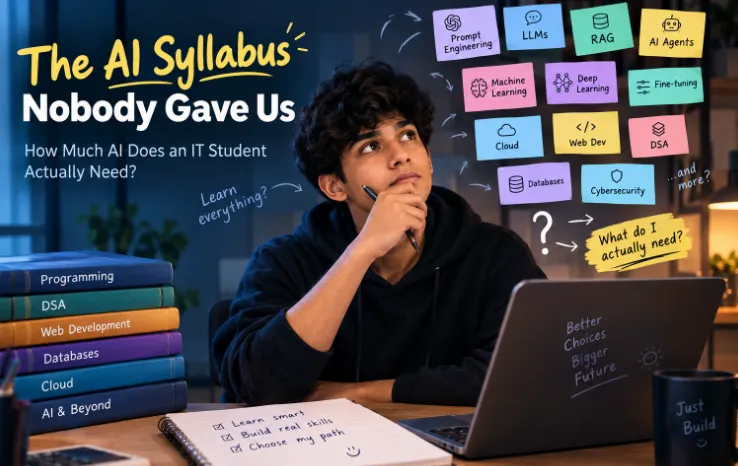
The AI Syllabus Nobody Gave Us: How Much AI Does an IT Student Actually Need?
AI is everywhere—but trying to learn everything from prompt engineering to agents, RAG, and LLMs can leave IT students knowing a little about everything and mastering nothing. So what should we actually learn, what can wait, and where does AI fit into a real software career?

The AI Syllabus Nobody Gave Us: How Much AI Does an IT Student Actually Need?
There was a time when an IT student could say, “I’m learning programming,” and that was a perfectly reasonable answer.
Now?
“I’m learning Java.”
“But do you know Python?”
“Yes.”
“What about DSA?”
“I’m learning it.”
“Cloud?”
“A little.”
“AI?”
“Generative AI, actually.”
“Machine learning?”
“Not yet.”
“What about RAG? AI agents? LLMs? Fine-tuning?”
And suddenly, instead of learning technology, you are trying to keep up with a technology vocabulary that seems to grow every week.
This raises a question that doesn't get asked enough:
How much AI does an IT student actually need?
Not how much AI exists.
Not how many AI tools are trending.
Not how many certificates you can collect.
How much do you actually need for the career you want?
The Pressure to Learn Everything
Open LinkedIn for five minutes and you'll probably see someone talking about AI.
Learn Generative AI.
Build AI agents.
Master RAG.
Learn prompt engineering.
Become an AI engineer.
Build with LLMs.
Learn machine learning.
Learn deep learning.
Fine-tune models.
The problem isn't that these technologies are useless.
The problem is that they are all being presented as if they are equally important to every student.
They aren't.
A student preparing for frontend development doesn't need the same AI knowledge as a machine learning engineer.
A cloud engineer doesn't need the same depth of mathematics as an AI researcher.
A backend developer may need to know how to integrate an LLM API without needing to train an LLM from scratch.
Yet students often treat all of these as items on one giant checklist.
And that is where the confusion begins.
AI Is Important. But "Learn AI" Is Not a Career Plan.
Ignoring AI completely would be a mistake.
AI-assisted development is already becoming part of normal software development. Stack Overflow's 2025 Developer Survey reported that 84% of developers were using or planning to use AI tools in their development process. At the same time, 46% said they distrust the accuracy of AI outputs.
That combination is interesting.
Developers are using AI.
But they don't automatically trust it.
That tells us something important:
The future isn't simply about knowing how to generate code with AI.
It is also about knowing how to understand, evaluate, test, and improve what AI produces.
That is a very different skill.
The AI Learning Trap
Imagine an IT student who starts with Java.
After a few weeks, they hear that Python is important.
So they start Python.
Then DSA becomes important.
Then someone recommends web development.
Then cloud.
Then machine learning.
Then Generative AI.
Then AI agents.
At some point, they have watched hundreds of hours of tutorials.
But ask them to build a small application from scratch.
Suddenly, everything becomes difficult.
This is the technology collection problem.
You can collect:
- Programming languages
- Frameworks
- Cloud services
- AI tools
- Certifications
- Courses
- Badges
and still struggle to solve a real problem.
The number of technologies on your resume isn't the same as your level of technical ability.
So What Should an IT Student Actually Learn?
Instead of creating one enormous AI checklist, I think AI learning should have levels.
Level 1: AI Literacy
This should be for almost everyone.
You should understand:
- What AI actually means
- What machine learning is
- What deep learning is
- What Generative AI is
- What an LLM is
- What tokens and context mean
- What hallucinations are
- What AI APIs do
- Basic privacy and security concerns
- The limitations of AI systems
You don't need to become a researcher.
You need a correct mental model.
Level 2: AI-Assisted Development
This is where AI becomes a productivity tool.
You can use AI to:
- Understand unfamiliar code
- Debug errors
- Generate test cases
- Explain documentation
- Review your code
- Brainstorm solutions
- Improve documentation
- Learn unfamiliar concepts
But there should be one rule:
Never submit code you cannot explain.
If AI writes your code and you cannot explain why it works, you haven't really learned the solution.
You've outsourced the learning.
Level 3: Building AI-Powered Applications
Once your programming fundamentals are reasonably strong, you can start building applications that use AI.
This could involve:
- AI APIs
- Structured outputs
- Embeddings
- Vector databases
- RAG
- Tool calling
- AI agents
- Evaluation
- AI-powered features
Now AI becomes something you build with, rather than something you simply talk to.
That's a significant step.
Level 4: AI Engineering
This is where specialization begins.
If you decide that AI itself is your career direction, then deeper knowledge becomes necessary.
That could include:
- Statistics
- Linear algebra
- Machine learning
- Deep learning
- Model training
- Model evaluation
- Fine-tuning
- MLOps
- Model deployment
- AI infrastructure
But here's the important part:
Not every IT student needs to reach this level.
That's specialization, not basic literacy.
Your Career Should Decide Your AI Depth
Consider four students.
The Frontend Developer
They might need to know how to integrate AI features into an application.
They may benefit from understanding:
UI → API → AI model → response → user
But they don't necessarily need to understand every detail of neural-network training.
The Cloud Engineer
Their AI focus could be:
Deployment → scalability → infrastructure → security → monitoring → cost
They may work with AI systems without becoming an ML researcher.
The Backend Developer
They might focus on:
APIs → databases → authentication → AI integration → RAG → system design
Again, their core strength remains software engineering.
The Machine Learning Engineer
Their path goes much deeper:
Mathematics → statistics → ML → deep learning → models → evaluation → deployment
Same industry.
Different requirements.
That is why there cannot be one universal "AI syllabus" for every IT student.
The Most Underrated AI Skill: Verification
Here's the part that concerns me most.
AI makes producing code incredibly easy.
But producing code has never been the hardest part of software engineering.
Producing correct software is.
An AI-generated solution can:
- Look convincing
- Compile successfully
- Pass a few basic tests
- Still be fundamentally wrong
That is why knowing how to verify AI output is becoming increasingly important.
Don't ask only:
"Can AI write this?"
Ask:
"How do I know this is correct?"
That question forces you to understand:
- Logic
- Edge cases
- Performance
- Security
- Testing
- Architecture
And those skills existed before the current AI boom—and will probably survive whatever comes after it.
Use AI as a Tutor, Not a Substitute
Suppose you're learning Java and get stuck on a problem.
The easiest approach is:
"Solve this problem."
Copy.
Paste.
Done.
But that teaches you very little.
Instead, ask:
"Give me a hint without giving me the solution."
Try again.
Then:
"Here is my code. Find the logical mistake without rewriting it."
Fix it.
Then:
"What edge cases should I test?"
Now AI has helped you learn.
The difference is subtle but important:
One approach removes the struggle.
The other makes the struggle productive.
Learning requires some struggle.
If AI removes every difficult moment, it can also remove the moments where learning happens.
The Question Students Should Ask Before Learning Any New Technology
Before adding another technology to your learning list, ask five questions.
1. Does it support my target career?
If yes, learn it.
If not, ask whether it provides transferable knowledge.
2. Can I explain why I need it?
"Everyone is learning it" isn't a reason.
3. Can I build something with it?
If you've completed ten tutorials but can't create a small project independently, you probably haven't learned it deeply enough.
4. Is it replacing a fundamental skill?
If learning AI is preventing you from learning programming, databases, networking, or problem solving, your priorities may be backwards.
5. Will the underlying knowledge survive if the tool disappears?
This might be the most valuable question.
Frameworks change.
Models change.
Tools change.
Fundamentals last much longer.
Maybe Learning Less Is Sometimes the Smarter Choice
Students are constantly told:
Learn more.
Add another skill.
Add another certificate.
Add another technology.
But sometimes the smartest decision is:
"Not yet."
If you're trying to become a cloud engineer, perhaps you don't need to spend months studying model architecture right now.
If you're trying to become a frontend developer, you don't need to immediately learn model fine-tuning.
If you're trying to become an ML engineer, then avoiding mathematics because it's difficult is a completely different problem.
The question isn't:
"Is this technology important?"
Almost everything can be important.
The better question is:
"Is this important for me, right now, for the career I am building?"
That question can save you months of scattered learning.
The AI Skill Pyramid
I would think about the learning path like this:
1
2
3
4
5
6
7
8
9
10
11
12
13
                 AI RESEARCH
                      ▲
                      │
             AI ENGINEERING
                      ▲
                      │
             AI APPLICATIONS
                      ▲
                      │
          AI-ASSISTED DEVELOPMENT
                      ▲
                      │
       PROGRAMMING + CS FUNDAMENTALS
The foundation still matters.
AI doesn't remove the need for programming.
It doesn't remove databases.
It doesn't remove networking.
It doesn't remove software engineering.
It doesn't remove problem solving.
It changes how we use these skills.
So, How Much AI Do You Actually Need?
My answer is simple.
Everyone should learn enough AI to:
Understand it.
Know what modern AI can and cannot do.
Use it.
Use AI tools intelligently and responsibly.
Build with it.
Understand how AI can become part of software.
Verify it.
Question outputs instead of blindly trusting them.
Specialize in it only when your career requires it.
Go deeper into ML, deep learning, LLM engineering, agents, or research when your goals justify the investment.
The Real Skill Isn't Knowing Everything
Maybe the biggest problem with learning technology today isn't a lack of information.
We have too much information.
Courses.
Tutorials.
YouTube videos.
Certificates.
AI tools.
Documentation.
Roadmaps.
The difficult part is deciding:
What deserves my time?
An IT student doesn't need to become an expert in every technology that appears on the internet.
They need to become good enough at the fundamentals to solve problems—and then learn the technologies that make them better at solving those problems.
AI is not the destination for every IT student.
It is a tool, a capability, and for some people, a specialization.
The smartest student isn't necessarily the one who knows the most AI tools.
It may be the one who can look at a new technology and say:
"I understand what it does. I know where it fits. I know what I need from it—and I know what I don't need yet."
Because in a world where technology keeps getting bigger, knowing what not to learn might become a skill of its own.
Enjoyed reading this content? Let the author know!
Your likes, comments, shares, and saves help creators reach more builders.

Loading recommendations
Loading article