
AWS and Artificial Intelligence
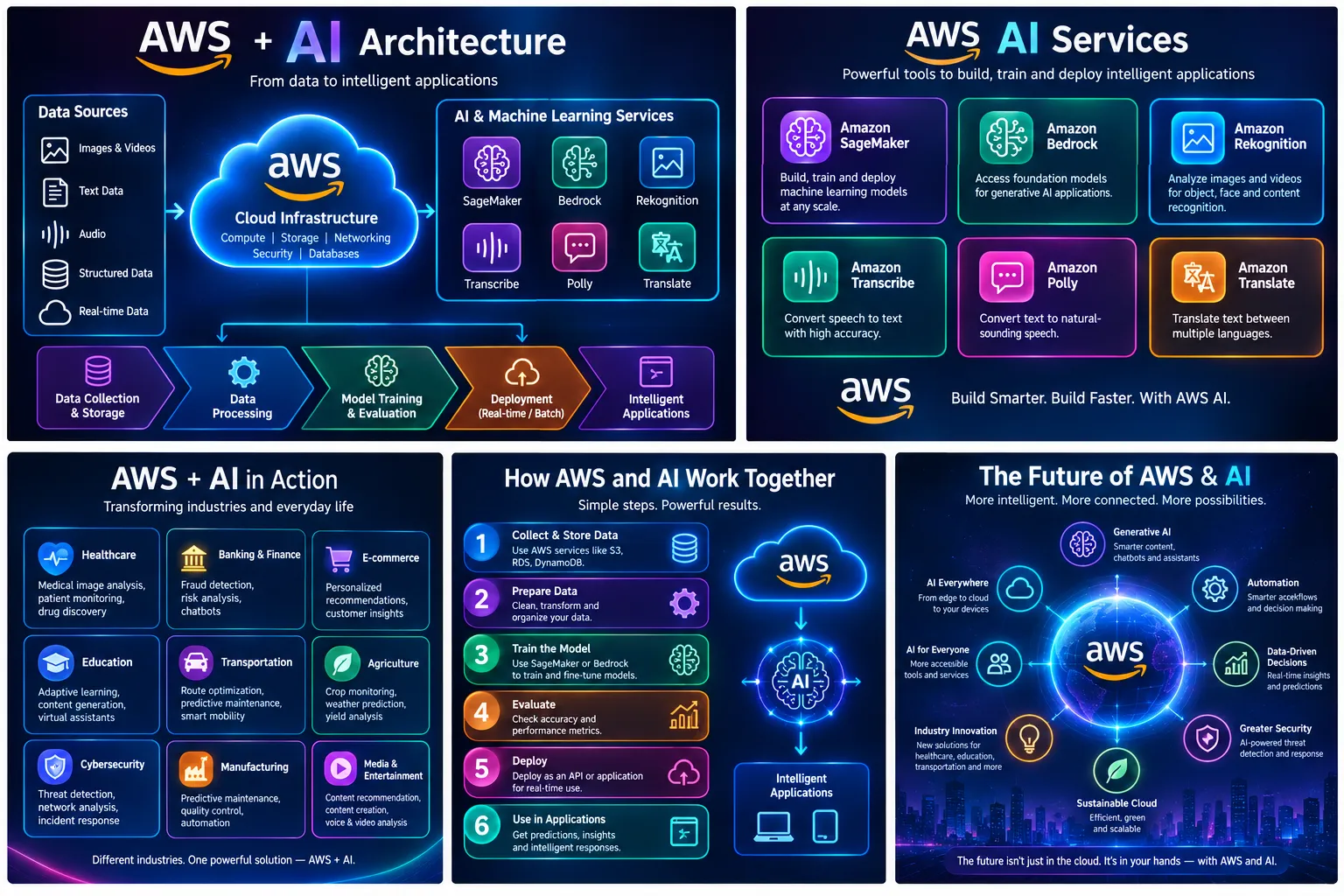
Amazon Web Services (AWS) is one of the world's leading cloud computing platforms, providing a wide range of services that help individuals, organizations, and businesses build, deploy, and manage applications through the internet. Artificial Intelligence (AI), on the other hand, is a technology that enables computers and machines to perform tasks that normally require human intelligence, such as learning, reasoning, understanding language, recognizing images, and making decisions.

AWS and Artificial Intelligence
Introduction
Artificial Intelligence (AI) has become one of the most important technologies in the modern world. From voice assistants and recommendation systems to autonomous vehicles, medical applications, fraud detection, and generative AI, intelligent systems are becoming part of our everyday lives. However, developing and running AI applications requires large amounts of data, computing power, storage, and specialized hardware. This is where cloud computing platforms such as Amazon Web Services (AWS) play an important role.
Amazon Web Services (AWS) is a cloud computing platform developed by Amazon. It provides computing power, storage, databases, networking, security, analytics, and Artificial Intelligence and Machine Learning services through the internet. Instead of purchasing expensive servers and maintaining physical data centers, organizations can use AWS resources whenever they need them and scale their resources according to their requirements.
The combination of AWS and Artificial Intelligence provides developers and organizations with a powerful environment for creating intelligent applications. AWS provides the infrastructure and services, while AI provides the ability to learn from data, recognize patterns, generate content, make predictions, and automate decisions.
What is Artificial Intelligence?
Artificial Intelligence is a branch of computer science that focuses on creating machines and software capable of performing tasks that normally require human intelligence. These tasks include learning, reasoning, problem-solving, understanding natural language, recognizing images, identifying patterns, and making predictions.
Machine Learning (ML) is an important part of AI. Instead of explicitly programming every possible rule, machine-learning systems learn patterns from data. For example, an email spam detector can be trained using thousands of examples of spam and non-spam emails. After learning from these examples, the system can predict whether a new email is likely to be spam.
Other important areas of AI include Natural Language Processing (NLP), computer vision, speech recognition, robotics, deep learning, and generative AI.
Why is AWS Important for AI?
Artificial Intelligence applications often require significant computing resources. Training a complex machine-learning model can involve processing millions or even billions of data points. Traditional computers may not have enough processing power to perform these tasks efficiently.
AWS provides cloud-based computing resources that can be increased or decreased according to the requirements of an AI project. Developers can use powerful computing instances, large-scale storage, databases, and networking services without purchasing physical infrastructure.
Another important advantage is scalability. Suppose a small company develops an AI application and initially has only a few hundred users. As the application becomes popular, thousands or millions of users may start using it. AWS allows the company to increase its computing resources to handle the additional workload.
This flexibility is especially useful for AI startups, students, researchers, and large organizations.
AWS Services Used in Artificial Intelligence
AWS provides many services that can be used for AI and Machine Learning applications.
1. Amazon SageMaker
Amazon SageMaker is a major AWS service for machine learning. It helps developers and data scientists build, train, and deploy machine-learning models.
A typical machine-learning project involves several steps, including collecting data, preparing the data, selecting an algorithm, training the model, evaluating the model, and deploying it. SageMaker provides tools that support many of these stages.
For example, a data scientist could use SageMaker to develop a model that predicts whether a customer is likely to purchase a particular product. The model can be trained using historical customer data and then deployed so that an application can use the predictions.
2. Amazon Bedrock
Generative AI has rapidly changed the technology landscape. AWS provides Amazon Bedrock for building generative AI applications using foundation models through APIs.
Developers can use foundation models to create applications such as chatbots, summarization tools, content-generation systems, question-answering applications, and document-analysis solutions.
For example, a company could create an AI assistant that answers questions about its internal documents. Instead of developing a large language model from scratch, developers can use foundation models through AWS services and build application-specific functionality around them.
3. Amazon Rekognition
Amazon Rekognition provides computer-vision capabilities for analyzing images and videos.
Computer vision allows machines to understand visual information. Applications can use computer vision for tasks such as object detection, image analysis, and facial analysis.
For example, a security application could analyze video footage to identify specific objects or events. Retail companies can also use computer vision for inventory-related applications and visual analysis.
4. Amazon Transcribe
Amazon Transcribe is a speech-to-text service. It converts spoken language into written text.
This technology can be useful for applications such as meeting transcription, customer-service systems, voice-based applications, and accessibility tools.
For example, an organization could record a customer-service conversation and use speech recognition to convert the conversation into text for further analysis.
5. Amazon Polly
Amazon Polly performs the opposite type of task: it converts written text into natural-sounding speech.
This can be useful for applications such as educational tools, accessibility applications, virtual assistants, and voice-enabled services.
For example, an educational application can read written lessons aloud so that students can listen instead of reading the content.
6. Amazon Translate
Language barriers can make communication difficult. Amazon Translate provides machine-translation capabilities that can help applications translate text between supported languages.
This can be useful for websites, customer-support applications, multilingual content, and international businesses.
How AWS and AI Work Together
An AI application usually requires several components. First, data must be collected and stored. Cloud storage services can be used to store large datasets. The data can then be prepared and processed before being used for machine learning.
Next, a machine-learning model is trained using the prepared data. The model learns patterns from the training dataset. After training, the model is evaluated using appropriate metrics to determine how well it performs.
Once the model provides acceptable results, it can be deployed as part of an application. Users can then send information to the application, and the AI model can generate predictions or responses.
For example, consider an AI-based healthcare application designed to predict the risk of a particular condition. Patient-related data could be securely stored and processed, a machine-learning model could be trained using suitable historical data, and the trained model could be deployed for prediction. The application could then provide a risk estimate to an authorized user.
This example demonstrates how cloud infrastructure and AI can work together to create practical applications.
Applications of AWS and Artificial Intelligence
AWS and AI have applications across many industries.
Healthcare
Healthcare organizations can use AI for medical image analysis, prediction, patient-support systems, document processing, and administrative automation. Cloud infrastructure can help healthcare organizations manage large amounts of data and provide scalable computing resources.
Banking and Finance
Banks can use AI to detect unusual transactions, identify potential fraud, assess financial risk, and provide customer-service chatbots. AI systems can analyze large volumes of transactions much faster than humans.
E-Commerce
Online shopping platforms use AI to understand customer preferences and provide personalized recommendations. For example, if a customer frequently searches for a particular type of product, an AI system can recommend related products.
Education
AI can support personalized learning systems, automated content generation, question-answering systems, and educational assistants. Cloud services make it possible to provide these applications to large numbers of students.
Transportation
AI can be used for route optimization, demand forecasting, predictive maintenance, and intelligent transportation systems. These applications can help organizations improve efficiency and reduce operational costs.
Agriculture
AI can analyze agricultural data, weather information, and images to support crop monitoring and prediction. Cloud computing can provide the storage and processing resources required for large datasets.
Cybersecurity
AI can help identify unusual patterns and potentially suspicious activities in large amounts of network and system data. Cloud-based security systems can process information continuously and support organizations in detecting threats.
Advantages of Using AWS for AI
One of the major advantages of AWS is scalability. Organizations can increase or decrease their resources depending on demand.
Another advantage is flexibility. Developers can choose from different services and computing options depending on the requirements of their projects.
AWS also provides a broad range of AI and machine-learning services. Developers do not always need to build every component from the beginning.
Cost efficiency can also be an advantage because organizations can use cloud resources according to their needs rather than maintaining all physical infrastructure themselves. However, cloud costs still need to be monitored carefully.
Security is another important consideration. AWS provides numerous security and identity-management capabilities, but organizations are still responsible for configuring their cloud environments correctly and protecting their applications and data.
Challenges of AWS and AI
Although AWS provides many advantages, using AI in the cloud also presents challenges.
The first challenge is cost management. AI workloads can consume significant computing resources, especially when training large models. Organizations need to monitor usage and optimize their resources.
The second challenge is data privacy and security. AI systems often process large amounts of potentially sensitive information. Organizations must use appropriate security controls and follow relevant laws and regulations.
Another challenge is AI model quality. An AI model is only as reliable as the data and methods used to develop it. Poor-quality or biased data can result in inaccurate or unfair predictions.
There is also a need for skilled professionals. Organizations need people who understand cloud computing, programming, databases, data science, machine learning, cybersecurity, and AI.
Future of AWS and Artificial Intelligence
The future of AWS and Artificial Intelligence is expected to be strongly connected with the growth of generative AI, automation, cloud computing, and data-driven applications.
Generative AI is already changing how people interact with software. Instead of simply clicking buttons and following fixed workflows, users can communicate with applications using natural language.
AI-powered assistants can help developers write and understand code, organizations analyze documents, businesses communicate with customers, and students learn new concepts.
As AI models become more capable, cloud platforms will continue to play an important role in providing the infrastructure required to train, deploy, and operate these systems.
For students studying Artificial Intelligence and Data Science, learning AWS can therefore be a valuable additional skill. Understanding cloud concepts, storage, databases, machine learning deployment, APIs, and AI services can help students move beyond simply building models on a local computer.
Conclusion
AWS and Artificial Intelligence represent two important technologies that are transforming the modern digital world. Artificial Intelligence provides the ability to learn from data, recognize patterns, make predictions, understand language, analyze images, and generate content. AWS provides the cloud infrastructure and specialized services needed to develop, train, deploy, and scale these intelligent applications.
Services such as Amazon SageMaker, Amazon Bedrock, Amazon Rekognition, Amazon Transcribe, Amazon Polly, and Amazon Translate demonstrate how cloud computing can simplify the development of AI-powered solutions.
The combination of AWS and AI is already being used in healthcare, banking, education, e-commerce, transportation, agriculture, cybersecurity, and many other fields. As organizations continue to adopt intelligent technologies, the demand for professionals who understand both AI and cloud computing is likely to increase.
For an AI and Data Science student, learning the fundamentals of AWS along with Python, data structures, databases, machine learning, deep learning, and generative AI can provide a strong foundation for future projects, internships, hackathons, and career opportunities. AWS does not replace the need to understand AI fundamentals; instead, it provides a powerful platform for turning AI knowledge into real-world applications.
Ultimately, AWS provides the cloud, AI provides the intelligence, and together they provide a powerful foundation for building scalable intelligent applications for the future.
The combination of AWS and Artificial Intelligence has made it easier for organizations to develop and use intelligent applications without having to build expensive computing infrastructure from scratch.
AWS provides powerful cloud infrastructure that can support the large amount of computing power and storage required by modern AI applications. AI systems often need large datasets, high-performance processors, and specialized hardware such as GPUs. Instead of purchasing and maintaining this hardware, developers can use AWS cloud resources according to their requirements. This makes AI development more flexible, scalable, and cost-effective.
AWS provides several services specifically designed for Artificial Intelligence and Machine Learning. Amazon SageMaker is one of the most important services for developing, training, and deploying machine learning models. It provides tools that allow developers and data scientists to prepare data, train models, evaluate their performance, and deploy them into applications. AWS also provides AI services such as Amazon Rekognition for image and video analysis, Amazon Transcribe for converting speech into text, Amazon Polly for converting text into natural-sounding speech, and Amazon Translate for language translation.
Generative AI has also become an important part of AWS's AI ecosystem. Amazon Bedrock provides access to foundation models through APIs, allowing developers to build generative AI applications without managing the underlying machine-learning infrastructure. These capabilities can be used to create chatbots, content-generation systems, question-answering applications, document-analysis tools, and intelligent assistants.
AWS and AI are used across many industries. In healthcare, AI can help analyze medical images and support clinical workflows. In banking, AI can help detect suspicious transactions and identify fraud. In e-commerce, recommendation systems can suggest products based on customer behavior. In education, AI can support personalized learning. Transportation companies can use AI for route optimization, forecasting, and intelligent automation.
The combination of AWS and Artificial Intelligence therefore provides a powerful foundation for modern digital applications. AWS supplies scalable cloud infrastructure and specialized AI services, while Artificial Intelligence provides the intelligence needed to analyze information, recognize patterns, automate tasks, and make predictions. Together, they allow students, developers, startups, and large organizations to experiment with AI and transform innovative ideas into practical applications.
Enjoyed reading this content? Let the author know!
Your likes, comments, shares, and saves help creators reach more builders.

Loading recommendations
Loading article