
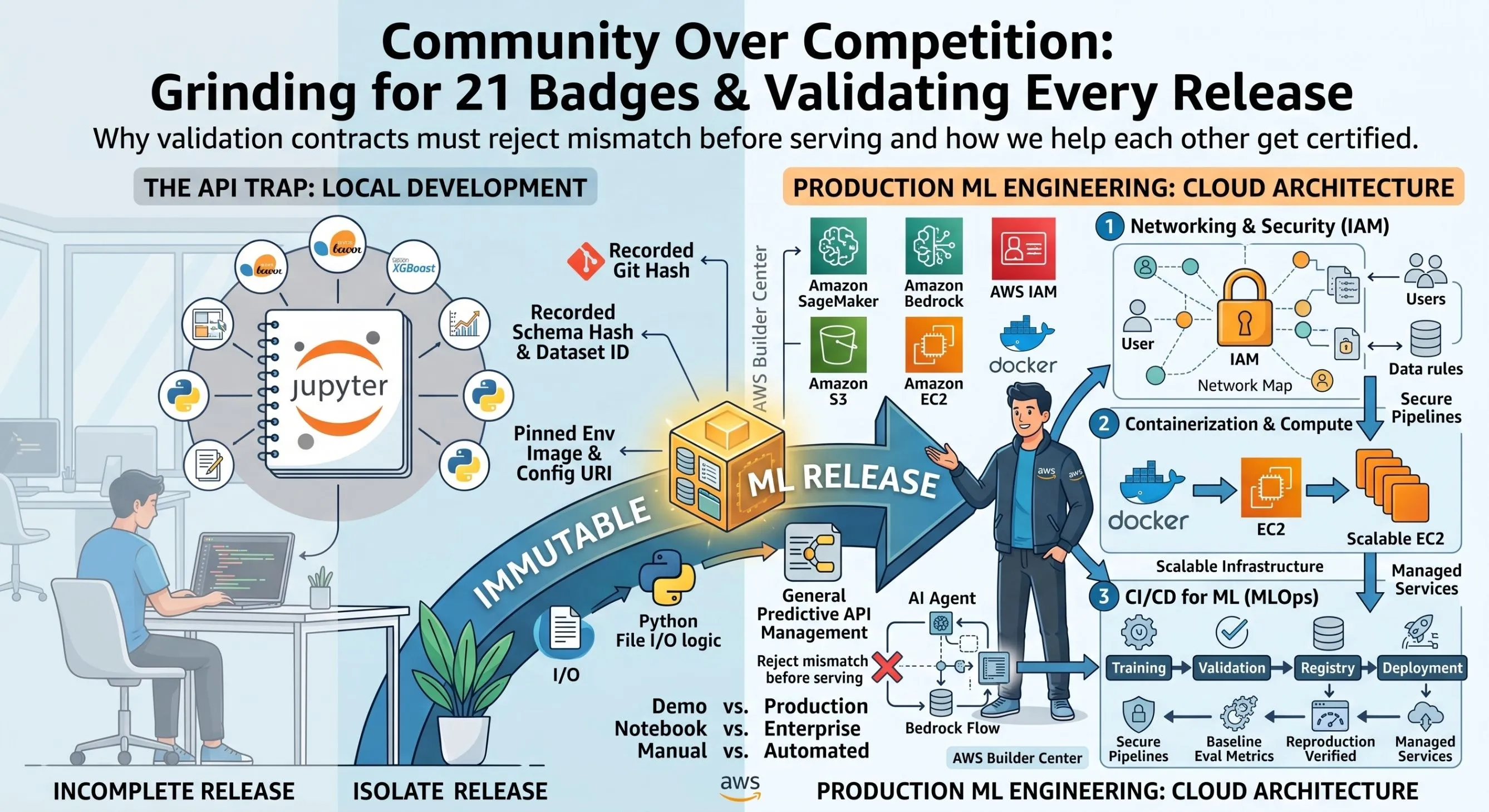
The "Works on My Machine" Trap: Why ML Reproducibility is Harder Than It Looks
Getting an XGBoost model to run locally in a Python script is easy. Getting it to run predictably in a cloud pipeline is a different story. Here is a reflection on the "Works on My Machine" problem in ML, and why versioning data is just as critical as versioning code.

The Classic Developer Curse, Amplified
Every computer science student knows the infamous excuse: "It works on my machine!"
In traditional software engineering, this usually means there is a mismatched library or a forgotten environment variable. But as I transition from building local predictive models (like my recent customer churn API) to planning cloud deployments, I am realizing that the "Works on My Machine" problem in Machine Learning is infinitely more complicated.
When a standard web app breaks, it is usually a code issue. When an ML pipeline breaks, it could be the code, the environment, the model weights, or the raw data itself.
More Than Just Saving a Model File
When you first learn Python File I/O, the goal is simply to read a CSV, train an algorithm, and export the model file. However, a recent discussion I had with an experienced builder completely changed how I view this process.
I learned that simply deploying a model file is dangerous. If you do not package the preprocessing contract (how the data was cleaned, the exact feature order, the category encodings) alongside the model itself, your API might accept bad data and silently serve terrible predictions without ever throwing a visible error.
Real reproducibility means capturing the entire state of the project:
- The Code: The exact Git commit of the training logic.
- The Environment: The pinned dependencies and container image.
- The Data Contract: The strict schema validation rules that reject any incoming data that does not match the training set perfectly.
Let's Swap Deployment Horror Stories!
To the MLOps engineers, cloud architects, and backend developers in the community, I would love to learn from your real-world experiences:
- What is the worst "silent failure" you have seen where a model deployed successfully but the data contract was broken?
- What are your go-to tools or AWS services for enforcing strict data schemas before a payload ever hits your prediction endpoint?
- For a student developer just starting with CI/CD, what is the first automated test you would recommend building into an ML pipeline?
Drop your best advice (or worst deployment nightmares) in the comments below! (And if you are a fellow student navigating the MLOps learning curve, drop a LIKE so we can get more industry experts to share their wisdom!)
Enjoyed reading this content? Let the author know!
Your likes, comments, shares, and saves help creators reach more builders.

Loading recommendations
Loading article