
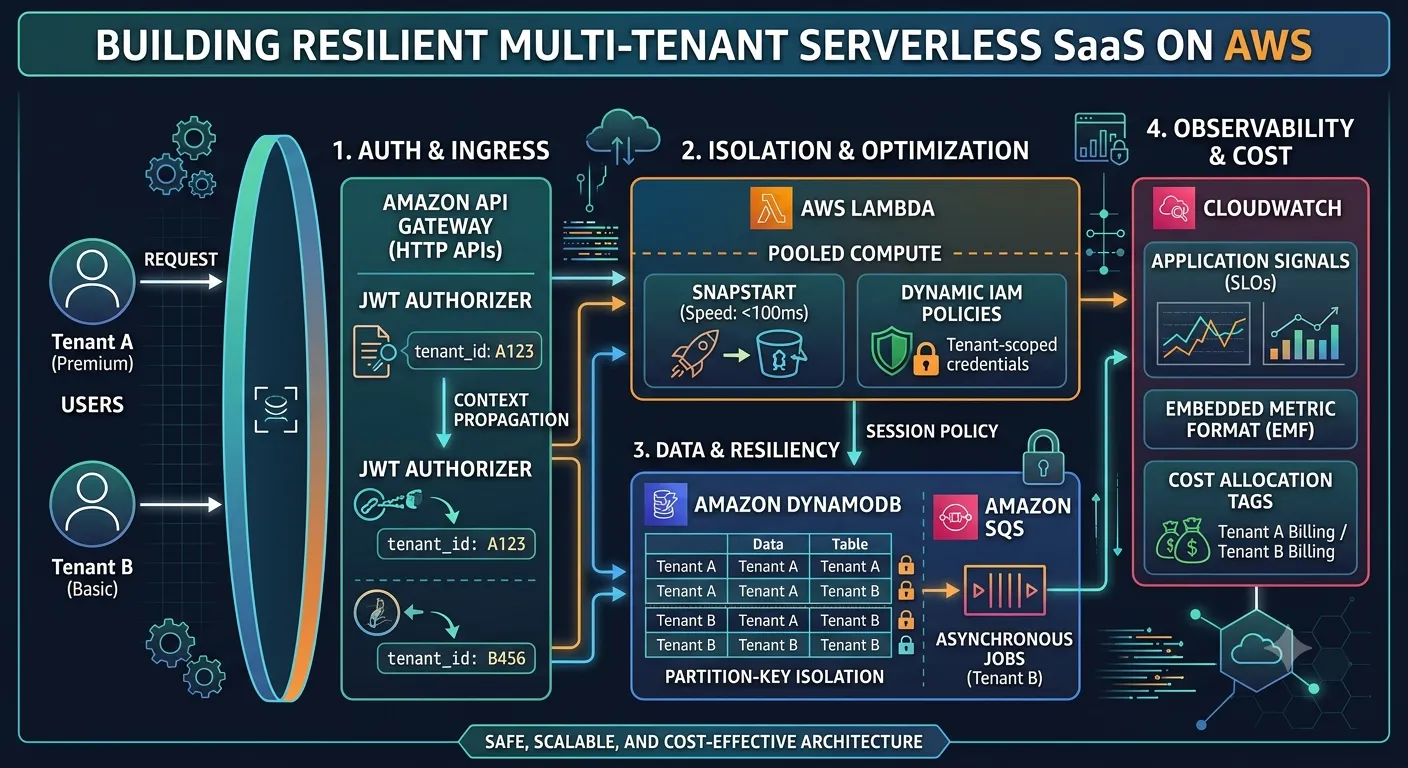
Building Resilient Multi-Tenant Serverless SaaS on AWS (58 characters)
Building Production-Grade Multi-Tenant Serverless Architectures on AWS: A Deep-Dive Implementation Guide Covering Amazon API Gateway HTTP Routing, AWS Lambda Cold-Start Optimization via SnapStart, Fine-Grained Dynamic Tenant Isolation with IAM Session Policies, Distributed Observability Instrumentation using Amazon CloudWatch Application Signals, and Cost Allocation Strategies for Enterprise Workloads to Maximize System Resiliency, Scalability, and Security Compliance Across Hybrid Enterprise Deployments

Designing multi-tenant architectures in cloud-native environments requires balancing compute efficiency, operational cost, and strict data boundary enforcement. In serverless paradigms, traditional isolation patterns like single-tenant virtual machines are replaced by dynamic runtime partitioning.
This guide details an architecture combining Amazon API Gateway, AWS Lambda, Amazon DynamoDB, and Amazon CloudWatch to build a secure, scalable software-as-a-service (SaaS) foundation.
1. Tenant Authentication and Context Propagation
Tenant identity must be validated at the network periphery before execution enters the compute layer.
API Gateway HTTP APIs with JWT Authorizers: Extract the tenant_id claim directly from decoded JSON Web Tokens supplied by Amazon Cognito or your OpenID Connect (OIDC) identity provider.
Context Injection: Pass the extracted tenant context downstream via request headers (x-tenant-id) or API Gateway stage variables.
Lambda Powertools: Use the Tracer and Logger utilities to bind tenant_id to all execution metadata automatically, ensuring distributed traces retain tenant context end-to-end.
2. Isolation at the Compute and Storage Layers
Multi-tenant compute models generally fall into pooled or siloed approaches:
Pooled Compute (Shared Lambdas): Multiple tenants share the same Lambda runtime pool. Compute density is maximized, and costs remain minimal during idle periods.
Dynamic IAM Scoping: To prevent cross-tenant data leakage in pooled storage, generate short-lived credentials via AWS Security Token Service (AssumeRole) using dynamic IAM session policies. Restrict database queries to partition keys matching the caller's verified tenant_id.
Enjoyed reading this content? Let the author know!
Your likes, comments, shares, and saves help creators reach more builders.

Loading recommendations
Loading article