
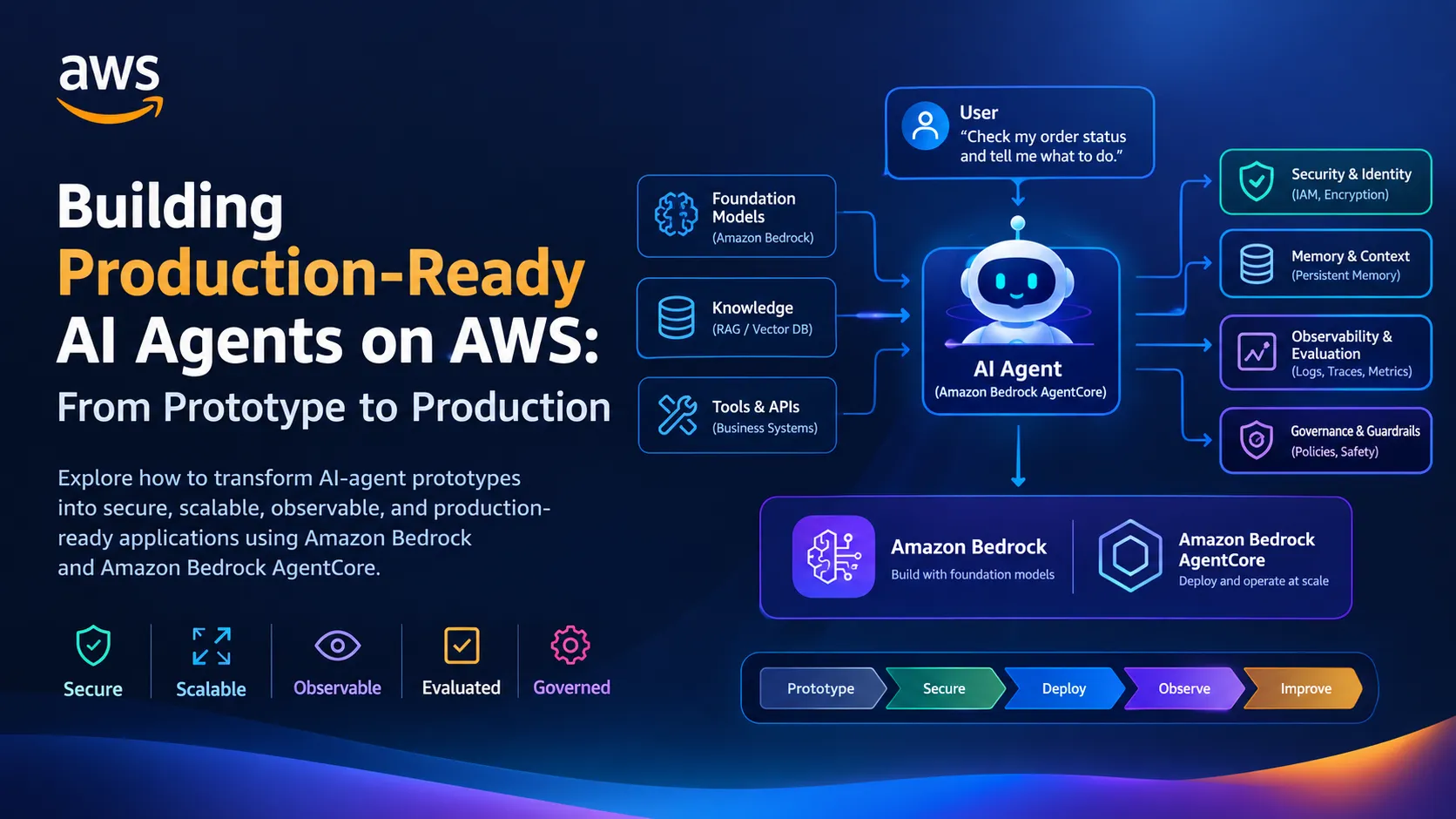
Building Production-Ready AI Agents on AWS: From Prototype to Production
Explore how to transform AI-agent prototypes into secure, scalable, observable, and production-ready applications using Amazon Bedrock and Amazon Bedrock AgentCore.

Yes. If AWS Builder Center has a body-size limit, we should keep the article professional but much shorter.
Below is a compact copy-paste-ready version. It keeps the important AWS/AgentCore concepts without the huge explanations.
Do NOT paste the Title or Description into the Body. Paste only everything inside this code block.
Generative AI has moved beyond simple chatbots. Modern AI agents can reason about tasks, use tools, retrieve information, maintain context, and interact with external systems.
However, a prototype that works in a demo is very different from an AI agent that can safely operate in production.
A production-ready agent needs more than a foundation model. It needs secure access to data and tools, identity, memory, observability, evaluation, governance, scalability, and reliable runtime infrastructure.
This article explores how Amazon Bedrock and Amazon Bedrock AgentCore can help developers move from an AI-agent prototype to a production-ready application.
---
## 1. From Chatbots to AI Agents
A traditional chatbot can be represented as:
```text
User → AI Model → Response
User → AI Model → Response
An AI agent adds reasoning, tools, knowledge, and memory:
+-------------+
| User |
+------+------+
|
v
+-------------+
| AI Agent |
+------+------+
|
+-------------+-------------+
| | |
v v v
Knowledge Tools Memory
| | |
+-------------+-------------+
|
v
Final Result
| User |
+------+------+
|
v
+-------------+
| AI Agent |
+------+------+
|
+-------------+-------------+
| | |
v v v
Knowledge Tools Memory
| | |
+-------------+-------------+
|
v
Final Result
Instead of simply generating text, an agent can determine what information it needs, select tools, execute actions, and use the results to complete a task.
---
2. The Production AI Agent Stack
A production agent can be viewed as several connected layers:
+----------------------------------+
| User Application |
+----------------+-----------------+
|
v
+----------------------------------+
| Identity & Security |
+----------------+-----------------+
|
v
+----------------------------------+
| Agent Runtime |
+----------------+-----------------+
|
+---------+---------+
| | |
v v v
Models Knowledge Tools
| | |
+---------+---------+
|
v
+----------------------------------+
| Memory | Policy | Observability |
| | | Evaluation |
+----------------------------------+
The important principle is that production AI is not only a model-integration problem. It is a complete application engineering problem.
---
3. Amazon Bedrock
Amazon Bedrock provides access to foundation models and capabilities for building generative AI applications.
A production application can combine foundation models with:
Knowledge sources
Tools and APIs
Memory
Identity
Security
Observability
Evaluation
The model provides reasoning, while the surrounding application provides the controls and capabilities required for production.
---
4. Amazon Bedrock AgentCore
Amazon Bedrock AgentCore provides capabilities for building, deploying, and operating AI agents securely at scale.
Important AgentCore capabilities include:
Runtime – Run agents and tools in a managed environment.
Memory – Maintain useful short-term and long-term context.
Gateway – Connect agents with tools, APIs, and MCP-compatible capabilities.
Identity – Help agents securely authenticate to AWS resources and external services.
Observability – Monitor agent workflows, traces, latency, and errors.
Evaluations – Measure agent quality and behavior.
Policy – Apply deterministic controls around agent actions.
Browser – Enable browser-based agent workflows.
Code Interpreter – Provide controlled code execution capabilities.
These capabilities can be used independently or combined depending on the application's requirements.
---
5. Knowledge and RAG
Enterprise agents often need information that is not contained in a foundation model.
Retrieval-Augmented Generation (RAG) can provide relevant information at inference time:
User Question
|
v
Retrieve Relevant Information
|
v
Context + Question
|
v
Foundation Model
|
v
Grounded Response
|
v
Retrieve Relevant Information
|
v
Context + Question
|
v
Foundation Model
|
v
Grounded Response
Production systems should consider retrieval quality, data freshness, source reliability, and access permissions.
The agent should retrieve only information that the user is authorized to access.
---
6. Tools and Security
Tools allow an agent to take action.
For example:
get_order_status()
check_inventory()
create_support_ticket()
send_notification()
check_inventory()
create_support_ticket()
send_notification()
However, tool access creates a security boundary.
A production agent should follow the principle of least privilege.
Agent
|
v
Policy Check
|
+----+
| |
Allow Deny
| |
v v
Tool Safe Response
|
v
Policy Check
|
+----+
| |
Allow Deny
| |
v v
Tool Safe Response
Sensitive operations should have stronger controls, validation, authorization, and auditing.
AI reasoning should never replace deterministic security controls.
---
7. Identity and Memory
Agents frequently act on behalf of users.
A secure flow is:
User
|
v
Authenticated Session
|
v
AI Agent
|
v
Authorized Tools
|
v
Authenticated Session
|
v
AI Agent
|
v
Authorized Tools
AgentCore Identity helps agents authenticate and securely access required resources and services.
Memory can also improve agent experiences by preserving relevant context:
Short-Term Memory
├─ Current conversation
└─ Current task
├─ Current conversation
└─ Current task
Long-Term Memory
├─ Useful preferences
└─ Relevant history
├─ Useful preferences
└─ Relevant history
Memory should be intentional. Production systems should define what is stored, why it is stored, how long it is retained, and who can access it.
---
8. Observability and Evaluation
AI agents can follow dynamic workflows, making debugging more difficult than traditional applications.
A single request may involve:
User
|
v
Agent
|
+--> Model
|
+--> Tool
|
+--> Knowledge
|
v
Final Response
|
v
Agent
|
+--> Model
|
+--> Tool
|
+--> Knowledge
|
v
Final Response
AgentCore Observability can provide visibility into agent behavior and telemetry.
Important signals include:
Latency
Errors
Tool calls
Model usage
Token usage
Agent traces
Resource usage
Evaluation is equally important.
A good agent should be measured on:
Task completion
Response quality
Tool usage
Safety
Reliability
A useful continuous improvement loop is:
Build → Test → Evaluate → Deploy
^ |
| v
+------ Improve ← Observe
^ |
| v
+------ Improve ← Observe
---
9. Policy and Governance
Production agents need clear boundaries.
For example, an agent may be allowed to check an order but require additional authorization before modifying an account or performing a financial action.
Agent Decision
|
v
Policy Check
/ \
Allow Deny
| |
v v
Action Safe Response
|
v
Policy Check
/ \
Allow Deny
| |
v v
Action Safe Response
AgentCore Policy can help enforce deterministic controls around agent actions.
This creates an important principle:
AI reasoning + deterministic security controls
---
10. Example: Customer Support Agent
Consider a customer asking:
> "My order is delayed. Can you check its status?"
A production agent could:
1. Authenticate the customer.
2. Understand the request.
3. Call an order-status tool.
4. Retrieve the latest delivery information.
5. Retrieve the applicable company policy.
6. Determine available options.
7. Return a grounded response.
8. Record telemetry and evaluate the interaction.
The workflow becomes:
Customer
|
v
Authentication
|
v
AI Agent
|
+----> Order Tool
|
+----> Knowledge / Policy
|
v
Response
|
+----> Observability
|
+----> Evaluation
|
v
Authentication
|
v
AI Agent
|
+----> Order Tool
|
+----> Knowledge / Policy
|
v
Response
|
+----> Observability
|
+----> Evaluation
This is much closer to a real production AI application than simply sending a prompt to a model.
---
11. Production Readiness Checklist
Before deploying an AI agent, consider:
Architecture
[ ] Is the use case clearly defined?
[ ] Is the architecture scalable?
[ ] Are failure scenarios considered?
Security
[ ] Is authentication implemented?
[ ] Is authorization enforced?
[ ] Is least privilege applied?
[ ] Are sensitive actions protected?
Knowledge
[ ] Are sources trustworthy?
[ ] Is retrieved information relevant?
[ ] Are permissions enforced?
Tools
[ ] Are only required tools exposed?
[ ] Are tool inputs validated?
[ ] Are failures handled safely?
Memory
[ ] Is memory actually required?
[ ] Are retention rules defined?
[ ] Is user data isolated?
Operations
[ ] Are logs and traces available?
[ ] Is agent quality evaluated?
[ ] Are cost and latency monitored?
[ ] Is there a continuous improvement process?
---
12. From Prototype to Production
A practical development path is:
Define Problem
|
v
Build Prototype
|
v
Add Knowledge
|
v
Add Tools
|
v
Implement Identity & Security
|
v
Add Memory
|
v
Deploy
|
v
Observe & Evaluate
|
v
Optimize & Improve
|
v
Build Prototype
|
v
Add Knowledge
|
v
Add Tools
|
v
Implement Identity & Security
|
v
Add Memory
|
v
Deploy
|
v
Observe & Evaluate
|
v
Optimize & Improve
The goal is not simply to build an agent that works.
The goal is to build an agent that works reliably, securely, measurably, and at scale.
---
Conclusion
The transition from an AI prototype to production requires a change in mindset.
It is no longer enough to ask:
> "Can the model answer the question?"
We also need to ask:
> "Can the agent safely complete the task?"
> "Can we observe what it did?"
> "Can we measure whether it succeeded?"
> "Can we control what it is allowed to do?"
> "Can we operate it reliably at scale?"
Amazon Bedrock and Amazon Bedrock AgentCore provide building blocks for addressing these requirements.
A production-ready AI agent combines:
Foundation Models + Knowledge + Tools + Memory + Identity + Security + Observability + Evaluation + Governance
The most successful AI applications will not simply be the ones with the most powerful models.
They will be the ones that combine intelligence with strong engineering: secure, scalable, observable, evaluated, governed, and reliable.
Enjoyed reading this content? Let the author know!
Your likes, comments, shares, and saves help creators reach more builders.

Loading recommendations
Loading article