
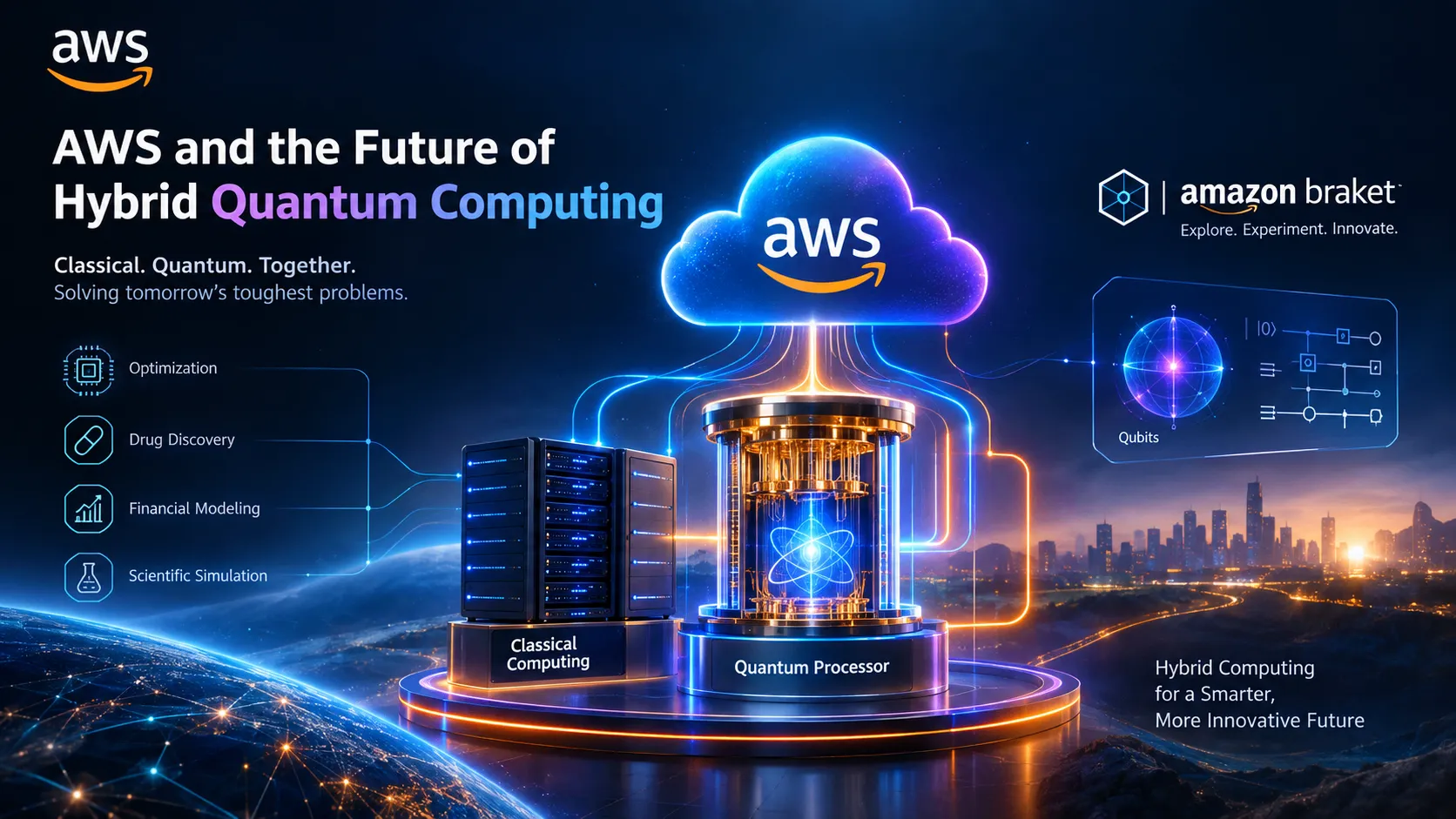
AWS and the Future of Hybrid Quantum Computing
Quantum computing is emerging as a powerful technology for solving certain complex problems that are difficult for traditional computers to handle efficiently. With AWS, organizations can explore quantum technologies through cloud-based infrastructure and experiment with different quantum computing approaches without building their own quantum hardware.

Computing has continuously evolved to solve problems that were once considered impossible. From large-scale data processing to artificial intelligence and cloud computing, every generation of technology has introduced new ways to process information and solve complex challenges. Today, quantum computing is emerging as one of the most exciting areas of technological development. Unlike traditional computing, quantum computing uses principles of quantum mechanics to process information in fundamentally different ways.
However, quantum computing is not expected to simply replace classical computers. Instead, one of the most promising directions is hybrid computing, where classical and quantum systems work together. Classical computers remain extremely powerful for everyday applications, data processing, storage, networking, and application management, while quantum processors may eventually provide advantages for specific types of computational problems.
AWS is exploring this future through its cloud-based quantum computing capabilities. With services such as Amazon Braket, organizations can experiment with quantum computing without needing to build their own quantum infrastructure. This creates a path for researchers, developers, and businesses to explore quantum technologies while continuing to rely on the scalability and flexibility of cloud computing.
Understanding Hybrid Quantum Computing
Hybrid quantum computing combines the strengths of classical computing and quantum computing. A traditional computer can handle many tasks efficiently, including preparing data, controlling applications, managing workflows, and analyzing results. A quantum computer, on the other hand, can be used for specific computational tasks where quantum algorithms may offer potential advantages.
A hybrid workflow could begin with a classical system preparing a problem and its required data. The relevant portion of the problem can then be converted into a quantum circuit and executed on a quantum processor or simulator. The resulting output can be returned to the classical system, where it can be analyzed and used to continue the workflow.
This approach is important because current quantum computers are still developing. They are not designed to replace CPUs and GPUs for general-purpose computing. Instead, quantum computing can be viewed as another type of computational resource that may become useful for selected workloads.
The combination of cloud infrastructure and quantum technologies therefore creates an interesting model for future computing. Instead of purchasing and maintaining specialized quantum hardware, organizations can explore quantum capabilities through cloud-based services and integrate them with existing technology environments.
The Role of AWS in Quantum Computing
Cloud computing has already changed how organizations access computing resources. Instead of purchasing physical servers and managing large infrastructure environments, businesses can access computing, storage, networking, databases, analytics, and artificial intelligence services through the cloud.
Quantum computing can follow a similar direction.
AWS provides a cloud-based environment for experimenting with quantum technologies through Amazon Braket. The service is designed to help users develop and test quantum algorithms and experiment with quantum hardware and simulators.
This cloud-based approach is valuable because quantum hardware is highly specialized. Building and operating a quantum computer requires complex technologies, controlled environments, and specialized expertise. Cloud access can reduce the infrastructure barrier and provide a more flexible way to experiment.
Amazon Braket also supports access to different quantum computing technologies, allowing users to explore quantum algorithms across simulators and available quantum hardware. This gives organizations an opportunity to compare approaches and understand how quantum computing could fit into future workloads.
The larger idea is not simply to provide access to quantum machines. It is to connect quantum experimentation with the broader cloud ecosystem.
Amazon Braket and Quantum Experimentation
Amazon Braket provides a practical environment for exploring quantum computing concepts and workflows. Users can create quantum circuits, simulate them, and experiment with quantum algorithms.
A quantum circuit consists of operations performed on qubits. These operations are represented through quantum gates that manipulate the state of the qubits. Concepts such as superposition and entanglement are fundamental to understanding how quantum algorithms operate.
For example, a classical bit can normally represent either 0 or 1. A qubit can exist in a quantum state that represents a combination of possible states until it is measured. This difference creates the foundation for quantum computation.
Amazon Braket allows users to experiment with these concepts using simulators and quantum devices available through the service. Developers can therefore move beyond theoretical explanations and explore how quantum circuits behave in practice.
This experimentation model is particularly important because quantum computing is still an evolving field. Researchers and organizations need environments where they can test ideas, evaluate algorithms, and understand the practical limitations of current quantum technologies.
Classical Computing Meets Quantum Computing
The most interesting future may be a world where classical and quantum computing operate together.
Imagine a large optimization problem involving thousands or millions of possible combinations. A classical cloud application could collect the required data, prepare the problem, and manage the overall workflow. A quantum component could then be used to explore a specific computational challenge. Once the quantum computation is completed, the results could return to the classical environment for further analysis.
This creates a continuous cycle between classical and quantum systems.
The classical infrastructure provides scalability, data management, orchestration, and application services. Quantum computing provides another computational approach that can be explored for specific problems.
This model could eventually become useful across multiple industries. However, it is important to recognize that quantum computing is still an emerging technology. Not every problem will benefit from quantum computing, and practical advantages depend on the development of quantum hardware, algorithms, error correction, and software.
Therefore, hybrid computing should be viewed as an evolving approach rather than a guaranteed replacement for traditional systems.
Potential Applications
One of the reasons quantum computing attracts so much attention is its potential application across different industries.
Optimization
Optimization problems appear in transportation, logistics, supply chains, manufacturing, scheduling, and many other areas. Organizations often need to find the best solution among a very large number of possibilities.
Quantum algorithms may eventually provide new approaches to certain optimization problems. Hybrid workflows could allow classical systems to manage the overall problem while quantum resources are explored for specific computational components.
Drug Discovery and Chemistry
Understanding molecular behavior is computationally challenging. Quantum computing is particularly interesting in chemistry because molecules themselves follow quantum mechanical principles.
Future quantum systems could potentially help researchers explore molecular structures, interactions, and chemical processes. Although significant technical challenges remain, this is one of the areas where quantum computing research could have long-term impact.
Financial Modeling
Financial institutions work with complex optimization, risk analysis, portfolio management, and simulation problems. Quantum computing is being investigated as a possible tool for certain financial workloads.
A hybrid architecture could combine classical financial systems and cloud infrastructure with quantum algorithms designed for specific mathematical problems.
Scientific Research
Scientific simulations often require enormous computational resources. Researchers studying physics, materials, chemistry, and other scientific fields may eventually use quantum computing as an additional computational resource.
Cloud access can make experimentation easier by providing a connection between existing scientific workflows and emerging quantum technologies.
Artificial Intelligence and Machine Learning
Quantum computing is also being researched in relation to machine learning and optimization. While practical quantum advantage for mainstream AI workloads has not been established, researchers continue to explore quantum machine learning algorithms and hybrid quantum-classical models.
The combination of classical AI infrastructure with quantum experimentation could become an interesting research direction as both technologies continue to evolve.
Why Cloud Computing Matters for Quantum Technology
Quantum computing requires specialized hardware, but access to that hardware does not necessarily need to be limited to organizations that own quantum computers.
Cloud computing changes this model.
Instead of physically owning a quantum system, an organization can access quantum resources through a cloud platform. This can make experimentation more flexible and allow teams to evaluate quantum technologies before making major infrastructure investments.
Cloud platforms can also provide supporting services around quantum computing. Data can be stored and processed using cloud infrastructure, applications can be developed using familiar programming environments, and computational workflows can be orchestrated using existing cloud technologies.
This creates an ecosystem rather than a standalone quantum computer.
The future of quantum computing may therefore depend not only on improving quantum processors but also on building software, cloud services, developer tools, and infrastructure that make quantum technology useful in real-world environments.
Challenges Ahead
Although quantum computing has significant potential, there are still major challenges.
Quantum systems can be extremely sensitive to environmental disturbances. Maintaining stable quantum states is difficult, and quantum errors can occur during computation. Developing reliable error correction remains one of the most important challenges in the field.
Another challenge is algorithm development. Quantum algorithms need to be designed specifically for quantum systems, and only certain classes of problems are expected to benefit significantly from quantum approaches.
There is also a gap between experimental quantum computing and large-scale practical applications. Current quantum systems are still developing, and researchers are continuing to investigate where quantum advantage can provide meaningful real-world benefits.
These challenges mean that organizations should approach quantum computing as an emerging technology with significant research potential rather than assuming that it will immediately replace classical computing.
AWS and the Next Generation of Computing
The future of computing is likely to involve multiple types of processors working together. CPUs, GPUs, specialized accelerators, and potentially quantum processors could each play different roles depending on the workload.
AWS has an opportunity to bring these technologies together through its cloud ecosystem.
A future application could potentially use traditional cloud services for data storage and processing, GPUs for artificial intelligence workloads, specialized hardware for high-performance computing, and quantum resources for selected computational problems.
This type of architecture could make computing more flexible. Instead of asking which single technology is the best, organizations could select the most appropriate technology for each part of a problem.
Quantum computing therefore becomes part of a broader computing ecosystem rather than an isolated technology.
The Road Ahead
Quantum computing is still in an early stage, but its development is moving forward rapidly. Researchers are improving quantum hardware, developing new algorithms, and exploring potential applications across different industries.
Cloud platforms can play an important role in this development because they provide an accessible environment for experimentation and integration.
AWS services such as Amazon Braket provide a way to explore quantum computing while maintaining the benefits of cloud infrastructure. This allows organizations to learn what quantum computing can offer today while preparing for future developments.
The long-term goal should not simply be to build faster computers. It should be to create computing systems capable of solving increasingly complex problems using the most appropriate technologies available.
Enjoyed reading this content? Let the author know!
Your likes, comments, shares, and saves help creators reach more builders.

Loading recommendations
Loading article