
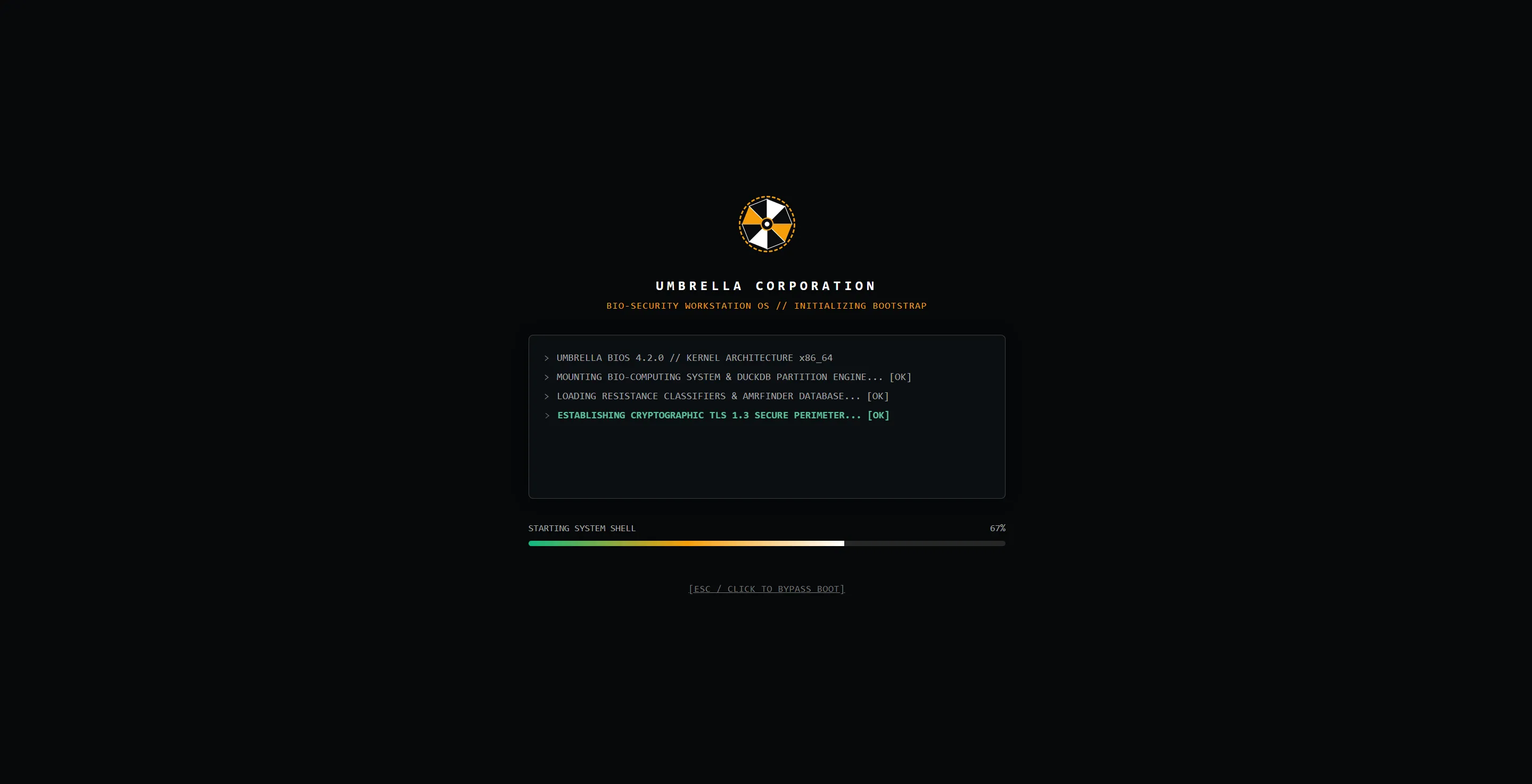
Umbrella OS — Built for Kiro Build Challenge
A web-based scientific desktop where a bacterial genome goes from upload to QC, AMR detection and a model-backed prediction, with an AI app builder, all tracked with full provenance. Built with Kiro.


OVERVIEW
Umbrella OS is a web-based scientific desktop for computational biology where a researcher can upload a bacterial genome, run QC, inspect mutations, detect antimicrobial resistance (AMR), and get a model-backed prediction with confidence and evidence. An AI assistant explains every result, and a built-in app builder can create new scientific tools from plain English. It helps students, researchers and AMR analysts who currently stitch together disconnected tools by hand.
PROBLEM STATEMENT
Computational biology workflows are fragmented across FASTA files, web tools, AMR annotators, custom scripts, notebooks and spreadsheets. The pain is in the gaps between them: data is converted by hand, parameters are forgotten, results are copy-pasted, and tool versions go untracked. This makes analysis slow and hard to reproduce.
Researchers need a single environment that turns raw bacterial sequence data into reproducible analysis, comparative evidence and model-backed insights without stitching tools together manually.
SOLUTION & WHAT WE BUILT
Umbrella OS keeps the familiar desktop model (windows, launcher, taskbar, terminal) but fills it with domain-native scientific apps. Every sample has one persistent identity, and every result carries its input hash, tool version, parameters and model version.
Workflow: Sample Vault → Sequence QC → Genome analysis → Mutation engine → AMR annotation → Report
Core features
- Stateful desktop: select a sample once and every app sees it. Apps communicate through a typed event bus (
sample.selected,variants.created), so there is no re-uploading. - Genome Analyzer: length, contigs, GC%, N% and SHA-256 checksum. Large files run as background jobs, and sequence slices are fetched by coordinate instead of sending whole genomes to the browser.
- Mutation Lab: deterministic reference-vs-query comparison. If a mutation overlaps a known AMR marker, it links to that evidence rather than making its own claim.
- AMR Sentinel: runs NCBI AMRFinderPlus, normalizes hits into features, and feeds a per-antibiotic logistic-regression model. Each prediction is an evidence dossier: predicted class, calibrated confidence, evidence coverage, out-of-distribution flag, QC state and model version, with a "research use only" note.
- Report Studio: composes everything into a report with hashes, versions and timestamps.
- Vella (AI assistant): works in Explain, Analyze and Orchestrate modes and calls typed tools (
genome_qc,mutation_compare,amr_scan,phenotype_predict). It never invents mutation coordinates, genes, probabilities or citations. If a tool fails, it reports the failure instead of guessing. - Umbrella Forge (our hero feature): ask for a tool that doesn't exist, such as "Build a bacterial sequence comparator with two sequence selectors, a difference table, a base-level viewer and export." Forge runs a 7-step pipeline: intent → app spec → UI/logic → permission analysis → validation → install → evolve. Generated apps are declarative and sandboxed, never raw model output run on the host. A follow-up like "Add GC-content comparison" creates a versioned update instead of overwriting the app.
Keeping the science honest: annotations are evidence, not ground truth. Phenotype targets come from laboratory measurements or benchmark-pinned labels, never from another tool's prediction. Evaluation is designed around grouped splits with a sealed test set to avoid leakage. Umbrella OS is a research tool, not a clinical diagnostic.
HOW WE USED KIRO
Kiro acted as an engineering multiplier. We kept the scientific assumptions in human-reviewed files and let Kiro handle structure and implementation. All artifacts are in the repo's
.kiro/ folder.Specs (requirements → design → tasks): we wrote a separate spec for each major component (
desktop-shell, app-runtime, forge, genome-analyzer, mutation-lab, amr-sentinel, model-pipeline). This let us build in dependency order, with a clear checklist for each part. For Forge, the requirements pinned down exactly which capabilities a generated app may request, giving permission analysis and validation precise acceptance criteria.Steering files: four persistent rule files (
product.md, architecture.md, scientific-integrity.md, ui.md) kept every session consistent.scientific-integrity.mdencoded rules like never use a predicted phenotype as a training target and every result must carry provenance.architecture.mdlocked in boundaries such as generated apps never touch the host filesystem or shell.ui.mdfixed the visual language and shared component set so generated apps looked native.
Hooks: automated guardrails (
test-on-save, validate-generated-app, provenance-check). They validated Forge manifests against schema and permission rules and flagged any result missing a hash, tool version or dataset version.Biggest lesson: constraining the AI makes it more useful. The SDK, capability model and steering rules made Forge and Vella more reliable, not less.
ARCHITECTURE & TECH STACK
- Frontend: Next.js 15, React 19, TypeScript, Tailwind CSS, shadcn/ui, Framer Motion, Apache ECharts
- Backend: FastAPI, Pydantic, Uvicorn; Python scientific core (optional C++17 for measured hot paths)
- AI layer: LLM gateway with typed tool calling (Vella) and an app-spec DSL with validator (Forge)
- Data: PostgreSQL (samples, jobs, provenance), Parquet + DuckDB (derived tables), filesystem for immutable raw sequences
- ML: scikit-learn (per-antibiotic regularized logistic regression with calibration)
- Bio tools: NCBI AMRFinderPlus
- Execution: WSL2 Ubuntu + Docker, with long jobs run as subprocesses streaming progress events to the UI
- Deployment: Vercel (live frontend)
- Dev workflow: Kiro Specs, Steering and Hooks
LINKS & DEMO
- GitHub Repository: https://github.com/FROSTY-MUG/Umbrella
- Working Demo (Live App): https://umbrella-pink.vercel.app/
TEAM / BUILDER DETAILS
- Builder Name(s): Aryan Arora and Saksham Chawla
- Track: AI-native scientific computing for healthcare: unifying fragmented genomics workflows into one reproducible, provenance-tracked desktop for antimicrobial resistance (AMR) research.
Built during the Kiro Build Challenge conducted jointly by AWS Student Builder Group GEU & AWS Student Builder Group PIET.
Challenge Details: https://awssbggeu.com/challenges/kiro-build-challenge
Challenge Details: https://awssbggeu.com/challenges/kiro-build-challenge
Enjoyed reading this content? Let the author know!
Your likes, comments, shares, and saves help creators reach more builders.

Loading recommendations
Loading article