
Authentication: The First Layer of Security in Modern Applications
Whether you are using a banking application, social media platform, college portal, or an AI application, authentication helps answer one basic question:

Authentication is one of the first things users interact with when they use an application, but it is also one of the most important behind-the-scenes security mechanisms.
Whether you are using a banking application, social media platform, college portal, or an AI application, authentication helps answer one basic question:
“Who are you?”
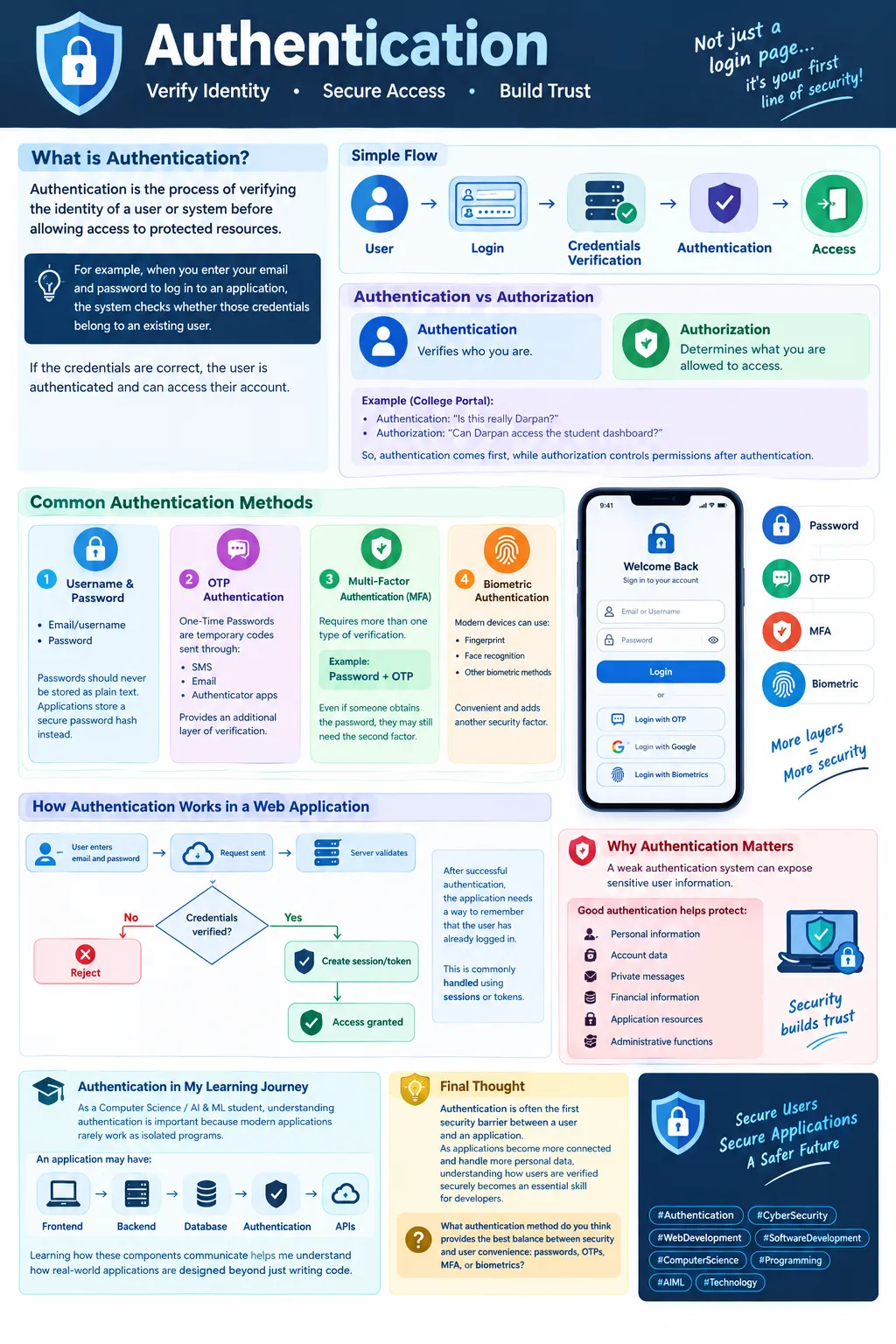
What is Authentication?
Authentication is the process of verifying a user's or system's identity before allowing access to protected resources.
For example, when you enter your email and password to log in to an application, the system checks whether those credentials belong to an existing user.
If the credentials are correct, the user is authenticated and can access their account.
Simple flow:
User → Login → Credentials Verification → Authentication → Access
Authentication vs Authorization
These two terms are often confused.
Authentication verifies who you are.
Authorization determines what you are allowed to access.
For example:
You log in to a college portal.
- Authentication: “Is this really Darpan?”
- Authorization: “Can Darpan access the student dashboard?”
So, authentication comes first, while authorization controls permissions after authentication.
Common Authentication Methods
1. Username and Password
This is the most common authentication method.
The user provides:
- Email/username
- Password
The server verifies the credentials and provides access if they are valid.
However, passwords should never be stored as plain text. Applications normally store a secure password hash instead.
2. OTP Authentication
One-Time Passwords are temporary codes sent through channels such as:
- SMS
- Authenticator applications
An OTP provides an additional layer of verification.
3. Multi-Factor Authentication
Multi-Factor Authentication, or MFA, requires more than one type of verification.
For example:
Password + OTP
Even if someone obtains the password, they may still need the second authentication factor.
4. Biometric Authentication
Modern devices can also use:
- Fingerprint
- Face recognition
- Other biometric methods
This makes authentication more convenient while adding another security factor.
How Authentication Works in a Web Application
A typical login system can follow this process:
1
2
3
4
5
6
7
8
9
10
11
12
13
User enters email and password
             ↓
       Request sent
             ↓
       Server validates
             ↓
    Credentials verified?
        ↙          ↘
      No            Yes
      ↓              ↓
   Reject        Create session/token
                     ↓
                Access granted
After successful authentication, the application needs a way to remember that the user has already logged in.
This is commonly handled using sessions or tokens.
Why Authentication Matters
A weak authentication system can expose sensitive user information.
Good authentication helps protect:
- Personal information
- Account data
- Private messages
- Financial information
- Application resources
- Administrative functions
For developers, authentication is therefore not just a login page. It is an important part of the application's overall security architecture.
Authentication in My Learning Journey
As a Computer Science / AI & ML student, understanding authentication is important because modern applications rarely work as isolated programs.
An application may have:
Frontend → Backend → Database → Authentication → APIs
Learning how these components communicate helps me understand how real-world applications are designed beyond just writing code.
The important lesson is simple:
A login form is only the visible part of authentication. The real work happens behind it.
Final Thought
Authentication is often the first security barrier between a user and an application.
As applications become more connected and handle more personal data, understanding how users are verified securely becomes an essential skill for developers.
What authentication method do you think provides the best balance between security and user convenience: passwords, OTPs, MFA, or biometrics?
#Authentication #CyberSecurity #WebDevelopment #SoftwareDevelopment #ComputerScience #Programming #AIML #Technology
Enjoyed reading this content? Let the author know!
Your likes, comments, shares, and saves help creators reach more builders.

Loading recommendations
Loading article