
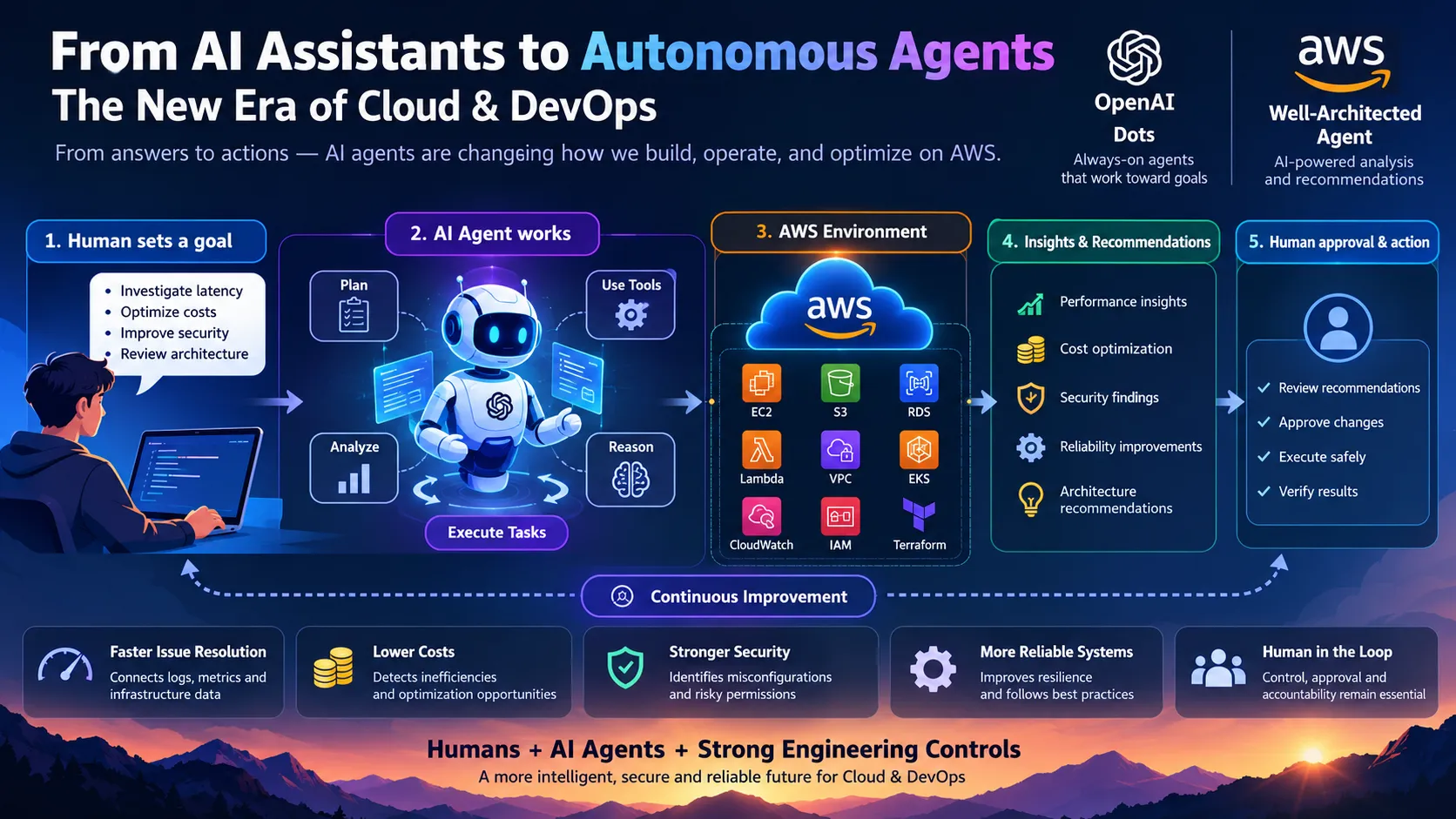
AI Agents: The New Era of Cloud & DevOps
Explore how AI agents are transforming cloud and DevOps through automation, intelligent operations, security, and human-in-the-loop engineering.

From AI Assistants to Autonomous Agents: The New Era of Cloud & DevOps
AI is rapidly moving beyond answering questions and generating code. The rise of AI agents is changing how software, cloud infrastructure, and DevOps workflows can be designed and operated.
At DevDay 2026, OpenAI introduced Dots, highlighting the idea of always-on agents that can continue working toward goals between conversations. At the same time, AWS has introduced the AWS Well-Architected Agent, bringing AI-assisted analysis and recommendations directly into cloud architecture and operations.
This raises an important question for DevOps engineers:
How much autonomy should we give AI agents in production cloud environments?
From AI Assistants to AI Agents
Traditional AI interaction usually looks like:
Human → Prompt → AI → Answer → Human acts
Agentic AI changes this workflow:
Human → Goal → Agent → Plan → Tools → Execute → Observe → Report
The difference is that an agent can participate in a complete workflow rather than simply providing an answer.
For DevOps, this could mean AI agents helping with tasks such as analyzing logs, investigating incidents, reviewing infrastructure, identifying configuration problems, and recommending remediation.
What This Means for DevOps
DevOps already relies heavily on automation through CI/CD, Infrastructure as Code, monitoring, containers, and cloud services.
AI agents can add another layer of intelligence to these workflows.
For example, imagine an application experiencing increased latency:
1
2
3
4
5
6
7
8
9
10
11
12
13
14
15
16
17
CloudWatch Metrics
        ↓
Application Logs
        ↓
Infrastructure Analysis
        ↓
AI Agent
        ↓
Possible Root Cause
        ↓
Recommended Fix
        ↓
Human Approval
        ↓
Remediation
        ↓
Verification
Instead of manually checking every component, an agent could help connect information from different parts of the environment and guide the engineer toward the most likely cause.
AWS and the Agentic Cloud
The AWS Well-Architected Agent is an interesting example of this direction. It can analyze AWS environments and provide recommendations related to areas such as cost, security, performance, and resilience.
This represents a shift from simply monitoring infrastructure toward using AI to understand the environment and provide more contextual recommendations.
The broader idea is powerful:
Observe → Understand → Recommend → Approve → Execute → Verify
However, the important part is the approval and control layer.
Should AI Agents Have Full Access?
Giving an AI agent access to a cloud environment is very different from asking an AI a question.
A wrong answer may waste a few minutes.
A wrong infrastructure change could cause an outage, increase costs, expose data, or create a security vulnerability.
A practical approach could be:
Low-risk actions:
Read logs, analyze metrics, generate reports, and perform diagnostics automatically.
Read logs, analyze metrics, generate reports, and perform diagnostics automatically.
Medium-risk actions:
Prepare infrastructure or configuration changes but require human approval.
Prepare infrastructure or configuration changes but require human approval.
High-risk actions:
Require explicit human approval for IAM changes, production database operations, destructive actions, and sensitive security changes.
Require explicit human approval for IAM changes, production database operations, destructive actions, and sensitive security changes.
This makes least privilege, IAM, observability, and approval workflows even more important in an agentic cloud environment.
The DevOps Engineer Is Not Disappearing
I don't see agentic AI simply as AI replacing DevOps engineers.
Instead, the role may evolve.
Engineers could spend less time performing repetitive operational tasks and more time designing:
- Cloud architecture
- Automation workflows
- Security boundaries
- IAM policies
- CI/CD pipelines
- Observability
- Reliability controls
- Human approval mechanisms
The valuable skill will not only be knowing how to tell an agent what to do.
It will be understanding whether the agent should be allowed to do it, how it should do it safely, and how we verify the result.
Final Thought
The future of cloud engineering may not be Humans vs. AI.
It may be:
Humans + AI Agents + Strong Engineering Controls
As AI agents become increasingly capable of interacting with cloud environments, the challenge will not simply be giving them more autonomy.
The real challenge will be deciding where autonomy should end and human judgment should begin.
How much autonomy would you be comfortable giving an AI agent in a production AWS environment?
Enjoyed reading this content? Let the author know!
Your likes, comments, shares, and saves help creators reach more builders.

Loading recommendations
Loading article