
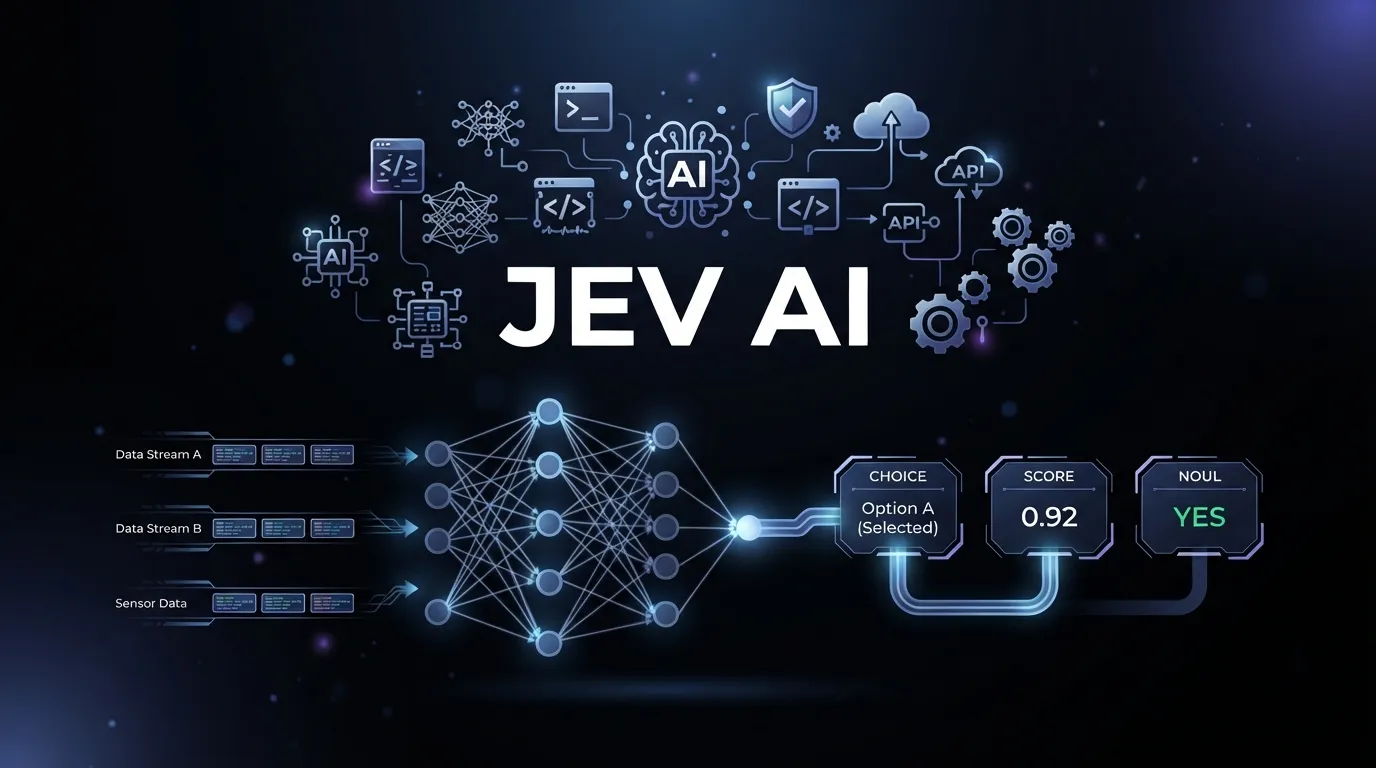
Jev AI : A Different Approach to AI Models
Explore Jev AI, a decision-focused model for structured outputs, routing, and scoring, and see how it differs from LLMs and where it fits.

Most AI applications today are built around Large Language Models (LLMs). Models such as GPT, Claude, and Gemini are designed to understand prompts and generate natural-language responses. This works extremely well for tasks such as writing, coding, summarization, and conversation.
However, many software applications do not actually need a paragraph of generated text. They need a decision. For example:
- Is this email spam?
- Which department should handle this ticket?
- Should this transaction be flagged?
- Which tool should an AI agent use?
This is where Jev takes a different approach.
What Is Jev?
Jev, developed by TypeSafe AI, is a decision-oriented AI model. Instead of generating natural-language responses, it returns structured decisions such as choices, scores, and probabilities.
The basic difference looks like this:
- LLM: prompt → a paragraph of generated text
- Jev: prompt → a typed decision, such as
{"department": "Billing", "confidence": 0.94}
This makes Jev particularly interesting for applications where the possible outcomes are already known.
Why Is This Useful?
One of Jev's biggest advantages is structured output. Suppose an application receives a support request. An LLM might explain that the issue appears to be related to billing. With a decision model, the application can simply receive:
json
1
2
3
4
{
  "department": "Billing",
  "confidence": 0.94
}
The backend can immediately route the request without having to parse a natural-language response.
Other potential advantages include:
- Simpler integration: Applications work with predefined decisions rather than parsing generated text.
- Predictable output: The application defines the possible answers, so the model cannot return a value outside them.
- Useful for automation: Decisions can directly trigger workflows or actions.
- Confidence information: Probability-based results help determine when a decision should be automated and when it should be reviewed by a person.
- Lower complexity for specific tasks: A decision model doesn't need to behave like a full conversational system when the task is simply classification or selection.
Where Can Jev Be Used?
Jev's approach makes sense for tasks such as:
- Customer Support: classify and route tickets to the correct department.
- Security: determine whether an event should be flagged for further investigation.
- AI Agents: decide which tool or workflow should be executed.
- Content Moderation: classify content as safe, spam, or requiring review.
- Risk Scoring: assign risk levels to transactions, requests, or other events.
- Model Routing: decide which specialized AI model should handle a particular request.
But There Are Limitations
Jev is not a replacement for an LLM. Its strength is also its limitation: it is designed around defined decisions. If an application needs an explanation, creative writing, code generation, or an open-ended conversation, a traditional generative model is usually a better fit.
There are also the usual concerns around AI systems. Predictions can be wrong, confidence scores should not be treated as guarantees, and important decisions still need appropriate validation and human oversight. A model can make the wrong decision even when its output is perfectly well formed.
Another consideration is that Jev is very new. TypeSafe AI introduced it in September 2026, and it is currently in early access, so its ecosystem, tooling, documentation, and real-world adoption are still developing. Performance and cost figures published so far come from TypeSafe's own testing and should be verified against your own workloads.
Jev and LLMs Can Work Together
The interesting part isn't necessarily Jev versus LLMs. They can complement each other. An LLM can handle the conversation and reasoning, while Jev handles a specific decision inside the application's workflow. This gives developers another way to design AI systems without forcing one model to handle every part of the application.
Conclusion
Jev represents an interesting shift in how we think about AI. Traditional AI models are increasingly good at generating information. Jev focuses on a different problem: turning information into structured decisions that software can act on.
It won't replace generative AI, and it isn't meant to. But for classification, routing, scoring, and automation, a decision-focused model can be a useful addition to the AI stack.
As AI applications become more complex, the future may not be about finding one model that does everything. It may be about combining specialized models and giving each one a clear responsibility.
Sometimes an application doesn't need another paragraph from AI. It just needs the right decision.
Enjoyed reading this content? Let the author know!
Your likes, comments, shares, and saves help creators reach more builders.

Loading recommendations
Loading article