
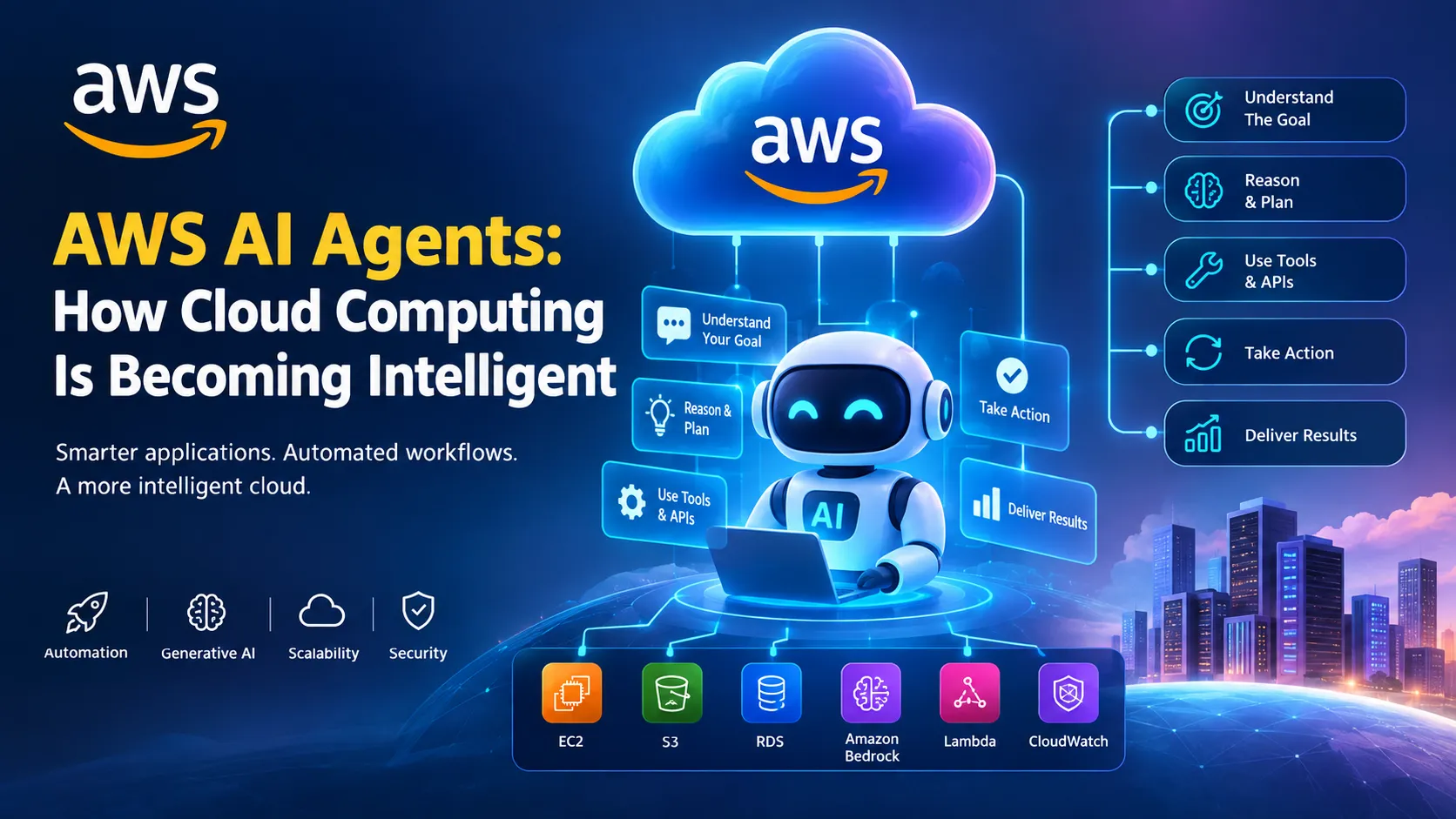
How Cloud Computing Is Becoming Intelligent
AWS AI Agents are changing the way applications interact with users, data, and cloud services. Discover how intelligent AI agents can reason, make decisions, use tools, automate tasks, and transform traditional cloud applications into intelligent systems.

AWS AI Agents: How Cloud Computing Is Becoming Intelligent
Cloud computing has already transformed the technology industry. Businesses no longer need to purchase large physical servers or build expensive data centers to run their applications. With cloud platforms such as Amazon Web Services (AWS), companies can access computing power, storage, databases, networking, and artificial intelligence through the internet.
But cloud computing is now entering another major phase.
The next generation of cloud applications will not simply store information or execute commands. They will increasingly be able to understand goals, make decisions, use tools, and complete tasks.
This is where AI agents come into the picture.
AWS is combining cloud infrastructure with artificial intelligence to help developers build applications that can work more intelligently and automate complex workflows.
What Is an AI Agent?
An AI agent is a software system that can understand a goal, reason about what needs to be done, use available tools, and take actions to achieve that goal.
A traditional application usually follows predefined instructions:
Input → Fixed Logic → Output
An AI agent can work more dynamically:
Goal → Understand → Reason → Choose Action → Use Tools → Observe Result → Continue
For example, imagine a customer asks:
“Find my recent order and tell me why it has not arrived.”
A traditional chatbot might simply provide a general answer.
An AI agent could potentially:
- Understand the customer's request.
- Identify the customer's order.
- Access an order-management system.
- Check the delivery status.
- Analyze the information.
- Determine the likely issue.
- Provide an explanation.
- Take an authorized action if required.
This ability to work across multiple steps is what makes AI agents different from simple chatbots.
Why AWS AI Agents Matter
Modern businesses use many different systems.
A company might have:
- Customer databases
- Payment systems
- Inventory software
- CRM platforms
- Internal documents
- Analytics systems
- Cloud applications
- Support platforms
Normally, employees have to move between these systems manually.
AI agents can act as an intelligent layer connecting these systems.
Instead of simply answering questions, an agent can potentially reason over information and interact with approved tools.
This can reduce repetitive work and help employees focus on more valuable tasks.
Amazon Bedrock and AI Agents
One of the important AWS services for building generative-AI applications is Amazon Bedrock.
Amazon Bedrock provides access to foundation models through AWS and allows developers to build generative-AI applications without managing the underlying model infrastructure themselves.
For agent-based applications, developers can create systems where an AI model can work with tools, data sources, and business workflows.
A simplified architecture could look like this:
User
↓
AI Application
↓
AI Agent
↓
Foundation Model
↓
Tools + APIs + Business Data
↓
Result / Action
The agent becomes the decision-making layer between the user's goal and the systems required to complete it.
How an AWS AI Agent Works
An AI agent can be understood through several basic stages.
1. Understand the Goal
The agent first analyzes the user's request.
For example:
“Find products under ₹2,000 and recommend the best option.”
The agent needs to understand that the user wants both filtering and recommendation.
2. Plan the Task
The agent determines what information is required.
It might decide:
Search products → Filter by price → Compare options → Generate recommendation
3. Use Tools
The agent can be connected to approved tools or APIs.
For example:
- Database API
- Search system
- Inventory API
- Payment service
- Internal knowledge base
4. Analyze the Results
The agent receives information from the tools and evaluates it.
It can determine whether additional information is required.
5. Complete the Task
Finally, the agent produces an answer or performs an authorized action.
This makes the application more dynamic than a simple question-and-answer chatbot.
AI Agents vs Traditional Chatbots
The difference can be understood easily.
| Traditional Chatbot | AI Agent |
|---|---|
| Mainly responds to questions | Can work toward a goal |
| Usually follows predefined flows | Can dynamically plan tasks |
| Limited tool usage | Can interact with multiple tools |
| Mostly conversational | Can perform multi-step workflows |
| Response-focused | Action-focused |
A chatbot might tell you how to reset a password.
An AI agent could potentially verify the appropriate context and initiate an authorized password-reset workflow.
The key difference is the ability to move from conversation to action.
Real-World Applications of AWS AI Agents
AI agents can be useful across many industries.
Customer Support
An AI agent can help support teams understand customer problems, retrieve relevant information, and assist with common workflows.
E-Commerce
Agents can help customers discover products, compare options, track orders, and receive personalized recommendations.
Finance
AI agents can assist with document analysis, financial workflows, reporting, and information retrieval, subject to appropriate security and authorization.
Healthcare
Agents can support administrative workflows, information retrieval, and documentation processes. Sensitive healthcare applications require strong privacy, security, and human oversight.
Education
Imagine an AI learning assistant that can:
- Analyze student performance
- Identify weak subjects
- Recommend study material
- Create a study schedule
- Answer questions
- Track learning progress
AWS cloud infrastructure can provide the computing and data services required to build such applications.
AI Agents and Startup Opportunities
AI agents could create new opportunities for startups.
A startup does not necessarily need to build a foundation model from scratch.
Instead, developers can combine:
AI Model + Cloud Infrastructure + Business Data + APIs + Agent Logic
to create specialized applications.
For example, a startup could build an AI agent specifically for:
- Restaurants
- Online stores
- Education
- Customer support
- Real estate
- Travel
- Marketing
- Business analytics
The opportunity is not simply to create another chatbot.
The bigger opportunity is to build AI systems that actually solve business problems.
AWS AI Agents and Automation
Automation has traditionally depended on fixed workflows.
For example:
If payment received → Send email
This works well when the process is predictable.
AI agents can be useful when the situation is less predictable.
For example
Customer complaint → Understand complaint → Find customer information → Investigate issue → Decide next step → Prepare response
The agent can handle different situations rather than following exactly the same path every time.
However, important business actions should still have appropriate permissions, safeguards, monitoring, and human oversight.
Security Is Critical
Giving an AI agent access to business tools creates new security challenges.
An agent should not automatically have unlimited access to a company's systems.
Organizations need to carefully control:
- Identity
- Permissions
- Data access
- API access
- Sensitive information
- Logging
- Monitoring
- Human approval
For example, an agent might be allowed to read an order status but not automatically issue a large refund.
This principle can be summarized as:
AI should have only the permissions required to complete its task.
Security becomes even more important as agents become capable of performing real-world actions.
The Future of Cloud Computing
Traditional cloud computing provides infrastructure.
AI-powered cloud computing can provide something more:
Infrastructure + Intelligence + Automation
Instead of developers manually creating every step of a workflow, intelligent applications can increasingly handle parts of the reasoning and execution process.
This does not mean traditional software will disappear.
Instead, future applications are likely to combine:
- Traditional code
- APIs
- Databases
- Cloud infrastructure
- AI models
- AI agents
- Human decision-making
This combination could create a new generation of intelligent software.
What Students Should Learn
Students interested in AWS AI agents should build knowledge in several areas.
Cloud Computing
Learn the basics of:
- AWS
- Compute
- Storage
- Databases
- Networking
- IAM
- Monitoring
Programming
Python is a useful language for building AI and cloud applications.
Artificial Intelligence
Understand:
- Machine learning
- Large language models
- Generative AI
- Prompt engineering
- AI agents
APIs
Learn how different software systems communicate with each other.
Databases
Understand how applications store and retrieve information.
Security
Learn authentication, authorization, permissions, and responsible AI practices.
Combining these skills can help students move from simply using AI tools to building intelligent applications.
A Simple Future Example
Imagine a college creates an AI Student Assistant using AWS.
A student asks:
“I have exams next month. Analyze my previous marks and create a study plan.”
The AI agent could potentially:
Student Data → Performance Analysis → Weak Subject Detection → Study Plan → Calendar/Notification System
Instead of simply generating text, the system becomes an intelligent application connected to real data and approved services.
This is the larger idea behind AI agents.
Challenges of AI Agents
AI agents are powerful, but they are not perfect.
Some important challenges include:
Accuracy
AI systems can sometimes produce incorrect information.
Security
Agents connected to external systems must be carefully controlled.
Cost
Large AI workloads can become expensive if they are not designed efficiently.
Privacy
Sensitive information must be handled according to applicable security and privacy requirements.
Reliability
An agent performing a multi-step task needs monitoring and safeguards.
Human Oversight
Important decisions should not always be delegated entirely to an AI system.
The goal should not be to remove humans from every process.
The goal is to use AI where it provides real value while keeping appropriate human control.
Enjoyed reading this content? Let the author know!
Your likes, comments, shares, and saves help creators reach more builders.

Loading recommendations
Loading article