
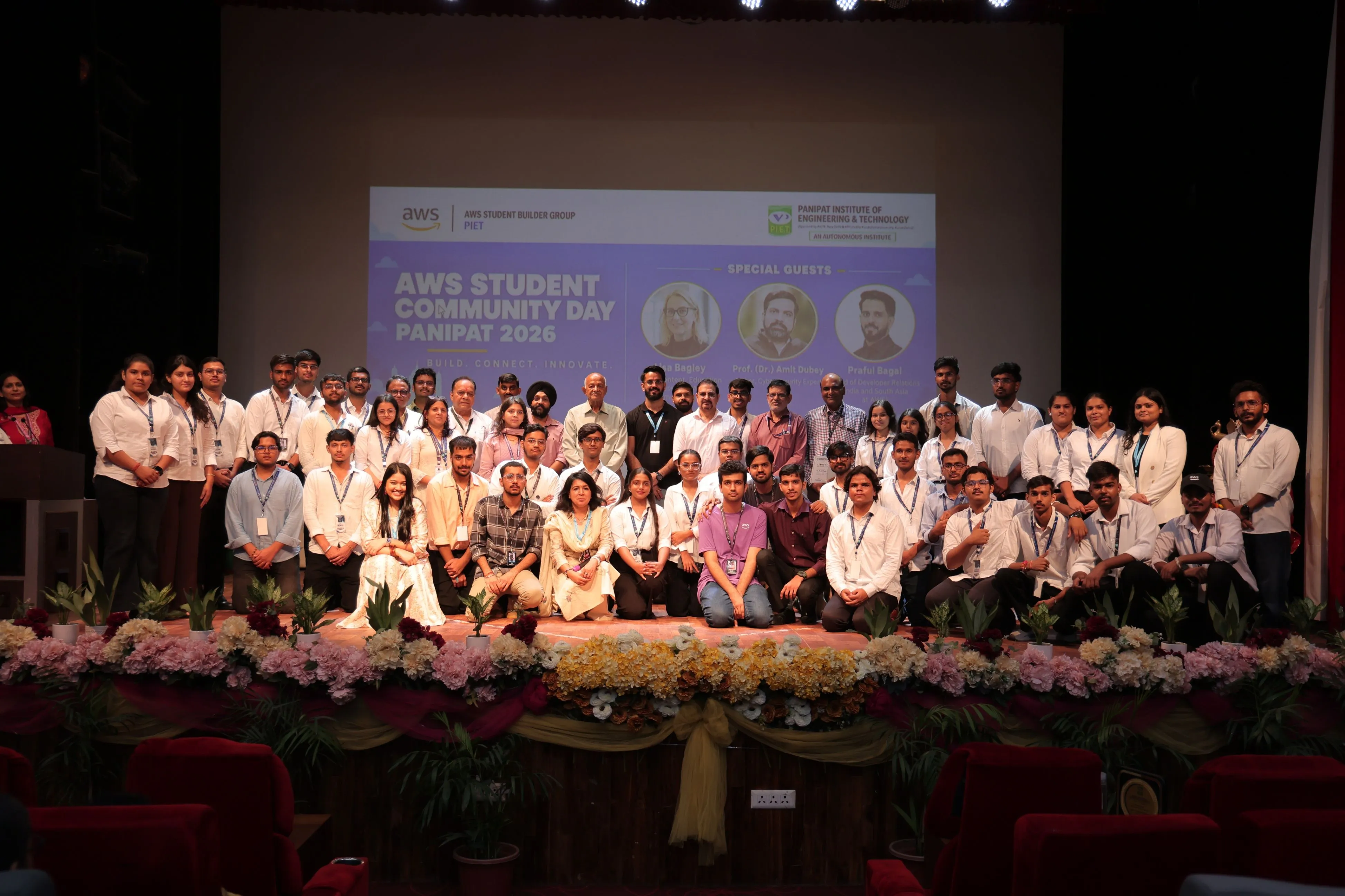
AWS Student Community Day Panipat 2026
A behind-the-scenes look at organizing AWS Student Community Day Panipat 2026, covering the planning, challenges, budgeting, marketing, logistics, team coordination, and execution. This article shares what worked, what didn’t, the problems we faced, lessons learned, and what I could have done better. The goal is to give future SCD organizers practical insights to plan and execute their events more effectively.

From an Idea to Haryana’s First AWS Student Community Day: What I Learned Organizing SCD Panipat 2026
Organizing an AWS Student Community Day sounded very different when it was just an idea.
Then the planning actually started.
AWS Student Community Day Panipat 2026 was not just another college event for me. It was my first large-scale event, and it was eventually held at PIET on September 11, 2026, bringing together students, speakers, organizers, volunteers, and communities around AWS, cloud computing, cybersecurity, AR/VR, and emerging technologies.
It was also Haryana's first AWS Student Community Day.
This article is not meant to be a highlight reel. I want to document what actually went into making the event happen, the problems we faced, the decisions that worked, the decisions that didn't, and what I would do differently if I had to organize another SCD.
1. Starting With Almost No Idea What I Was Doing
The first challenge was probably the biggest one: I had never organized anything at this scale before.
There is a huge difference between organizing a college workshop for 50-100 students and planning an event where you have to think about hundreds of registrations, speakers, food, finances, branding, venue logistics, volunteers, technical requirements, marketing, competitions, and an entire day's schedule.
The first thing I learned was that an SCD is essentially a project management problem disguised as a community event.
There are dozens of moving parts, and almost every part depends on another part being completed first.
We had to figure out:
- Where the event would take place
- When it would take place
- How much funding we had
- How we would use that funding
- Who would speak
- What the agenda would look like
- How we would attract attendees
- How we would handle registrations
- How many people we could realistically accommodate
- What food and swag we could provide
- How volunteers would be organized
- What would happen if something went wrong
The AWS SCD Playbook provides a framework for this, but the actual execution is still in the hands of the student organizers.
And that is where reality starts becoming very different from a checklist.
2. Building the Event From the Ground Up
Our initial goal was to create an event that wasn't simply a series of lectures.
We wanted multiple technical tracks and different experiences for students.
The final agenda included keynote sessions, cybersecurity, AWS Bedrock, AR/VR, and other technical sessions, along with an Ideathon and Buildathon.
We also had speakers and contributors from different backgrounds, including Praful Bagai, Lisa Bagley, Amit Dubey, Shivani Singh Vimal, and Chhavi, among others.
One of the things I personally wanted was to make the event feel bigger than a normal college seminar.
That meant investing time into branding, posters, standees, lanyards, stickers, tote bags, mousepads, social media promotion, and other event collateral.
That decision helped create a proper conference-like experience, but it also taught me an important lesson:
Every additional feature creates another logistical dependency.
A simple event is easier to execute.
A better event can be much harder to execute.
The trick is knowing which additions actually improve the attendee experience.
3. Venue, Date and the Reality of Coordination
The venue was PIET, which gave us a major advantage because we could use the institution's infrastructure.
However, planning inside an institution comes with its own coordination challenges.
Our event date also changed during the planning process. We initially planned for September 2 and eventually moved the event to September 11.
Changing a date sounds simple until you realize that the date affects speakers, registrations, marketing, logistics, food, volunteers, promotional material, and internal coordination.
This was one of the clearest lessons for me:
Do not treat the event date as a small detail. Treat it as one of the foundations of the entire project.
Once a date is publicly communicated, changing it can create a chain reaction across everything else.
4. Speakers Were More Than Just Names on a Poster

Speaker coordination was another major part of the process.
Getting someone to agree to speak is only the beginning.
You have to coordinate availability, session topics, timings, requirements, presentation material, travel or virtual arrangements, and the final agenda.
We were fortunate to have speakers who were willing to contribute their time to the event.
Praful Bagai Sir was particularly influential for me. His presence and the way he approached the students genuinely inspired me.
Amit Dubey Sir also deserves special mention for taking the time to attend and contribute to the event, especially with his cybersecurity session.
Shivani Singh Vimal shared valuable insights with students, while Chhavi brought enthusiasm around AR/VR and helped introduce students to a technology many of them had limited exposure to.
One lesson I would pass on to future organizers is simple:
Do not build your entire agenda around confirmed speakers until you actually have confirmation.
Have backup options.
A speaker dropping out late can affect the entire schedule.
5. Budgeting: Where the Event Becomes Real
The AWS seed funding gave us a starting point, but managing the money was a completely different challenge.
Our available budget was around ₹1.9 lakh, and we had to decide how to allocate it across food, speakers, swag, printing, branding, competitions, and other expenses.
Some of the major expenses included:
- Food
- Speaker fees
- Mousepads
- Tote bags
- Lanyards
- Printing and envelopes
- Sticker sheets
- Ideathon and Buildathon prizes
One of the biggest expenses was the speaker fee for Amit Dubey, while food was another major allocation.
The difficult part was that you cannot spend everything just because you have the money.
You have to constantly ask:
Does this expense actually improve the event?
Swag looks good in photographs, but food, technical infrastructure, speaker experience, and attendee experience can have a much larger impact.
I would also recommend keeping a buffer for unexpected expenses. We learned the hard way that last-minute purchases and changes are almost guaranteed.
6. Marketing Was Harder Than I Expected
This was one of the biggest challenges.
Getting people to register is not the same as getting people to actually attend.
We had a registration target of roughly 400-430 attendees, but at different points during the campaign, the numbers were far below where we wanted them to be.
At one point, we were concerned about whether we would have enough people to make a 500-seat auditorium feel properly occupied.
That creates a strange situation.
You are simultaneously planning an event for hundreds of people while wondering whether hundreds of people will actually show up. But guess what? 700+ Students Showed up!
We used multiple channels:
- WhatsApp communities
- Social media
- Posters
- College networks
- Community partnerships
- AWS Builder Center
- Direct promotion
- Collaboration with other Student Builder Groups
We also introduced different categories and entry for PIET students.
What I would change is starting serious promotion much earlier and treating marketing as its own workstream rather than something that happens alongside everything else.
7. The Team Problem

Another lesson was delegation.
When you are personally invested in an event, it is tempting to keep checking everything yourself.
That does not scale.
An SCD has too many simultaneous tasks for one person to control everything.
You need clearly assigned ownership.
Someone should own marketing.
Someone should own logistics.
Someone should own speakers.
Someone should own registrations.
Someone should own volunteers.
Someone should own competitions.
Someone should own finances.
And each person needs a clear deadline.
The AWS playbook itself recommends assigning responsibilities across areas such as agenda, marketing, financials, venue, and food, with a shared project plan to track owners, deadlines, and status.
Looking back, I would have implemented this structure much earlier.
8. The Final Week Is a Different World
The closer the event got, the faster everything started moving.
Speaker confirmations.
Final promotional pushes.
Printing.
Swag.
Food.
Volunteer coordination.
Room arrangements.
Competition logistics.
Presentation requirements.
Certificates.
Photography.
Registration.
And dozens of small things that nobody remembers until they are missing.
This is where checklists become extremely valuable.
One of the biggest mistakes an organizer can make is assuming that because something has been discussed, it has been completed.
Those are two completely different things.
For every important task, I would now track:
Task → Owner → Deadline → Status → Backup plan
That simple structure would have prevented several last-minute problems.
9. Event Day

Then September 11 arrived.
At that point, planning was over.
Execution had started.
The event ran from 9:00 AM to 4:30 PM, with multiple sessions, parallel tracks, competitions, speakers, volunteers, food, attendees, and all the unexpected problems that come with a live event.
Event day taught me something that months of planning could not:
You cannot eliminate problems. You can only become better at responding to them.
Something will go wrong.
A speaker may need something at the last minute.
A room may need adjustment.
A volunteer may not show up.
A technical setup may behave differently from what you tested.
Someone will ask a question that nobody anticipated.
The goal is not to have a completely problem-free event.
The goal is to have a team capable of solving problems without allowing them to affect everyone else.
10. What I Would Do Differently
If I organized another SCD, I would change several things.
Start the operational planning earlier
The overall idea can start months before the event, but detailed execution should begin much earlier than feels necessary.
Separate responsibilities much more aggressively
One person should not become the default owner for everything.
Lock critical vendors and requirements earlier
Food, printing, swag, AV, photography, and other vendors should have clear deadlines and backups.
Build a larger contingency buffer
Both financially and operationally.
Treat marketing as a separate project
Marketing should have its own calendar, targets, channels, owners, and measurable outcomes.
Create a detailed event-day command structure
During the event, everyone should know exactly who to approach for a particular problem.
Have backup plans for speakers and technology
Never assume that Plan A will survive until the final minute.
Document continuously
Trying to reconstruct everything after the event is much harder than documenting decisions, expenses, contacts, and deliverables while the event is happening.
11. What Went Right
Despite all the problems, there are things I am glad we did.
We created a multi-track technical event instead of limiting the day to a single topic.
We brought speakers from different areas of technology and community.
We included Ideathon and Buildathon competitions to give students something to actively participate in.
We invested in the visual identity of the event.
Most importantly, we actually executed it.
There is a huge difference between planning an event in a document and standing inside the auditorium on event day watching hundreds of students attend something that started as an idea.
12. The Biggest Lesson

The biggest thing I learned is that organizing an SCD is not primarily about making a good event.
It is about building a system that can reliably produce a good event.
That means planning, delegation, communication, budgeting, documentation, contingency planning, and execution.
The technical sessions may be what attendees remember, but the invisible work behind those sessions is what makes them possible.
For me, this event was also a personal transition.
Before SCD Panipat, I thought of event organization mostly as coordination.
After SCD Panipat, I understand it much more as project management, leadership, risk management, communication, and problem solving.
I also learned that your first large event will probably not be perfect.
That is fine.
What matters is that you document the mistakes instead of repeating them.
13. A Note to Future SCD Organizers
If you are reading this because you are planning your own Student Community Day, my biggest advice is:
Do not wait until you feel ready. Start early, build a team, delegate clearly, document everything, and assume that something will go wrong.
The AWS resources, SCD Playbook, SCD organizer community, and other SBGLs can give you a framework, but your event will still have its own problems.
Your venue will be different.
Your institution will be different.
Your audience will be different.
Your budget will be different.
Your team will be different.
So don't try to copy another SCD exactly.
Copy the principles.
Plan earlier than you think you need to.
Keep a financial buffer.
Have backups.
Communicate constantly.
And most importantly, remember that the event belongs to the community, not the organizer.
If students walk away having learned something new, met someone valuable, discovered a technology they had never explored, or simply felt more connected to the tech community, then the work behind the scenes was worth it.
For me, AWS Student Community Day Panipat 2026 was my first large-scale event.
It was also one of the most complicated things I have ever organized.
And I would not organize the next one the same way.
That is probably the most valuable outcome of all.
Enjoyed reading this content? Let the author know!
Your likes, comments, shares, and saves help creators reach more builders.

Loading recommendations
Loading article