
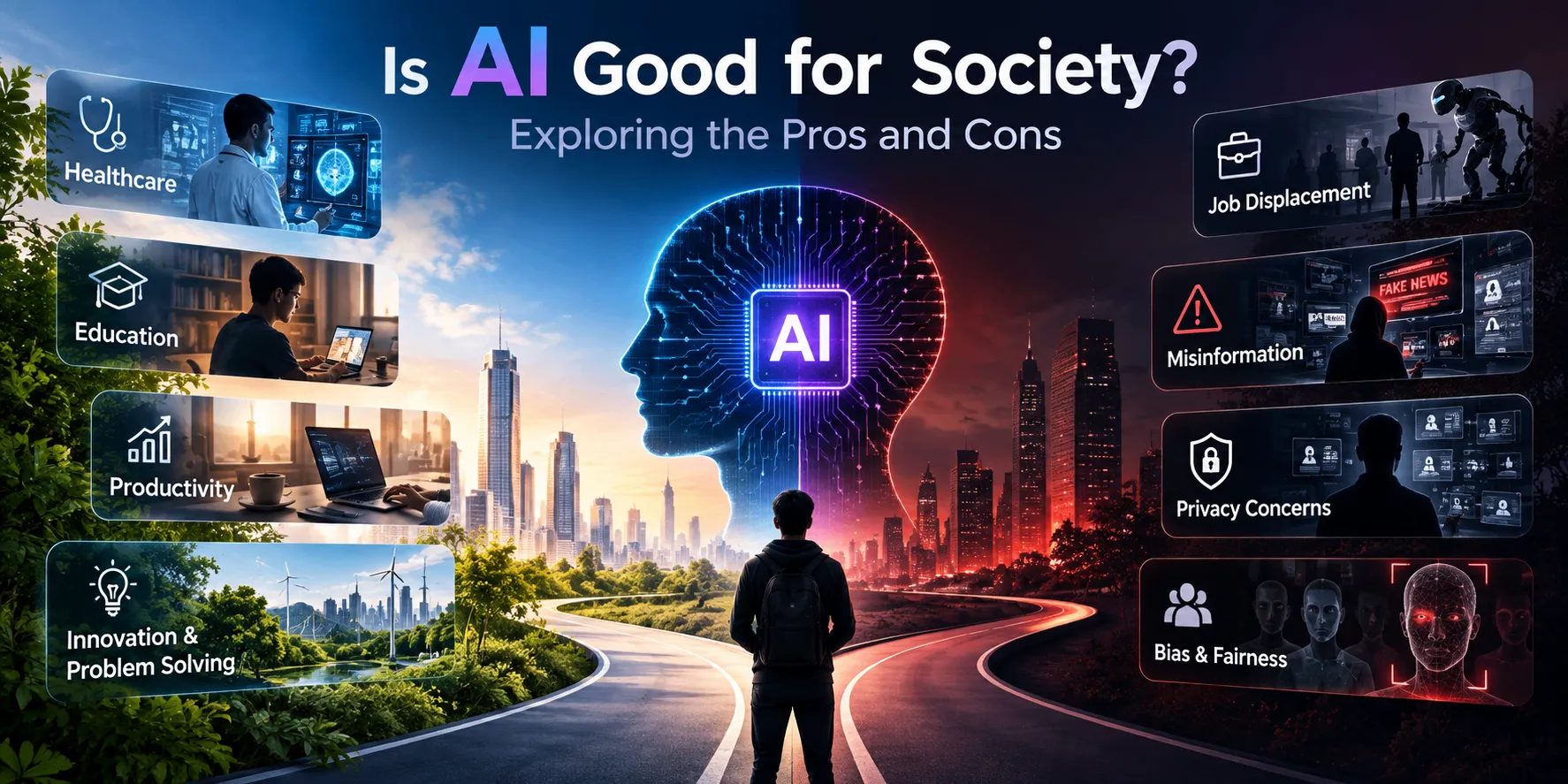
Is AI Good for Society? Exploring the Benefits and Risks of Artificial Intelligence
Artificial intelligence is rapidly changing how we work, learn, create, and solve problems. This article explores both sides of AI—its potential to improve society and the risks it creates—and why responsible human oversight matters.

Is AI Good for Society?
Artificial Intelligence is becoming a part of almost every area of our lives. From ChatGPT and coding assistants to healthcare and education, AI is helping people solve problems faster and work more efficiently.
But is AI always good for society?
The answer isn't simply yes or no. AI has both significant benefits and potential risks.
✅ How AI Can Help Society
Healthcare: AI can help doctors analyze medical data, detect patterns, and support research and diagnosis.
Education: Students can use AI as a learning assistant to understand difficult concepts, practice problems, and receive personalized explanations.
Productivity: AI can automate repetitive tasks such as data analysis, documentation, customer support, and code assistance, allowing people to focus on more meaningful work.
Problem Solving: AI can process huge amounts of information and assist researchers in areas such as climate science, drug discovery, and scientific research.
⚠️ The Challenges of AI
AI also introduces problems that society needs to address.
Job Displacement: Automation may reduce the need for certain repetitive tasks and change the skills required for many jobs.
Misinformation: Generative AI can create realistic fake images, videos, and information, making it harder to distinguish fact from fiction.
Privacy: AI systems often depend on large amounts of data, raising concerns about how personal information is collected and used.
Bias: AI systems can sometimes reproduce biases present in their training data, which can lead to unfair outcomes.
Overdependence: Relying too heavily on AI may reduce people's ability to think critically and solve problems independently.
🤝 Finding the Balance
AI should not necessarily be viewed as something that replaces humans.
Instead, it can be a tool that works alongside humans.
AI can handle large amounts of data, repetitive tasks, and pattern recognition, while humans provide creativity, empathy, critical thinking, and ethical judgment.
The real challenge is not simply making AI more powerful. It is learning how to use that power responsibly.
Conclusion
AI has the potential to bring enormous benefits to society, but it also comes with serious challenges.
Rather than blindly accepting or rejecting AI, we should understand its capabilities, recognize its limitations, and use it responsibly.
Enjoyed reading this content? Let the author know!
Your likes, comments, shares, and saves help creators reach more builders.

Loading recommendations
Loading article