
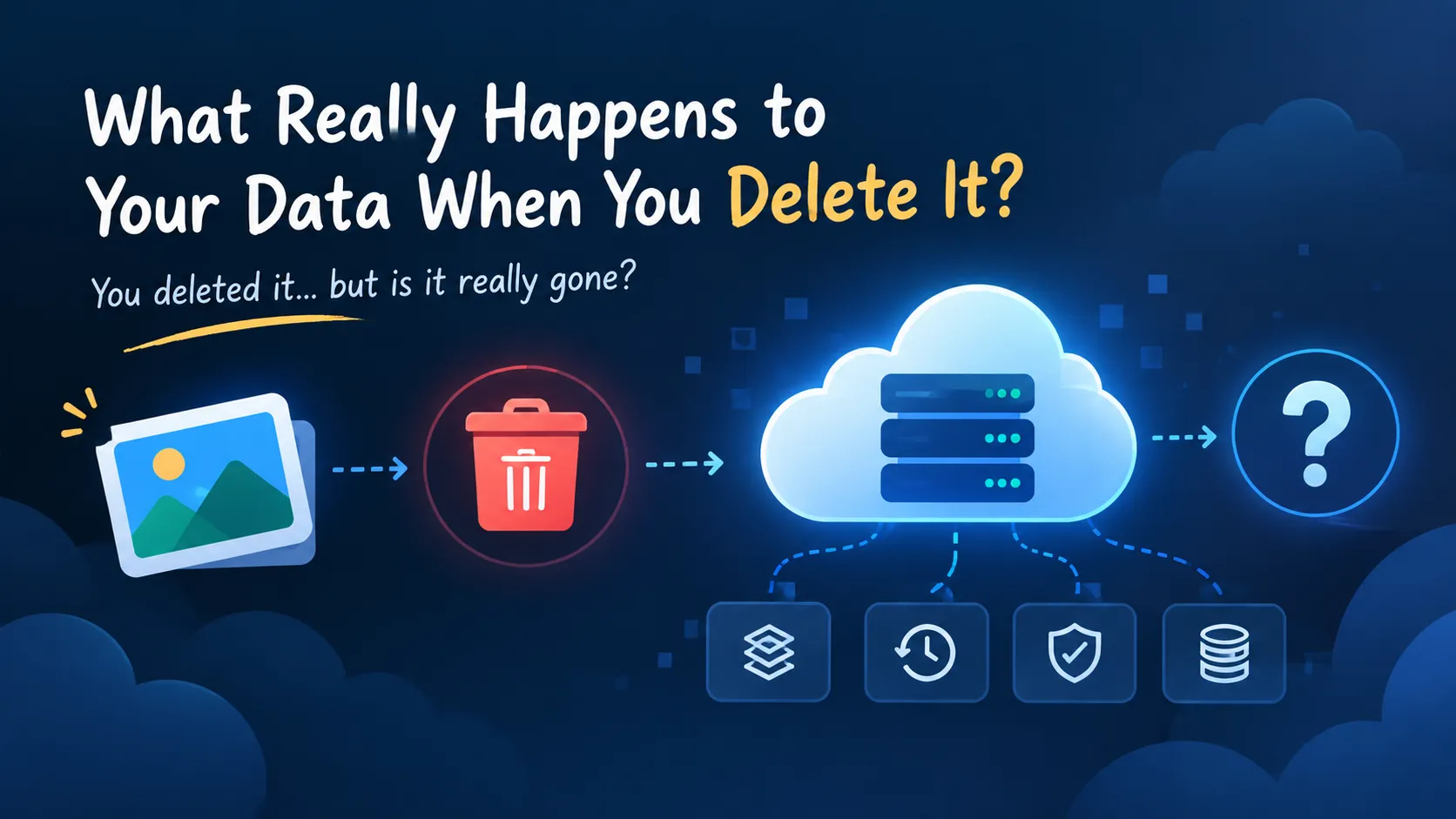
What Really Happens to Your Data When You Delete It? 🗑️☁️
We often assume that deleting a file means it is instantly gone forever. But what actually happens to data stored in the cloud? Explore the hidden journey of deleted data, including storage, versioning, lifecycle management, backups, and security, through a simple beginner-friendly AWS perspective.

What Really Happens to Your Data When You Delete It? 🗑️☁️
You take a photo.
You upload it.
You keep it for a few months.
Then one day, you press Delete.
The photo disappears from your screen.
But here’s the question that made me curious:
Did the photo actually disappear?
We usually think of deleting a file as the end of its life.
In cloud computing, the story can be a little more interesting.
🧩 First, Where Was Your Data?
When you upload a photo to a cloud-based application, it has to be stored somewhere.
Cloud providers such as AWS provide services that allow applications to store enormous amounts of data.
For example, Amazon S3 is an object storage service designed to store and retrieve data such as images, videos, documents, and backups.
So when an application stores your photo, it isn't floating around somewhere called “the cloud.”
It is being handled by real computing infrastructure.
That already makes the word cloud sound a little less magical.
🗑️ Then You Press Delete
Now imagine the application sends a request saying:
“This object should be deleted.”
Depending on how the storage system is configured, the result can be different.
For example, S3 supports features such as versioning.
If versioning is enabled, deleting an object doesn't necessarily mean every version immediately disappears. A delete marker can be added, while previous versions may still exist.
So there can be a difference between:
“I can't see the file anymore.”
and
“Every stored version of the file is permanently gone.”
That's an important distinction.
🔐 Why Keep Older Versions?
At first, keeping old versions might sound strange.
But imagine accidentally deleting an important business document.
If the system has been configured to preserve previous versions, that older data may still be recoverable.
This is one reason cloud storage isn't simply about:
Store → Delete → Gone.
There can be policies, versions, backups, and retention requirements involved.
⏳ Data Can Have a Lifecycle
Cloud systems can also use lifecycle rules.
Think of them as instructions that tell stored data what should happen as time passes.
For example:
New data
↓
Frequently accessed
↓
Less frequently accessed
↓
Moved to a different storage class
↓
Eventually deleted according to a configured rule
↓
Frequently accessed
↓
Less frequently accessed
↓
Moved to a different storage class
↓
Eventually deleted according to a configured rule
This can help organizations manage storage costs and automatically handle data over time.
So cloud storage isn't just about where data is stored.
It's also about how data is managed throughout its lifetime.
🌍 And There Is Another Interesting Question...
What if the data is important?
Companies may need to think about things like:
- backups
- disaster recovery
- data retention
- security
- compliance
- accidental deletion
This is why deleting data in a large cloud environment can be more complicated than clicking a trash-bin icon.
The exact behavior depends on how the application and its storage systems are designed and configured.
🤯 The Part That Surprised Me
Here's the idea I find most interesting:
“Deleted” doesn't always mean “instantly and irreversibly erased from every possible copy.”
There can be a difference between removing something from normal access and permanently removing every retained copy or version.
And that's not necessarily a bad thing.
Sometimes it's exactly what protects us from accidental deletion.
☁️ What AWS Teaches Us About Data
Learning about cloud computing isn't only about memorizing AWS service names.
It's about understanding questions like:
Where is my data stored?
Who can access it?
What happens if I delete it?
Can I recover it?
How long should it be retained?
What happens when a system fails?
These questions become increasingly important as applications handle more and more data.
🚀 One Small Question Can Open a Huge World
I started with a very simple question:
“What happens when I delete a file?”
But that question leads to storage, versioning, security, backups, lifecycle management, and even disaster recovery.
And that's what makes cloud computing fascinating.
Sometimes, you don't need to start by learning hundreds of AWS services.
Start with something familiar.
Take a photo. Upload it. Delete it.
Then ask:
“What actually happened behind that button?”
You might be surprised by how much of cloud computing is hiding behind something as simple as Delete. ☁️
Enjoyed reading this content? Let the author know!
Your likes, comments, shares, and saves help creators reach more builders.

Loading recommendations
Loading article