
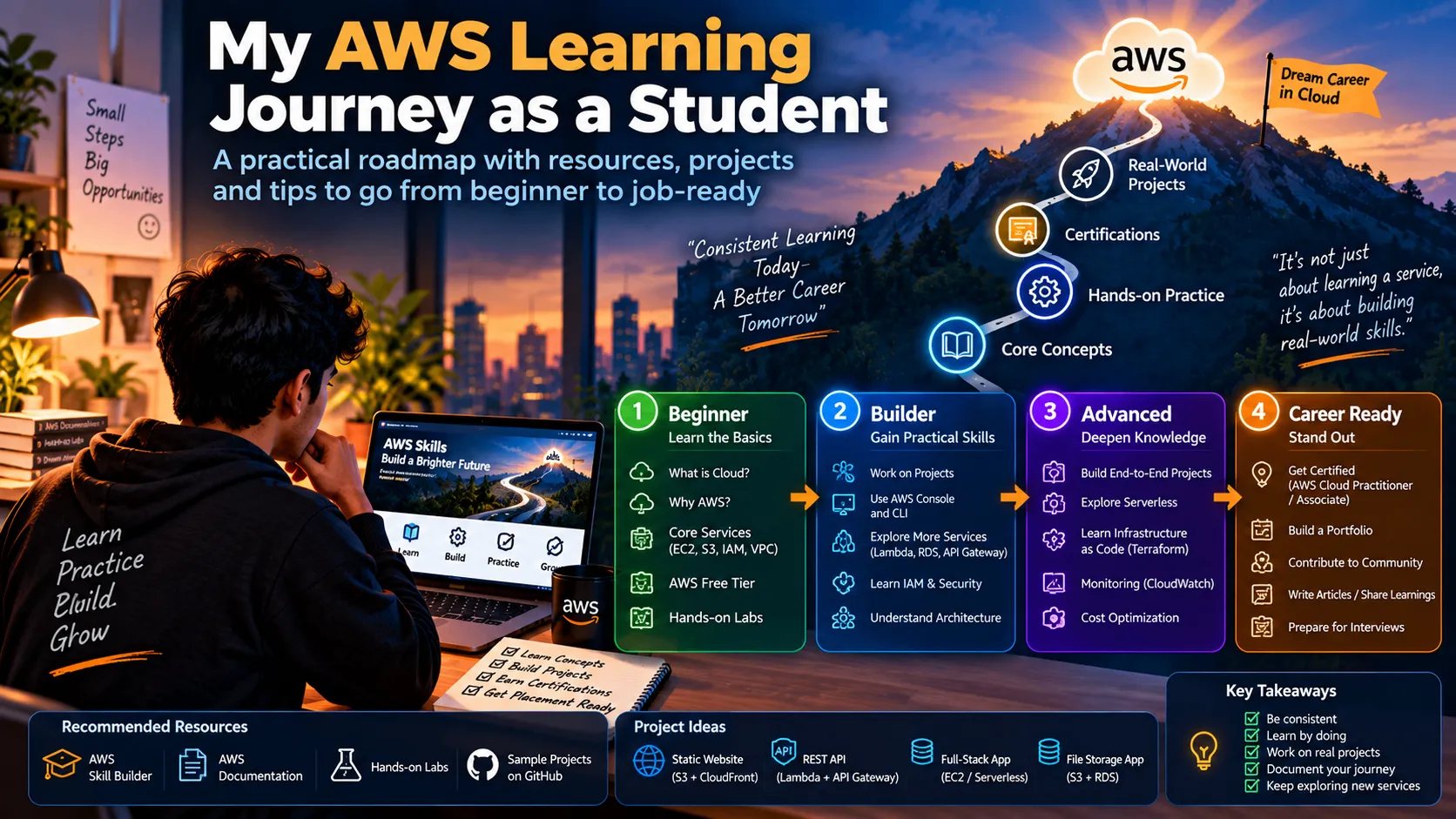
My AWS Learning Journey as a Student
A practical roadmap from beginner to job-ready cloud developer When I first started exploring AWS, one question kept coming back: “Where should I actually start?” AWS has hundreds of services, countless tutorials, certifications, documentation, and project ideas. It's easy to spend weeks watching videos without actually building anything. So I think the better approach is: Learn → Practice → Build → Deploy → Share → Repeat. Here's a roadmap that can help turn AWS learning into practical skills.

🟢 1. Start With the Fundamentals
Before jumping into advanced services, understand the basic cloud concepts.
Start with questions like:
- What is cloud computing?
- Why do companies use AWS?
- What is an AWS Region?
- What is an Availability Zone?
- What is scalability?
- What is elasticity?
- What is serverless computing?
Then learn some foundational services:
1
2
3
4
5
6
EC2
S3
IAM
VPC
RDS
Lambda
You don't need to memorize every feature.
Focus on understanding what problem each service solves.
For example:
1
2
3
4
5
6
EC2     → Compute
S3      → Object Storage
RDS     → Managed Database
IAM     → Access Control
Lambda  → Serverless Compute
VPC     → Networking
Once these concepts become familiar, AWS starts feeling much less overwhelming.
🔵 2. Stop Watching — Start Building
This is where learning becomes much more interesting.
After learning a service, try to use it.
For example, after learning S3:
Don't just read:
“S3 is an object storage service.”
Build:
Deploy a static website using S3.
After learning Lambda:
Build a simple serverless API.
After learning RDS:
Connect an application to a managed database.
The difference is huge.
1
2
3
4
5
6
7
Tutorial
   ↓
Understanding
   ↓
Hands-on Practice
   ↓
Real Experience
🟣 3. Build Small Projects First
You don't need to start with a huge production system.
Start small.
Project 1 — Static Website
1
2
3
4
5
HTML/CSS
    ↓
Amazon S3
    ↓
CloudFront
Project 2 — Serverless REST API
1
2
3
4
5
6
7
Client
   ↓
API Gateway
   ↓
Lambda
   ↓
DynamoDB
Project 3 — Full-Stack Application
1
2
3
4
5
6
7
8
9
Frontend
   ↓
CloudFront / S3
   ↓
API
   ↓
Backend
   ↓
Database
Each project introduces new AWS concepts.
🟠 4. Learn Security Early
Security shouldn't be something you learn only after building several projects.
Start understanding IAM early.
Learn concepts such as:
- Users
- Roles
- Policies
- Permissions
- Least privilege
- Authentication
- Authorization
For example, instead of giving every service full access:
1
❌ Service → Administrator Access
think about:
1
2
3
✅ Service
      ↓
Only Required Permissions
This way, security becomes part of your development mindset.
🔴 5. Learn How AWS Services Connect
Knowing individual services is useful.
Understanding how they work together is even more important.
Consider:
1
2
3
4
5
6
7
8
9
10
11
12
13
14
15
16
17
18
19
             User
               │
               ▼
          CloudFront
               │
               ▼
              S3
         Frontend Files
               │
               ▼
          API Gateway
               │
               ▼
             Lambda
               │
          ┌────┴────┐
          ▼         ▼
         S3        RDS
       Storage    Database
Now you're not just learning AWS services.
You're learning cloud architecture.
🚀 6. Move Toward More Advanced Topics
Once you're comfortable with the basics, gradually explore:
⚡ Serverless
Learn:
- Lambda
- API Gateway
- DynamoDB
- EventBridge
- SQS
🌐 Networking
Explore:
- VPC
- Subnets
- Route tables
- Security groups
- Internet/NAT gateways
📊 Monitoring
Learn:
- CloudWatch
- Logs
- Metrics
- Alarms
🏗️ Infrastructure as Code
Eventually explore tools such as:
- AWS CloudFormation
- Terraform
The important thing is progressive learning.
You don't need to learn everything at once.
🧪 7. Build One Project That Solves a Real Problem
This is where your AWS knowledge becomes portfolio material.
Instead of building:
“Another basic AWS demo.”
try building something that solves a problem.
For example:
📚 Student Learning Platform
1
2
3
4
5
6
7
8
9
Frontend
   ↓
API
   ↓
Authentication
   ↓
Database
   ↓
AWS Services
Or:
🚚 Logistics Application
1
2
3
4
5
6
7
8
9
Orders
   ↓
Backend
   ↓
Database
   ↓
Notifications
   ↓
Monitoring
Or:
🤖 AI Document Assistant
1
2
3
4
5
6
7
8
9
Document
   ↓
S3
   ↓
Lambda
   ↓
Amazon Bedrock
   ↓
AI Response
A real project gives you something valuable to discuss during interviews.
🏆 8. Certifications Can Come Later
Certifications can be useful, but don't make certification preparation your entire AWS journey.
A balanced approach could be:
1
2
3
4
5
6
7
8
9
10
11
Learn Concept
      ↓
Build Something
      ↓
Understand the Service
      ↓
Study Certification Material
      ↓
Take Practice Tests
      ↓
Certification
This way, you're not only memorizing exam concepts.
You also understand how the services work in practice.
💼 9. Turn Your Learning Into a Portfolio
Don't just learn privately.
Document what you build.
For every project, try to show:
Problem
What are you solving?
Architecture
Which AWS services did you use?
Implementation
How does the application work?
Security
How did you protect it?
Deployment
How did you deploy it?
Lessons Learned
What did you discover?
This can turn a simple project into a much stronger portfolio story.
🌱 10. Share Your Learning
One thing I've found valuable about learning cloud technology is that teaching others can reinforce your own understanding.
You can share:
- AWS projects
- Architecture diagrams
- Lessons learned
- Troubleshooting experiences
- Beginner guides
- Cost optimization tips
- Interesting AWS services
You don't have to be an expert before sharing.
Sometimes explaining something you just learned helps you understand it better.
🗺️ My Simple AWS Roadmap
If I had to simplify the entire journey:
1
2
3
4
5
6
7
8
9
10
11
12
13
14
15
16
17
18
19
20
21
22
23
24
25
26
27
28
29
30
31
        BEGINNER
           │
           ▼
    Cloud Fundamentals
           │
           ▼
    Core AWS Services
           │
           ▼
     Hands-on Practice
           │
           ▼
      Small Projects
           │
           ▼
   Cloud Architecture
           │
           ▼
 Security + Monitoring
           │
           ▼
   Advanced Projects
           │
           ▼
     Certification
           │
           ▼
     Portfolio + GitHub
           │
           ▼
       JOB READY 🚀
And the most important part is that you don't have to follow it perfectly.
Everyone's learning path will be different.
💡 Five Things I'd Remember
1️⃣ Don't try to learn every AWS service.
Learn the services relevant to what you're building.
2️⃣ Build while learning.
A small working project is often more valuable than hours of passive watching.
3️⃣ Understand architecture.
Knowing why services are connected matters.
4️⃣ Learn security and cost awareness.
Good cloud development isn't only about making an application work.
5️⃣ Stay consistent.
Even one small AWS experiment every few days can add up over time.
🎯 Final Takeaway
AWS can feel enormous when you're just starting.
But you don't need to understand the entire cloud.
Start with a few fundamental services.
Build something small.
Break it.
Fix it.
Deploy it.
Improve it.
Then build something slightly more complex.
Eventually, the individual AWS services stop feeling like isolated tools and start becoming building blocks for real applications.
Learn today. Build tomorrow. Keep growing. ☁️🚀
Enjoyed reading this content? Let the author know!
Your likes, comments, shares, and saves help creators reach more builders.

Loading recommendations
Loading article