
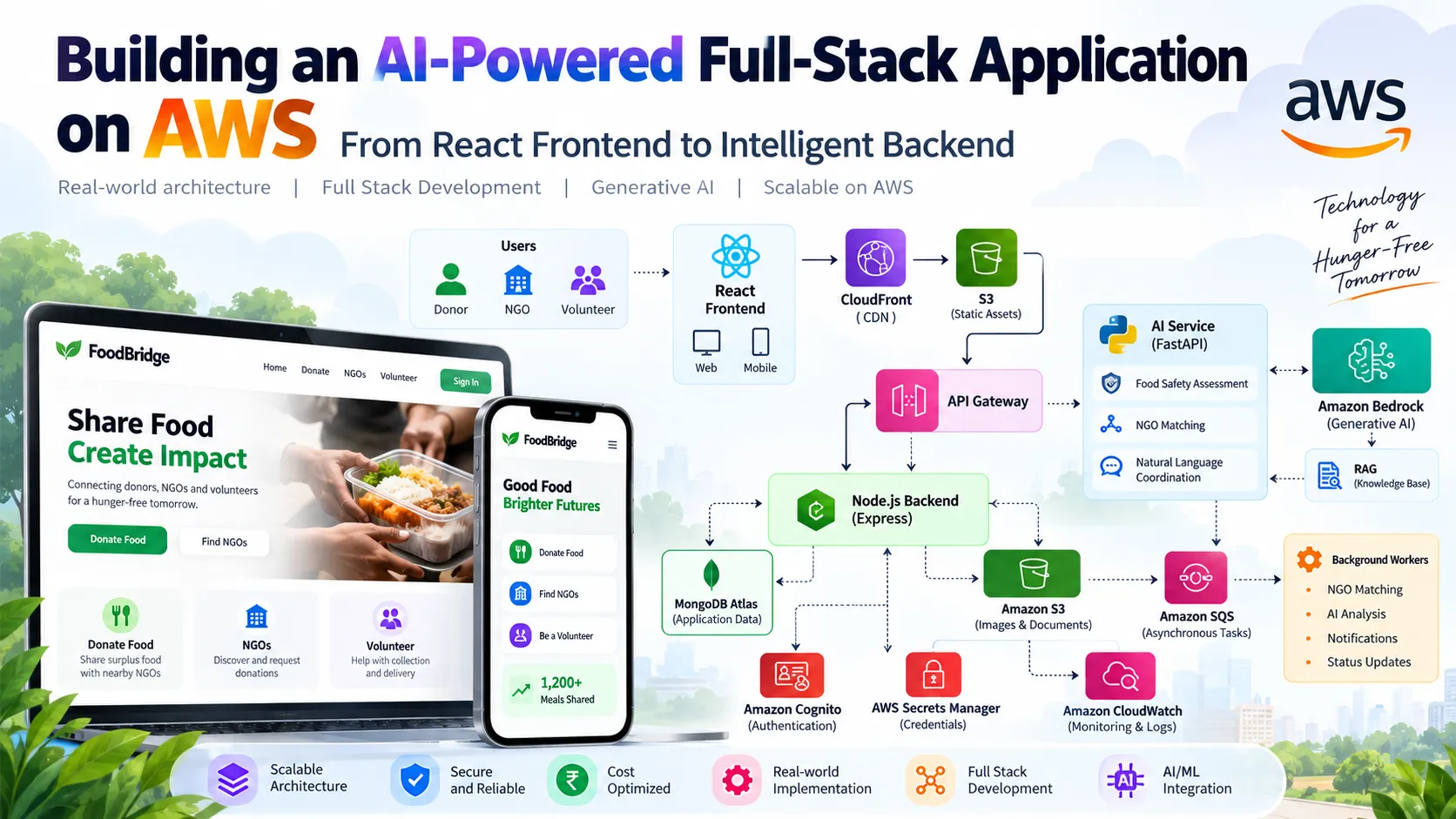
AWS FSD
Building an AI-Powered Full-Stack Application on AWS: From React Frontend to Intelligent Backend


Modern applications are no longer limited to displaying information or performing basic CRUD operations. Users increasingly expect applications to understand requests, automate workflows, provide intelligent recommendations, and remain available as usage grows.
Building such applications requires more than connecting a frontend to a backend API. Developers must consider architecture, scalability, security, data management, AI integration, and deployment from the beginning.
In this article, we will explore how to design a cloud-native, AI-powered full-stack application using React, Node.js, Python, and AWS services.
We will use a hypothetical application called FoodBridge, a platform that connects food donors with NGOs and volunteers to coordinate surplus food distribution.
The objective is to understand how traditional full-stack engineering can be combined with AI and cloud infrastructure to create a scalable application.
1. Understanding the Application Architecture
FoodBridge consists of three primary user groups:
- Donors who publish available food donations.
- NGOs that discover and request donations.
- Volunteers who assist with transportation and delivery.
A conventional implementation might use a React frontend, Express backend, and MongoDB database.
However, as the application grows, additional requirements emerge:
- Intelligent NGO matching.
- Food safety assessment.
- Automated volunteer allocation.
- Real-time status updates.
- Document and image storage.
- Scalable API processing.
This is where cloud-native architecture becomes useful.
2. Proposed Technology Stack
| Layer | Technology | Responsibility |
|---|---|---|
| Frontend | React | User interface |
| Backend | Node.js, Express | REST APIs and business logic |
| AI Microservice | Python, FastAPI | AI orchestration |
| Database | MongoDB Atlas or Amazon DynamoDB | Application data |
| Object Storage | Amazon S3 | Images and documents |
| Authentication | Amazon Cognito | User authentication |
| Compute | Amazon ECS with Fargate | Containerized services |
| API Management | Amazon API Gateway | API entry point |
| Messaging | Amazon SQS | Asynchronous tasks |
| AI | Amazon Bedrock | Foundation model integration |
| Monitoring | Amazon CloudWatch | Logs and metrics |
| Secrets | AWS Secrets Manager | Credential management |
The architecture separates application responsibilities rather than placing every feature inside a single backend.
3. High-Level System Architecture
1
2
3
4
5
6
7
8
9
10
11
12
13
14
15
16
17
18
19
20
21
22
23
24
25
26
27
28
29
30
31
32
33
34
35
36
37
38
39
40
41
42
43
44
45
46
47
48
49
50
51
52
53
                 USERS
                   |
                   v
             React Frontend
                   |
                   v
          Amazon CloudFront
                   |
                   v
              Amazon S3
             (Static Assets)

                   |
                   v
           Amazon API Gateway
                   |
                   v
          Node.js Backend (ECS)
                   |
          +--------+---------+
          |                  |
          v                  v
    Application DB      Amazon S3
          |
          v
    Business Logic
          |
          v
     FastAPI AI Service
          |
     +----+----------+
     |               |
     v               v
 Amazon Bedrock    RAG Retrieval
     |               |
     +-------+-------+
             |
             v
     AI Coordination
             |
     +-------+---------+
     |                 |
     v                 v
  Amazon SQS       MongoDB
     |
     v
 Background Workers
     |
     v
 Notifications / Dispatch

     Amazon CloudWatch
       Observability
This is a proposed reference architecture, not a claim that the entire system has already been deployed on AWS.
4. Designing the Backend with Microservices
A common mistake in early-stage projects is placing authentication, donations, matching, notifications, and AI logic inside one large controller.
This makes the application difficult to maintain as functionality increases.
A modular architecture can separate responsibilities:
User Service
Handles registration, authentication, profiles, and role-based access control.
Donation Service
Manages donation creation, availability, expiration, and status transitions.
Matching Service
Identifies NGOs based on location, capacity, food requirements, and availability.
AI Coordination Service
Processes natural-language requests and invokes appropriate application capabilities.
Notification Service
Sends notifications when donations are created, accepted, rejected, or assigned.
Each service should have a clearly defined responsibility and API contract.
For an initial implementation, these modules can remain within a modular monolith. Independent deployment should be introduced when operational requirements justify it.
5. Integrating Generative AI with Amazon Bedrock
AI integration should solve a specific application problem rather than exist merely as a chatbot feature.
For FoodBridge, an AI coordinator can assist with three workflows.
Food Safety Assessment
When a donor submits a donation, the system can collect:
- Food category.
- Preparation time.
- Storage conditions.
- Quantity.
- Expiration information.
The AI service can retrieve relevant food safety guidance and generate a structured assessment.
However, an LLM should not independently certify food as safe.
Critical eligibility decisions should rely on validated rules, authoritative guidance, and human review where required.
Intelligent NGO Matching
Instead of returning NGOs using geographical distance alone, the matching workflow can consider:
- Distance from donation location.
- NGO capacity.
- Food category compatibility.
- Availability.
- Delivery constraints.
A deterministic filtering and ranking process can select eligible candidates, while an LLM can explain the result in natural language.
Natural-Language Coordination
A donor might ask:
"Find an NGO that can collect 50 meal packages within the next two hours."
The AI coordinator can interpret the request, extract structured parameters, and invoke a predefined matching tool.
The application backend must still validate the parameters and enforce authorization.
6. Implementing an AI Coordination Endpoint
A Python FastAPI service can expose an endpoint for coordination.
Example:
1
2
3
4
5
6
7
8
9
10
11
12
13
14
15
16
17
18
19
20
21
22
23
24
25
from fastapi import FastAPI
from pydantic import BaseModel
app = FastAPI()
class CoordinationRequest(BaseModel):
donation_id: str
location: str
food_category: str
quantity: int
async def coordinate(request: CoordinationRequest):
# 1. Validate incoming parameters
# 2. Retrieve donation information
# 3. Identify eligible NGOs
# 4. Apply matching constraints
# 5. Generate an explanation
return {
"status": "processed",
"donation_id": request.donation_id,
"message": "Coordination workflow completed"
}This example demonstrates the API contract only. Production implementation would require database integration, authentication, error handling, observability, and actual matching logic.
Amazon Bedrock can be integrated into the AI service for model inference, while application tools remain responsible for database operations and business rules.
7. Using Amazon SQS for Asynchronous Processing
Not every operation needs to block an HTTP request.
Consider a donor creating a new donation.
The backend may need to:
- Save the donation.
- Identify eligible NGOs.
- Trigger AI-assisted analysis.
- Notify relevant users.
- Update the donation workflow.
Executing every operation synchronously increases request latency and creates unnecessary coupling.
Amazon SQS provides a mechanism for decoupling background work.
A possible workflow is:
1
2
3
4
5
6
7
8
9
10
11
12
13
14
15
16
Donation Created
       |
       v
Save Donation
       |
       v
Publish SQS Message
       |
       v
Background Worker
       |
       +------> NGO Matching
       |
       +------> AI Assessment
       |
       +------> Notifications
For production systems, workers should be idempotent, messages should have retry policies, and failed messages should be routed to a dead-letter queue.
8. Security Considerations
Security should be incorporated into the architecture instead of being added after development.
Important practices include:
- Use Amazon Cognito or another trusted identity provider for authentication.
- Enforce role-based authorization on backend APIs.
- Apply least-privilege IAM permissions.
- Store secrets in AWS Secrets Manager.
- Validate all user inputs.
- Use HTTPS for communication.
- Avoid exposing database credentials to frontend applications.
- Apply request throttling and API protection.
- Maintain audit logs for sensitive operations.
AI-generated outputs should also be treated as untrusted input. They must never bypass application authorization or directly execute unrestricted database operations.
9. Deployment Strategy
A possible deployment workflow is:
Frontend
Build the React application and host static assets in Amazon S3, distributed through Amazon CloudFront.
Backend
Package the Node.js and FastAPI services into Docker containers and deploy them using Amazon ECS with AWS Fargate.
Database
Use a managed database deployment with appropriate network restrictions, backups, and monitoring.
CI/CD
Use GitHub Actions or AWS CodePipeline to automate:
- Code validation.
- Unit and integration tests.
- Docker image creation.
- Image publishing to Amazon ECR.
- Deployment to the target environment.
Separate development, staging, and production environments to reduce deployment risk.
10. Scalability and Cost Optimization
Scalability is not simply increasing the number of servers.
A scalable application should minimize unnecessary work and isolate resource-intensive components.
Some important strategies include:
- Use CloudFront caching for static content.
- Apply pagination to database queries.
- Create indexes for frequently queried fields.
- Use asynchronous queues for long-running tasks.
- Configure ECS service auto scaling based on workload.
- Avoid unnecessary LLM calls.
- Cache reusable AI retrieval results when appropriate.
- Monitor token consumption and infrastructure utilization.
- Set AWS Budgets and billing alerts.
For a student project or early-stage application, deploying every component as an independent service may increase complexity and cost.
Starting with a modular backend and extracting services as demand grows is often a more practical engineering approach.
11. Lessons from Building AI-Enabled Applications
Several engineering lessons emerge from this architecture.
First, AI should complement deterministic business logic.
LLMs are useful for interpretation, summarization, and reasoning, but financial, authorization, and safety-critical decisions require explicit validation.
Second, asynchronous processing improves architectural flexibility.
Queues allow notification, matching, and other background workflows to evolve independently.
Third, scalability must be designed around actual bottlenecks.
A database query that performs poorly under load will not be fixed simply by adding more application containers.
Finally, production readiness involves more than deployment.
Monitoring, security, retries, failure handling, backups, and cost controls are all part of a reliable application.
Conclusion
Combining Full Stack Development, Artificial Intelligence, and AWS creates opportunities to build applications that are both intelligent and operationally reliable.
By separating frontend delivery, backend business logic, AI orchestration, data storage, and asynchronous processing, developers can create systems that are easier to maintain and evolve.
The most important lesson is that successful AI-powered applications are not built by adding an LLM to an existing API. They are engineered through thoughtful architecture, reliable infrastructure, explicit business rules, and continuous evaluation.
For developers beginning their cloud journey, building a small end-to-end application and progressively introducing AWS services is a practical way to understand cloud-native engineering.
References
- AWS Documentation: https://docs.aws.amazon.com/
- Amazon Bedrock: https://aws.amazon.com/bedrock/
- Amazon ECS: https://aws.amazon.com/ecs/
- Amazon SQS: https://aws.amazon.com/sqs/
- Amazon CloudFront: https://aws.amazon.com/cloudfront/
- AWS Well-Architected Framework: https://aws.amazon.com/architecture/well-architected/
Enjoyed reading this content? Let the author know!
Your likes, comments, shares, and saves help creators reach more builders.

Loading recommendations
Loading article