
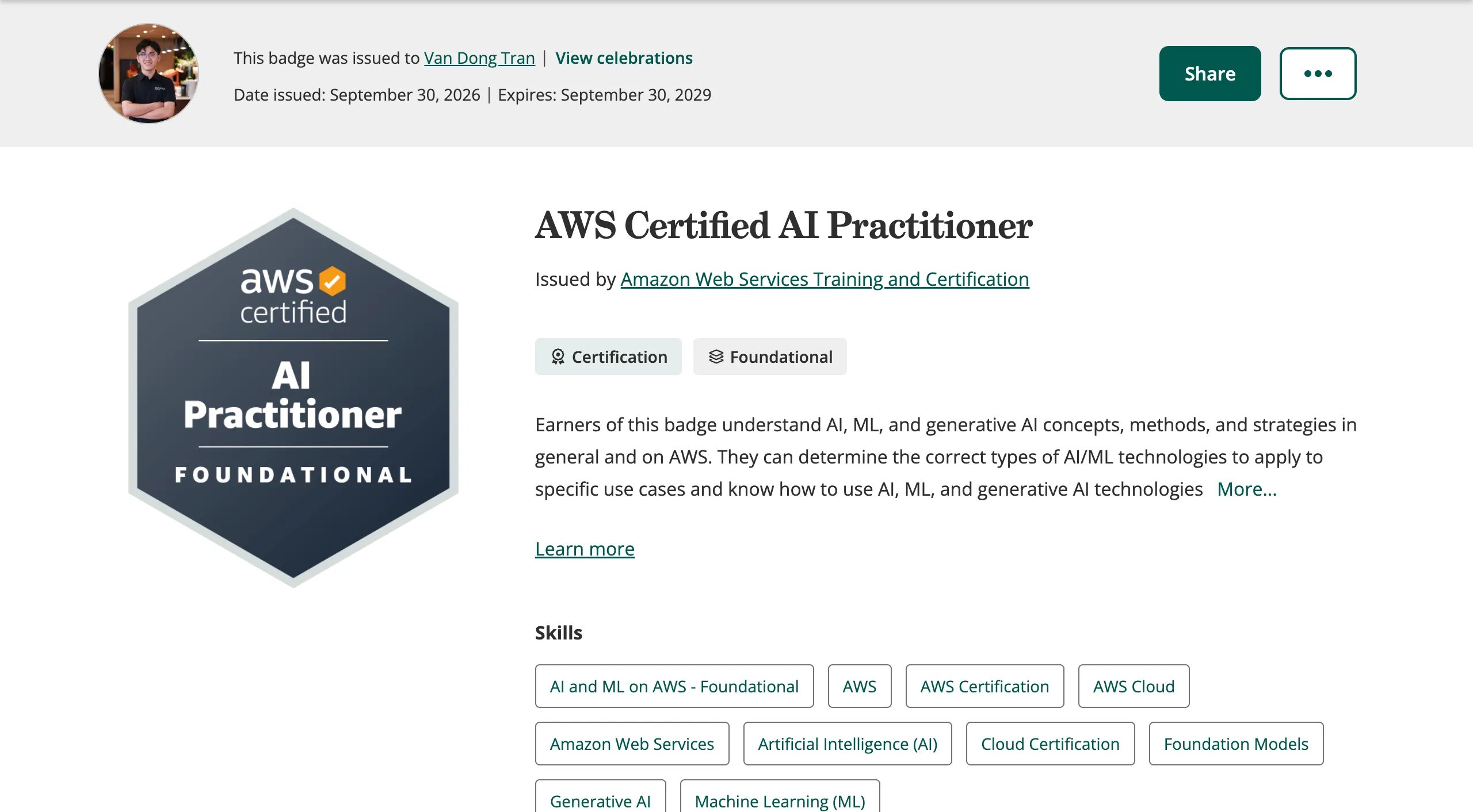
How I Prepared for AWS Certified AI Practitioner
I recently passed AWS Certified AI Practitioner. Here is the study approach, AWS services, and exam topics that helped me prepare effectively.

I recently earned the AWS Certified AI Practitioner certification. 🎉
This was an important milestone in my AWS learning journey because it helped me connect many concepts that I had previously learned separately — generative AI, machine learning, Amazon Bedrock, SageMaker, responsible AI, security, and model evaluation.
Instead of only sharing that I passed, I want to share the study approach that worked for me and what I would recommend to someone preparing for the exam.
1. Start with the concepts, not the AWS services
At the beginning, I made the mistake of trying to memorize too many AWS services.
A better approach was to first understand the problem.
For example:
- What is supervised vs. unsupervised learning?
- What is inference?
- What is overfitting?
- What are embeddings?
- What is RAG?
- What is a foundation model?
- What is prompt engineering?
- What is model hallucination?
- What are precision, recall, and F1 score?
Once the concepts were clear, mapping them to AWS services became much easier.
2. Understand what each AWS service is actually for
For this exam, I found it much more useful to understand the role of each service instead of memorizing every feature.
Some of the services I focused on were:
- Amazon Bedrock – building generative AI applications with foundation models
- Amazon SageMaker – building, training, and deploying machine learning models
- SageMaker JumpStart – accessing pre-trained models and ML solutions
- SageMaker Clarify – bias detection and explainability
- SageMaker Model Monitor – monitoring models in production
- Amazon Comprehend – natural language processing
- Amazon Rekognition – image and video analysis
- Amazon Textract – extracting text and structured data from documents
- Amazon Lex – conversational interfaces and chatbots
- Amazon Polly – text-to-speech
- AWS HealthScribe – healthcare-focused speech and clinical documentation
The important question I kept asking myself was:
“What problem would make me choose this service?”
That mindset helped a lot with scenario-based questions.
3. Spend extra time on Amazon Bedrock
Amazon Bedrock was one of the most important areas for me.
I focused on understanding:
- Foundation Models
- Prompt engineering
- Temperature and Top-K
- Embeddings
- Retrieval-Augmented Generation (RAG)
- Knowledge Bases
- Guardrails
- Model evaluation
- Responsible AI
- Fine-tuning and customization
- Security and privacy
One useful mental model was:
1
2
3
4
5
6
7
User Question
     ↓
Prompt
     ↓
Foundation Model
     ↓
Response
With RAG:
1
2
3
4
5
6
7
8
9
User Question
     ↓
Retrieve relevant information
     ↓
Add context to the prompt
     ↓
Foundation Model
     ↓
Grounded response
Understanding the architecture was much easier than memorizing definitions.
4. Learn the differences between similar services
A lot of my study time went into distinguishing services that looked similar.
For example:
SageMaker Clarify vs. Model Monitor
- Clarify → bias and explainability
- Model Monitor → monitor production models and detect changes
Canvas vs. Data Wrangler
- Canvas → build ML predictions with little or no code
- Data Wrangler → prepare and transform data
Guardrails vs. model evaluation
- Guardrails → control and filter model inputs and outputs
- Evaluation → measure the quality and performance of a model
Serverless vs. real-time vs. batch vs. asynchronous inference
Instead of memorizing definitions, I tried to understand the use case for each option.
That made exam questions much easier.
5. Do practice questions — but don't memorize the answers
Practice questions helped me identify where my understanding was weak.
My approach was:
1
2
3
4
5
6
7
Read question
      ↓
Choose an answer
      ↓
Explain WHY
      ↓
Explain why the other options are wrong
The last two steps were the most important.
If I could not explain why the other answers were wrong, I considered the topic not fully understood.
I also kept a list of topics I repeatedly confused.
For me, examples included:
- Precision vs. Recall
- BLEU vs. ROUGE vs. BERTScore
- K-means vs. K-NN
- Clarify vs. Model Monitor
- Serverless vs. asynchronous inference
- Guardrails vs. responsible AI evaluation
Every time I made the same mistake, I reviewed that concept again.
6. Use hands-on learning when possible
Reading documentation is useful, but using AWS services makes the concepts easier to remember.
AWS Skill Builder helped me connect theory with actual AWS workflows.
Even a small hands-on exercise can make concepts much easier to remember than reading several pages of documentation.
My learning loop became:
1
2
3
4
5
6
7
8
9
Learn
 ↓
Practice
 ↓
Make mistakes
 ↓
Understand why
 ↓
Repeat
7. My recommended study order
If I were preparing again, I would study in this order:
1
2
3
4
5
6
7
8
9
10
11
12
13
14
15
16
17
1. AI / ML fundamentals
        ↓
2. Generative AI fundamentals
        ↓
3. Amazon Bedrock
        ↓
4. Amazon SageMaker
        ↓
5. AWS AI services
        ↓
6. Responsible AI and security
        ↓
7. Model evaluation metrics
        ↓
8. Practice questions
        ↓
9. Review weak areas
This order worked better for me than jumping randomly between AWS services.
8. Don't try to memorize everything
One thing I learned during preparation:
You do not need to memorize every AWS feature.
What matters more is being able to recognize the requirement in a scenario.
When reading a question, I looked for keywords such as:
1
2
3
4
5
6
7
8
9
10
11
Least operational overhead
Managed service
Explainability
Bias
Real-time
Batch
Semantic search
Generative AI
Document extraction
Content moderation
Speech-to-text
These words often point toward the type of AWS service or solution the question is testing.
My biggest takeaway
Passing the certification was great, but the most valuable part was how much clearer the AWS AI ecosystem became during preparation.
Before studying:
1
2
3
4
5
6
7
8
Bedrock
SageMaker
Comprehend
Rekognition
Textract
Clarify
Model Monitor
...
felt like a long list of separate services.
After studying, I started seeing them as tools designed for different stages of an AI workload.
That shift in thinking was probably the biggest improvement in my preparation.
If you're currently preparing for AWS Certified AI Practitioner, my main advice would be:
Focus on understanding why a service is used, not just what the service does.
Good luck to everyone preparing for the exam! ☁️🤖
#AWS #AWSCertified #AWSAICertified #AWSAIPractitioner #AmazonBedrock #AmazonSageMaker #GenerativeAI #MachineLearning #AWSSkillBuilder #LearningInPublic
Enjoyed reading this content? Let the author know!
Your likes, comments, shares, and saves help creators reach more builders.

Loading recommendations
Loading article