
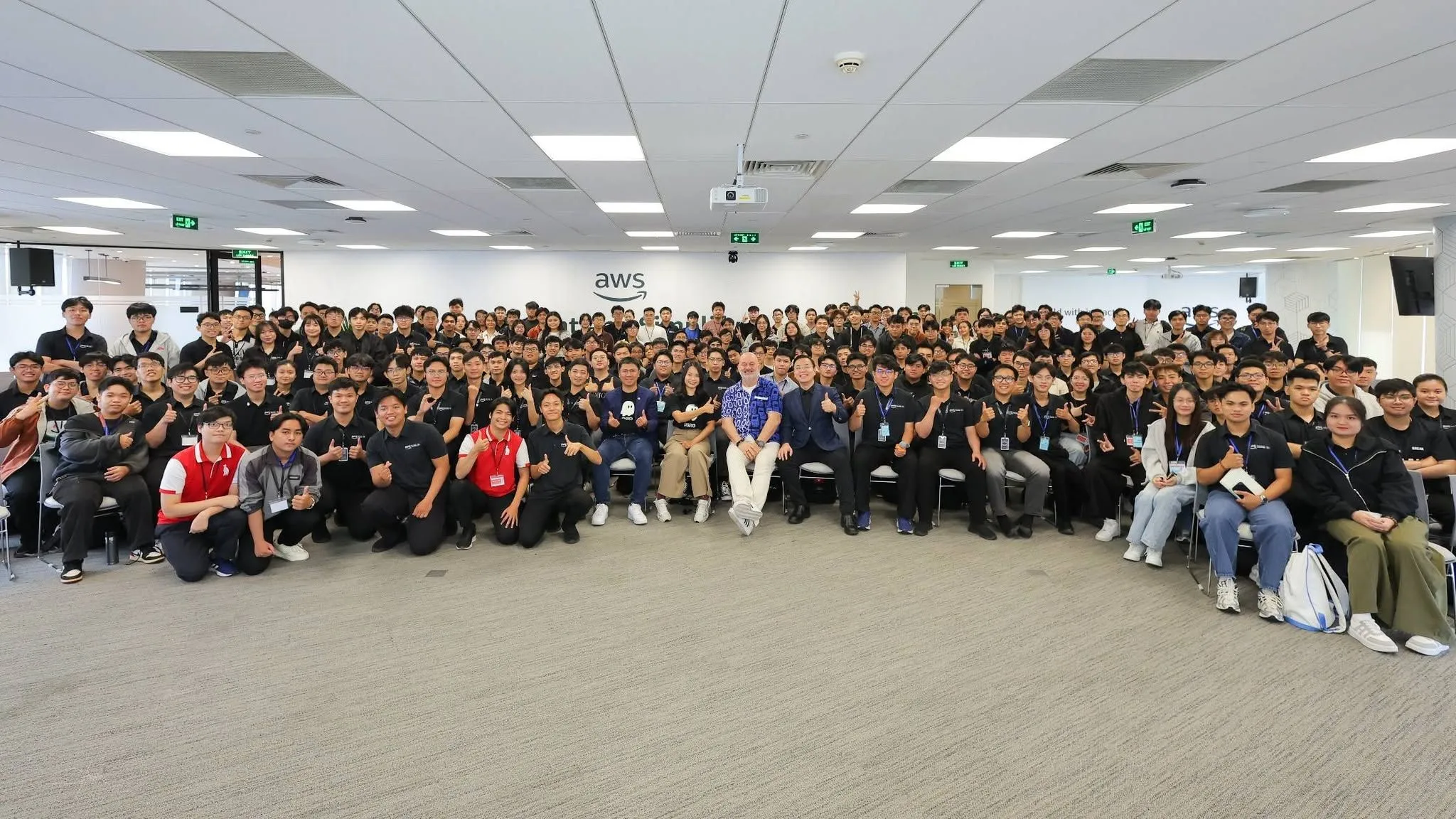
The Invariable Lessons of Tech and Humanity: Key Takeaways from Amazon CTO Werner Vogels
How should we view the future of software engineering as Artificial Intelligence increasingly automates day-to-day coding? Will developers eventually be rendered obsolete?

During a keynote session at the "Navigating the Future of Cloud & AI in Vietnam" event, Dr. Werner Vogels—Chief Technology Officer and Vice President at Amazon—addressed these concerns, drawing from over two decades of leading global infrastructure at Amazon and Amazon Web Services (AWS).
Here are the core insights on systems thinking, operational excellence, and the evolution of the modern engineer in the age of AI.

A Multi-Million-Dollar Outage and the Genesis of Homegrown Core Tech
When Dr. Werner Vogels joined Amazon more than two decades ago from Cornell University, he quickly confronted an unprecedented reality: no commercial off-the-shelf software could support Amazon’s massive operational scale.
On December 12 of that year—the peak shopping day of the holiday season—a critical failure occurred. The relational database cluster (RAC) overloaded, triggering a latent bug that brought down customer data storage for an entire day and cost the company millions of dollars in losses.
When the software vendor pointed out that Amazon was pushing their product far beyond its original design limits, Vogels realized they were right. The incident marked a decisive turning point in Amazon's infrastructure architecture:
- Analyzing Actual Usage Patterns: Engineers discovered that 70% of database workloads were simple Key-Value queries (such as fetching a shopping cart by ID), 20% involved single, unlinked tables, and only 10% genuinely required relational database capabilities.
- Building Homegrown Solutions: Realizing the inefficiency and risk of using enterprise relational databases for basic queries, Amazon set out to design its own distributed Key-Value store. This effort birthed the underlying technology behind Dynamo and DynamoDB.

The Key Takeaway: When operating at extreme scale, reliance on off-the-shelf solutions can become a major operational risk. Industry leaders must be prepared to build proprietary technology to solve their core problems.
Four Pillars of Operational Excellence
To maintain high availability across global infrastructure, Amazon built an engineering culture anchored in strict operational disciplines:
- Measuring at the 99.9th Percentile: Tracking median latency is misleading because it ignores the worst experience of 50% of users. Engineers must measure and optimize at P99.9 to lift the overall performance curve.
- Embracing "Everything Fails All the Time": System architectures are designed to withstand the sudden outage of one or two data centers without service disruption.
- Institutionalizing "GameDays": Teams intentionally disconnect production data centers during drills to test automated failover capabilities. These exercises eliminate manual intervention and automate data synchronization upon recovery.
- Inverting the IT Economic Model: AWS pioneered the pay-as-you-go model, liberating customers from rigid, long-term upfront contracts. In turn, this places the burden on the cloud provider to deliver exceptional service every day to retain customers.

The Anatomy of a "Renaissance Developer"
Addressing widespread anxieties regarding AI replacing software engineers, Dr. Vogels emphasized that developers will not lose their relevance—provided they evolve. He introduced the concept of the "Renaissance Developer," characterized by five essential traits:
- Curiosity and Continuous Learning: Languages and frameworks are constantly changing. Master-level engineers treat continuous learning as a lifelong commitment.
- Systems Thinking: The ability to see the big picture and understand how microservices interact at scale, rather than focusing solely on an isolated module.
- Ownership: While AI can generate code, the ultimate responsibility for production bugs, security vulnerabilities, and architectural integrity rests with the engineer.
- T-Shaped Expertise (Polymathy): Beyond deep technical specialization in their core domain, engineers should maintain broad knowledge across adjacent disciplines—such as UI, business logic, and databases—to optimize end-to-end data flows.
- Communication Skills: Often underestimated, effective communication enables engineers to uncover true business problems behind hype-driven technical requests and clearly articulate technical trade-offs (e.g., explaining the cost disparity between 99.99% and 99% uptime to business stakeholders).

AI as a Catalyst, Humans as the Immutable Core
While AI has compressed prototyping cycles from weeks to hours, Dr. Vogels noted that AI functions much like an imprecise, natural-language compiler—its output still requires rigorous human evaluation for security risks, edge cases, and code efficiency.
AIexcels at automating repetitive tasks. However, uniquely human capabilities—judgment, creativity, empathy, and professional pride—remain irreplaceable.
Quoting Rear Admiral Grace Hopper, Dr. Vogels concluded with a warning against complacency: "The most dangerous phrase in the language is, 'We've always done it this way.'" Sustainable career growth in technology does not come from fearing automation, but from continuously learning, cultivating systems thinking, and taking pride in being a true Renaissance Developer.
Enjoyed reading this content? Let the author know!
Your likes, comments, shares, and saves help creators reach more builders.

Loading recommendations
Loading article