
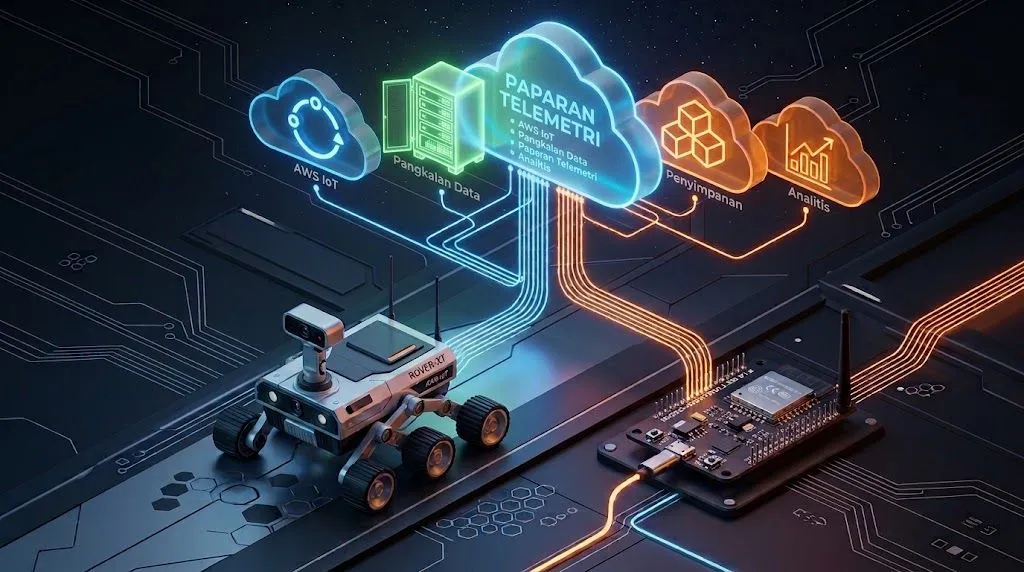
Connecting Embedded Systems and Robotics to AWS IoT Core: A Practical Overview
Explore how edge devices, microcontrollers, and autonomous robotic systems can securely ingest sensor telemetry into AWS IoT Core for real-time monitoring and scalable cloud analytics.

Introduction
In modern mechatronics and robotic engineering, deploying autonomous systems or smart embedded devices often requires reliable telemetry streaming, remote monitoring, and centralized data management. While local controllers execute real-time low-level tasks—such as motor actuation, sensor fusion, and localization—the cloud provides the infrastructure needed for long-term data analysis, fleet management, and remote diagnostics.
This article highlights an architectural overview of how embedded controllers and robotic systems (such as ROS 2 nodes or microcontroller units) can bridge telemetry data into AWS IoT Core to unlock scalable cloud computing capabilities.
System Architecture Overview
Connecting edge hardware to AWS typically involves three core layers:
- Edge Sensing & Control:
Microcontrollers or onboard companion computers read sensor data (such as ultrasonic range, battery voltage, temperature, or motor RPM) and publish state messages via standard lightweight protocols. - Ingestion Layer (AWS IoT Core):
AWS IoT Core acts as the managed message broker, securely handling incoming MQTT/HTTPS payloads from distributed edge nodes via X.509 certificate authentication. - Processing & Storage Pipeline:
Using the AWS IoT Rules Engine, incoming messages can be routed seamlessly without managing servers:- Amazon DynamoDB for low-latency state tracking and recent telemetry lookups.
- Amazon S3 for raw data archiving and historical dataset compilation.
- AWS Lambda for threshold triggers, automated alerting, and downstream system integration.
Implementation Steps
1. Device Provisioning and Security
Security at the edge is paramount. When provisioning a new device in AWS IoT Core:
- Create a dedicated IoT Thing representing your physical or simulated hardware.
- Generate and download an X.509 device certificate, private key, and the root CA certificate.
- Attach a least-privilege IoT Policy allowing only specific MQTT actions (such as
iot:Connectandiot:Publishto dedicated topics likedevice/+/telemetry).
2. Publishing Telemetry via MQTT
Edge nodes can format sensor readings into clean JSON payloads and stream them over secure MQTT (port 8883). Below is a minimal example using Python and the
awsiotsdk library:1
2
3
4
5
6
7
8
9
10
11
12
13
14
15
16
17
18
19
20
21
22
23
24
25
26
27
28
29
30
31
32
33
34
35
36
37
38
39
40
41
42
43
import json
import time
from awscrt import io, mqtt
from awsiot import mqtt_connection_builder
ENDPOINT = "YOUR-IOT-ENDPOINT.amazonaws.com"
CLIENT_ID = "rover_node_01"
PATH_TO_CERT = "certs/device.pem.crt"
PATH_TO_KEY = "certs/private.pem.key"
PATH_TO_ROOT = "certs/AmazonRootCA1.pem"
TOPIC = "rover/telemetry"
event_loop_group = io.EventLoopGroup(1)
host_resolver = io.DefaultHostResolver(event_loop_group)
client_bootstrap = io.ClientBootstrap(event_loop_group, host_resolver)
mqtt_connection = mqtt_connection_builder.mtls_from_path(
endpoint=ENDPOINT,
cert_filepath=PATH_TO_CERT,
pri_key_filepath=PATH_TO_KEY,
ca_filepath=PATH_TO_ROOT,
client_bootstrap=client_bootstrap,
client_id=CLIENT_ID,
clean_session=False,
keep_alive_secs=30
)
mqtt_connection.connect().result()
print("Device connected to AWS IoT Core!")
payload = {
"device_id": CLIENT_ID,
"battery_pct": 94.5,
"status": "OPERATIONAL",
"timestamp": int(time.time())
}
mqtt_connection.publish(
topic=TOPIC,
payload=json.dumps(payload),
qos=mqtt.QoS.AT_LEAST_ONCE
)
print("Telemetry payload published.")Enjoyed reading this content? Let the author know!
Your likes, comments, shares, and saves help creators reach more builders.

Loading recommendations
Loading article