
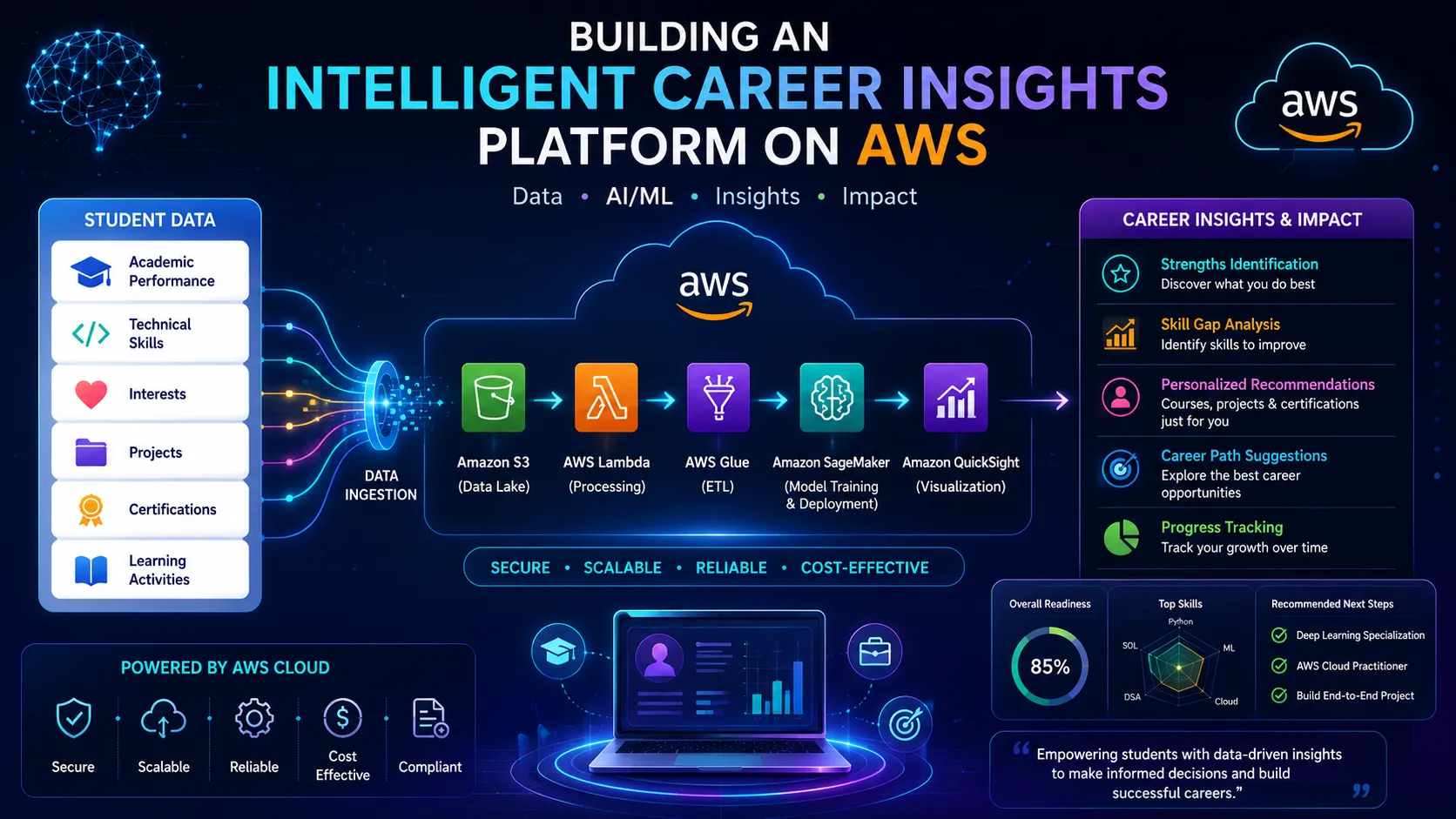
Building an Intelligent Career Insights Platform on AWS
Explore how AWS, Data Science, and Machine Learning can transform student data into meaningful career insights and personalized recommendations through a scalable cloud-based platform.

Building an Intelligent Career Insights Platform on AWS :
Choosing a career path is often difficult for students because there is no single factor that defines the right direction. Academic performance, technical skills, interests, projects, certifications, and learning habits can all provide useful information. However, these details are usually scattered across different places, making it difficult for students to understand their overall profile.
This idea focuses on building an Intelligent Career Insights Platform that brings these different pieces of information together. Instead of simply storing student data, the platform can analyze it and present meaningful insights that help students understand where they currently stand and what they can work on next.
Turning Student Data into Insights
The platform can collect information such as marks, programming skills, completed projects, areas of interest, certifications, and learning activities. Data Science techniques can be used to organize and prepare this information, while Machine Learning can help identify patterns within the data.
For example, a student may have good academic performance but limited practical project experience. The system could identify this difference and suggest areas where the student can gain more hands-on experience. In this way, the platform focuses not only on what a student has achieved but also on possible areas for growth.
Building the Platform with AWS
AWS can provide the cloud infrastructure needed to develop the platform. Amazon S3 can be used to store datasets and related resources, while AWS Lambda can handle processing tasks without requiring a continuously running server. Amazon SageMaker can support the development and deployment of machine learning models, and Amazon QuickSight can be used to display useful results through dashboards.
These services can be connected to create a system where data moves from storage and processing to analysis and finally to visualization. This also makes the platform easier to expand as the amount of data increases.
From Information to Career Insights
The main purpose of the platform is not to tell students exactly which career they should choose. Instead, it can provide information that helps them make better-informed decisions. The system could show their existing skills, highlight possible skill gaps, and identify learning areas related to their interests.
A simple workflow could be:
Student Data → Data Processing → Pattern Detection → Machine Learning → Career Insights → Visualization
This approach makes the collected data more useful by converting it into information that students can actually understand and use.
Making It More Personalized
The platform can become more useful by considering each student's individual learning journey. Future versions could include personalized learning paths, course recommendations, project suggestions, skill-gap tracking, and progress dashboards.
For example, if a student is interested in Data Science but has limited knowledge of statistics, the system could highlight statistics as an area to strengthen and suggest suitable learning resources or project ideas.
As the platform develops, additional features such as recommendation systems, interactive dashboards, skill assessments, and continuously updated student profiles can be introduced. Machine learning models can also be improved as more relevant and reliable data becomes available.
Privacy and responsible use of student information would also be important. The platform should use appropriate security measures and ensure that insights are presented as guidance rather than fixed decisions about a student's future.
Conclusion
An Intelligent Career Insights Platform can demonstrate how AWS, Artificial Intelligence, Machine Learning, and Data Science can be combined to solve a real problem faced by students. The idea goes beyond simply displaying data by turning student information into understandable insights and learning opportunities.
Developing this type of project can also provide practical experience with cloud computing, data processing, machine learning, visualization, and scalable application development while exploring how technology can support students in their career journey.
Enjoyed reading this content? Let the author know!
Your likes, comments, shares, and saves help creators reach more builders.

Loading recommendations
Loading article