
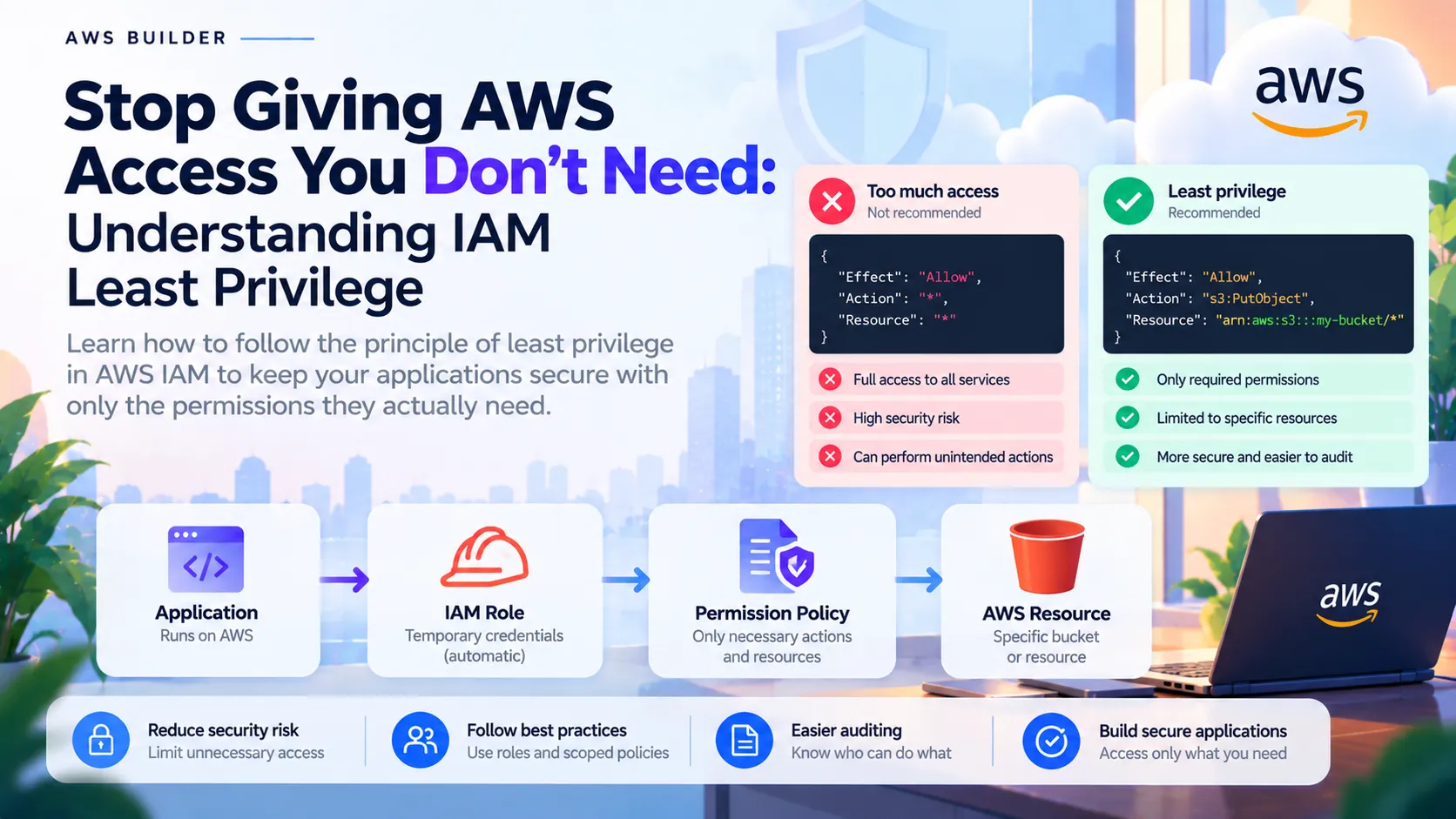
Stop Giving AWS Access You Don't Need: Understanding IAM Least Privilege
Learn how to follow the principle of least privilege in AWS IAM to keep your applications secure with only the permissions they actually need.


One of the easiest mistakes when building on AWS is giving an application more permissions than it actually needs.
It may work perfectly—but it creates unnecessary security risk.
What Is Least Privilege?
The principle is simple:
Give a user, application, or service only the permissions required to perform its job.
For example, if an application only needs to upload files to one S3 bucket, it shouldn't automatically receive permission to delete every object in every bucket.
Instead:
1
2
3
4
5
6
7
Application
     ↓
IAM Role
     ↓
Specific Permissions
     ↓
Required AWS Resource
Avoid "Allow Everything"
A policy such as:
1
2
3
4
5
{
  "Effect": "Allow",
  "Action": "*",
  "Resource": "*"
}
is extremely broad.
It may be convenient during development, but it gives the identity permission to perform essentially every supported action across resources.
A better approach is to restrict both the actions and the resources.
For example:
1
2
3
4
5
s3:PutObject
        ↓
Specific S3 Bucket
        ↓
Specific Object Path
Use IAM Roles for Applications
For workloads running on AWS, IAM roles are generally preferable to putting long-lived access keys inside application code.
The application receives temporary credentials through the AWS environment rather than storing permanent credentials in the source code.
A Simple Checklist
Before deploying an AWS workload, ask:
- Does this application really need this permission?
- Can the resource be restricted to a specific ARN?
- Can I use a role instead of long-lived credentials?
- Can read and write permissions be separated?
- Can unused permissions be removed?
The Bigger Lesson
AWS security doesn't start with complicated security products.
It starts with controlling who can do what, to which resource, and why.
Start with the minimum permissions your application needs—and expand them only when there is a real requirement.
Least privilege is not about making applications harder to build. It's about making access intentional.
Enjoyed reading this content? Let the author know!
Your likes, comments, shares, and saves help creators reach more builders.

Loading recommendations
Loading article