
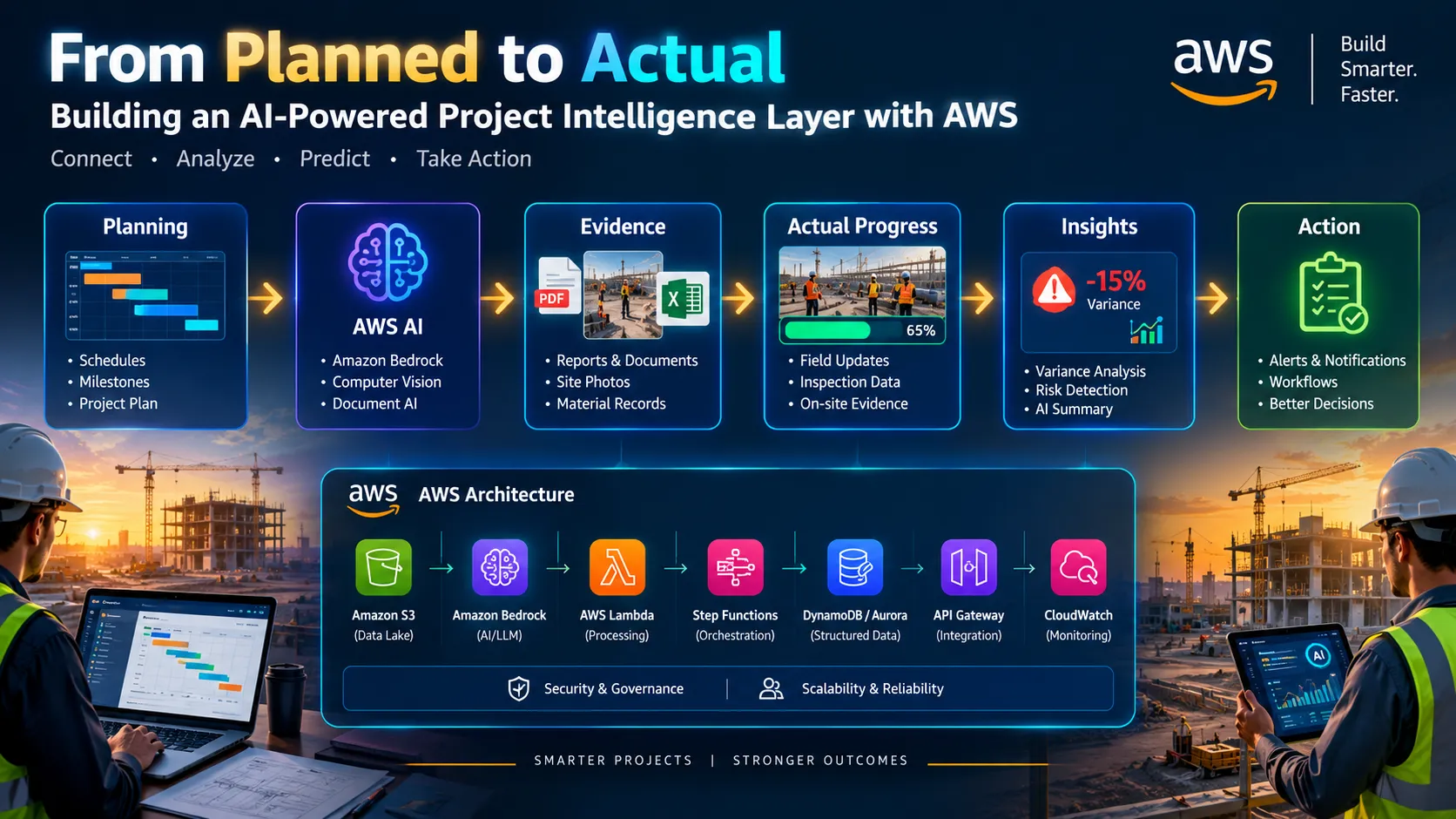
From Planned to Actual: Building an AI-Powered Project Intelligence Layer with AWS
Modern projects generate large amounts of schedules, reports, images, and field data, but connecting planned activities with actual progress remains challenging. This article explores how AWS AI services can create an intelligent project layer that extracts evidence, links it with planned activities, detects deviations, and converts project data into actionable insights.

From Planned to Actual: Building an AI-Powered Project Intelligence Layer with AWS
Introduction
Project teams generate information from many sources: schedules, daily reports, spreadsheets, documents, photographs, inspection records, and field updates. The challenge is not simply storing this information—it is connecting planned work with what is actually happening.
An AI-powered project intelligence layer can help bridge this gap by converting unstructured evidence and structured project data into meaningful, traceable insights.
The Core Problem
Traditional project monitoring often separates planning from execution.
A schedule may define:
Planned Activity → Planned Date → Planned Quantity → Planned Progress
While field teams generate:
Site Evidence → Actual Progress → Reports → Photos → Material Records
When these sources are not connected, teams spend significant time manually comparing information and identifying deviations.
Proposed AWS-Based Architecture
An AWS-based architecture can combine AI, storage, serverless computing, databases, and workflow orchestration.
1
2
3
4
5
6
7
8
9
10
11
12
13
14
15
16
17
Project Documents / Schedules / Images / Reports
                    ↓
                Amazon S3
                    ↓
          AI Document & Vision Layer
                    ↓
             Amazon Bedrock
                    ↓
       Information Extraction & Matching
                    ↓
       Planned vs. Actual Comparison
                    ↓
        Risk / Variance Identification
                    ↓
       Workflow & Automated Actions
                    ↓
       Dashboard / Reports / Alerts
1. Collecting Project Evidence
Amazon S3 can act as a centralized storage layer for project documents, schedules, photographs, reports, and other evidence.
Instead of treating every file as an isolated document, metadata can be associated with each item, such as:
- Project ID
- Activity ID
- Location
- Date
- Discipline
- Evidence type
- Source
- Confidence level
This creates a foundation for traceable AI processing.
2. Extracting Information with AI
Documents and reports often contain valuable information in different formats.
Amazon Bedrock can be used to build applications that extract and reason over relevant information using foundation models.
For example, an AI pipeline could identify:
- Activity names
- Quantities
- Dates
- Progress percentages
- Equipment
- Materials
- Constraints
- Reported issues
The extracted information can then be converted into structured records.
3. Connecting Planned and Actual Data
The most important layer is activity matching.
Suppose a schedule contains:
1
2
Activity ID: CW-PIP-042
Planned Progress: 80%
A field report may contain:
1
2
3
Observed Progress: 65%
Evidence: Site Photograph
Date: 02-Oct-2026
An intelligent matching layer can associate the field evidence with the corresponding planned activity.
The system can then calculate:
1
2
3
4
Variance = Actual Progress - Planned Progress

Variance = 65% - 80%
Variance = -15%
Instead of simply displaying the number, the system can provide the evidence supporting the observation.
4. Evidence-Based AI
AI-generated project insights should be traceable.
For example:
1
2
3
4
5
6
7
8
9
10
11
12
Activity: CW-PIP-042

Planned: 80%
Observed: 65%
Variance: -15%

Evidence:
✓ Schedule record
✓ Field photograph
✓ Daily progress report

AI Confidence: 92%
This approach makes the AI output easier for project teams to review.
The AI should support human decision-making rather than automatically making critical project decisions.
5. Detecting Risks and Exceptions
Once planned and actual information are connected, the system can identify patterns such as:
- Progress falling behind baseline
- Repeated delays
- Missing evidence
- Material-related constraints
- Activity dependencies
- Resource bottlenecks
- Inconsistent field reports
Amazon Bedrock can help generate natural-language explanations of these exceptions, while application logic can handle deterministic calculations and business rules.
For example:
Activity CW-PIP-042 is 15 percentage points behind planned progress based on the latest available evidence.
The application can then trigger an appropriate workflow.
6. From Insight to Action
Project intelligence becomes more useful when insights can initiate workflows.
A possible flow is:
1
2
3
4
5
6
7
8
9
10
11
Detect Variance
      ↓
Validate Evidence
      ↓
Identify Impact
      ↓
Create Action
      ↓
Notify Responsible Team
      ↓
Track Resolution
AWS Lambda can execute application logic, while AWS Step Functions can orchestrate multi-step workflows.
This allows the system to move beyond dashboards and become an operational decision-support layer.
7. Suggested AWS Technology Stack
| Requirement | AWS Service |
|---|---|
| Object Storage | Amazon S3 |
| Generative AI | Amazon Bedrock |
| Serverless Processing | AWS Lambda |
| Workflow Orchestration | AWS Step Functions |
| Structured Data | Amazon DynamoDB / Amazon Aurora |
| APIs | Amazon API Gateway |
| Monitoring | Amazon CloudWatch |
| Authentication | Amazon Cognito |
The exact architecture can vary depending on project scale, data sensitivity, latency requirements, and existing enterprise systems.
8. Human-in-the-Loop Validation
A critical design principle is human verification.
AI may identify a possible mismatch or progress variance, but a project engineer or authorized user should be able to review the evidence and confirm the final project state.
For example:
1
2
3
4
5
6
7
AI Detection
     ↓
Human Review
     ↓
Accept / Reject / Request Evidence
     ↓
Verified Project State
This provides a balance between automation and professional oversight.
Conclusion
An AI-powered project intelligence layer can bridge the gap between planning systems and real-world execution.
By combining Amazon S3, Amazon Bedrock, Lambda, Step Functions, databases, and APIs, developers can build systems that do more than store project information. They can connect evidence to activities, compare planned and actual progress, identify exceptions, explain the evidence behind insights, and initiate workflows.
The broader opportunity is to make project data continuously actionable—from Planning → Evidence → Intelligence → Decision → Action.
The objective is not to replace project professionals. It is to give them a more connected, traceable, and intelligent view of what is happening in the field.
Enjoyed reading this content? Let the author know!
Your likes, comments, shares, and saves help creators reach more builders.

Loading recommendations
Loading article