
Beyond the Classroom: Exploring AWS Opportunities for Students
Discover the AWS opportunities available to students beyond the classroom. From AWS Educate and AWS Skill Builder to AWS Builder Center, Student Builder Groups, AWS Community Builders, and more, explore how students can learn cloud and AI, build real-world projects, connect with like-minded builders, share their knowledge, and develop technical and leadership skills. This article provides a practical roadmap for turning your AWS learning journey into meaningful community participation and continuous growth

For students interested in cloud computing, artificial intelligence, data, software development, or emerging technologies, learning does not have to stop at the classroom.
Today, students can access a growing ecosystem of AWS learning resources, hands-on experiences, communities, events, and opportunities to share what they build with a global audience.
What makes this journey especially valuable is that students do not have to start as cloud experts. They can begin by learning the fundamentals, experiment with AWS services, join a student community, build projects, share their experiences, and eventually take on leadership roles.
The journey can be as simple as:
Learn → Build → Connect → Share → Lead
Here are some of the AWS opportunities students can explore along the way.
1. Start Learning with AWS Educate
For students who are completely new to cloud computing, AWS Educate is a great place to begin.
AWS Educate provides free, self-paced learning resources designed to help learners develop cloud and AI skills. The content is structured around practical learning, making it easier for beginners to understand concepts and experiment with AWS technologies.
Students can explore areas such as:
- Cloud computing fundamentals
- Storage
- Compute
- Artificial intelligence
- Machine learning
- Generative AI
- Cloud-based application development
One of the biggest advantages of learning through platforms such as AWS Educate is the opportunity to move from simply understanding a concept to actually experimenting with it.
For example, instead of only learning what cloud storage is, a student can explore Amazon S3 and understand how cloud storage can be used in a real application.
The goal should not be to learn every AWS service. Start with one concept, understand it well, and build something small.
2. Go Deeper with AWS Skill Builder
Once students have developed an understanding of the basics, AWS Skill Builder provides a broader learning environment for developing cloud skills.
AWS Skill Builder offers digital courses, learning plans, certification preparation, hands-on learning experiences, and other resources. AWS currently provides hundreds of free courses through the platform.
Students can use Skill Builder to create a structured learning path based on their interests.
For example:
Cloud beginner
→ Cloud fundamentals
→ Compute and storage
→ Networking
→ Security
→ Databases
→ Compute and storage
→ Networking
→ Security
→ Databases
AI/ML learner
→ Machine learning fundamentals
→ Generative AI
→ Amazon Bedrock
→ Responsible AI
→ Building AI applications
→ Generative AI
→ Amazon Bedrock
→ Responsible AI
→ Building AI applications
Developer
→ AWS compute
→ Serverless
→ Containers
→ Databases
→ DevOps
→ Serverless
→ Containers
→ Databases
→ DevOps
Students preparing for AWS Certifications can also use Skill Builder for certification preparation.
The important thing is to avoid treating learning platforms as something to simply “complete.” The real value comes when students take what they learn and apply it to projects.
3. Build Your AWS Identity with AWS Builder ID
As students begin exploring the AWS ecosystem, an AWS Builder ID becomes an important starting point.
A Builder ID provides access to experiences such as AWS Builder Center, AWS Skill Builder, AWS re, and other builder resources.
This also makes it easier for students to begin building a visible presence in the AWS builder community.
Learning becomes much more meaningful when it becomes something you can demonstrate:
“I learned this.”
becomes
“I learned this, built something with it, and shared what I learned.”
That shift from learning privately to building publicly can make a significant difference in a student's technical journey.
4. Discover the AWS Builder Center
AWS Builder Center is a community space where builders can learn, connect, share knowledge, participate in discussions, discover events, publish content, and interact with other members of the AWS community.
Students can use Builder Center to:
- Read technical articles
- Publish their own articles
- Participate in community discussions
- Join Spaces based on topics and interests
- Share projects and experiences
- Participate in challenges and events
- Connect with other builders
- Build a public profile showcasing their contributions
One particularly useful aspect for students is that you do not have to wait until you are an expert before contributing.
You can write about:
- Your first AWS project
- A service you recently learned
- A problem you encountered while building
- A tutorial you created
- A certification journey
- A hackathon experience
- A workshop you attended
- A technical concept you finally understood
- Lessons from a project that did not work as expected
Your learning journey itself can become valuable content for someone else.
5. Join an AWS Student Builder Group
Learning becomes more engaging when you do it with other people.
AWS Student Builder Groups (SBGs) are student-led communities where students come together to explore cloud and AI technologies, build projects, participate in technical events, and grow their skills together. AWS Student Builder Groups were formerly known as AWS Cloud Clubs.
For a student, joining an SBG can provide opportunities to:
- Attend technical workshops
- Participate in hands-on sessions
- Work on projects with peers
- Learn from other students
- Participate in community events
- Organize technical activities
- Meet other builders
- Develop communication and leadership skills
The community aspect is important because technical growth is not only about writing code.
It is also about asking questions, explaining concepts, collaborating with others, receiving feedback, and learning from different approaches.
And if there is no Student Builder Group at your institution, students can explore the possibility of starting one.
6. Don't Just Attend Events — Organize Them
One of the most valuable ways to learn something is to teach it.
Student Builder Groups create opportunities for students to move from being participants to organizers and leaders.
A student can organize:
- AWS introduction sessions
- Hands-on workshops
- Cloud study groups
- Certification preparation sessions
- Generative AI workshops
- Project-building sessions
- Technical quizzes
- Hackathons
- Community discussions
AWS Student Builder Group Leaders receive support from AWS and take responsibility for growing their campus communities and organizing activities. Current program benefits include opportunities involving AWS Credits, certification vouchers, learning resources, badges, and connections with AWS professionals.
Leadership in a technical community is also a form of learning.
When you organize a workshop on Amazon S3, for example, you are not only preparing slides. You are forced to understand the service well enough to explain it, anticipate questions, demonstrate it, and help someone else troubleshoot.
That process can deepen your own understanding.
7. Share What You Learn
One of the simplest opportunities students often overlook is sharing their learning.
You do not need to publish a highly advanced research paper or build the next major cloud platform.
Start small.
Suppose you learned about Amazon S3.
Instead of simply adding “AWS S3” to your resume, you could:
- Learn the fundamentals.
- Build a small project.
- Document what you did.
- Explain what you learned.
- Publish an article.
- Share it with your community.
- Help someone else who is learning the same topic.
That creates a cycle:
Learn → Build → Document → Share → Help Others → Learn More
AWS Builder Center provides a place where builders can publish articles and participate in community conversations.
Your first article does not have to be perfect.
It simply needs to be useful.
8. Explore AWS re
Another resource students should know about is AWS re, the AWS community knowledge platform.
It can be used to ask technical questions, find solutions, learn from discussions, and share knowledge with other AWS users.
When you encounter an error while building a project, don't immediately consider it a failure.
Debugging is part of learning.
Search for the problem. Ask a question. Understand the solution. Then document what you learned.
Eventually, the question you once asked may become the answer you provide to someone else.
9. Explore AWS Community Builders
As students become more active in learning and sharing AWS knowledge, they can also explore the AWS Community Builders program.
AWS Community Builders is designed for people who are passionate about learning and sharing AWS knowledge. Importantly, you do not need to be an AWS expert to begin participating in the broader AWS builder community.
Community Builders can take their learning and contribution journey further by creating technical content, engaging with other builders, and becoming part of a broader community of AWS enthusiasts.
This is where consistency becomes important.
You don't need to publish something every day.
Instead, focus on creating genuinely useful content:
- “What I learned about Amazon Bedrock”
- “Building my first serverless application”
- “How I used Amazon S3 in my project”
- “My AWS certification preparation journey”
- “What I learned from organizing an AWS workshop”
- “Five things I learned while building my first AWS project”
Over time, these contributions can become a portfolio of your technical growth.
10. Take Advantage of Student Rewards
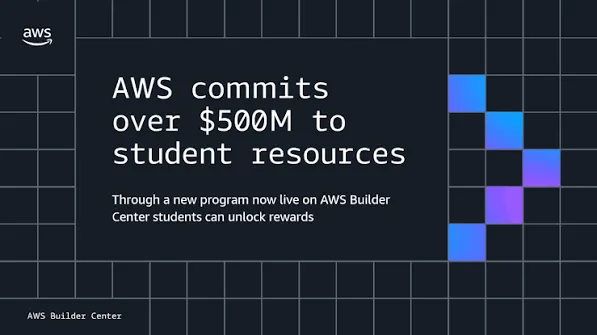
AWS is also expanding the benefits available specifically to higher-education students through AWS Builder Center.
As of 2026, verified eligible students can access Student Rewards, which can include 12 months of AWS Skill Builder premium access, AWS Credits, and an AWS foundational certification exam voucher as they complete eligible Builder Center activities and earn badges.
This creates an interesting model:
Learn → Participate → Contribute → Earn Rewards
Rather than simply consuming educational content, students can become active members of the builder ecosystem.
Students should check the current eligibility requirements and program terms before relying on any specific benefit, since programs and availability can change.
11. Don't Separate Cloud, AI, and Your Existing Field
AWS learning does not have to be a separate activity from your degree.
A Computer Science student can combine AWS with software development.
A Data Science student can explore cloud-based data pipelines and machine learning.
An AI student can explore services such as Amazon Bedrock.
A cybersecurity student can explore cloud security.
An electronics student can explore IoT and edge computing.
A business student can explore cloud-based applications and generative AI.
The important question is not:
“What AWS services should I learn?”
A better question is:
“What problem am I interested in solving, and which AWS technologies can help me solve it?”
That change in perspective can turn AWS from a collection of services into a toolkit for building solutions.
12. Build a Portfolio, Not Just a Certificate Collection
Certifications can demonstrate structured learning, but projects demonstrate application.
Instead of collecting certificates without building anything, students can combine the two.
For example:
Learn
Complete an AWS learning path.
↓
Build
Create a small cloud or AI project.
↓
Document
Write about the architecture and lessons learned.
↓
Share
Publish the project or article on Builder Center and other professional platforms.
↓
Connect
Discuss the project with other builders.
↓
Improve
Use feedback to improve the project.
↓
Lead
Teach the concept through a workshop or student community.
This creates a much stronger learning loop than studying in isolation.
13. Your First Contribution Doesn't Have to Be Technical
Being part of the AWS community is not limited to writing code.
You can contribute by:
- Organizing events
- Helping beginners
- Writing tutorials
- Creating diagrams
- Sharing project ideas
- Speaking at community events
- Hosting study groups
- Answering questions
- Creating learning resources
- Connecting students with opportunities
Communication is an important technical skill.
If you can understand a complex concept and explain it clearly to someone who is seeing it for the first time, you are developing a skill that will remain valuable far beyond your student years.
14. A Simple Roadmap for Students
If you are wondering where to start, don't try to do everything at once.
Try this:
Step 1 — Create your AWS Builder ID
Use it to access AWS builder resources and establish your presence in the AWS ecosystem.
Step 2 — Start with AWS Educate
Build your cloud fundamentals through beginner-friendly learning experiences.
Step 3 — Move to AWS Skill Builder
Choose a learning path aligned with your interests and career goals.
Step 4 — Build a small project
Use what you learned to solve a real problem.
It doesn't need to be complicated.
Step 5 — Join an AWS Student Builder Group
Find students who are learning and building alongside you.
Step 6 — Join AWS Builder Center
Read articles, join relevant Spaces, participate in discussions, and discover opportunities.
Step 7 — Share what you learn
Write an article, publish a project, explain a concept, or share your experience.
Step 8 — Take on leadership opportunities
Organize a workshop, mentor another student, or explore becoming a Student Builder Group Leader.
Step 9 — Explore AWS Community Builders
As you build your experience and become an active contributor, explore opportunities to participate in the broader AWS community.
From Student to Builder
The most important thing to remember is that you don't need to wait until you are an expert to become a builder.
You can start with one course.
Then one project.
Then one article.
Then one community event.
Then one person you help.
Over time, those small actions can become a technical portfolio, a professional network, leadership experience, and a community of people learning alongside you.
AWS provides students with opportunities to learn technology, build solutions, connect with other builders, and share knowledge with the community.
But the ecosystem only becomes valuable when you participate in it.
So if you're a student wondering where to begin, start small.
Learn something. Build something. Share something. Help someone.
And then do it again.
Because the goal isn't simply to become someone who knows AWS.
The goal is to become a builder
# aws-student-builders-groups# student-builders# aspiring-builders# builder-center# aws-community-builders
Any opinions in this article are those of the individual author and may not reflect the opinions of AWS.Enjoyed reading this content? Let the author know!
Your likes, comments, shares, and saves help creators reach more builders.

Loading recommendations
Loading article