
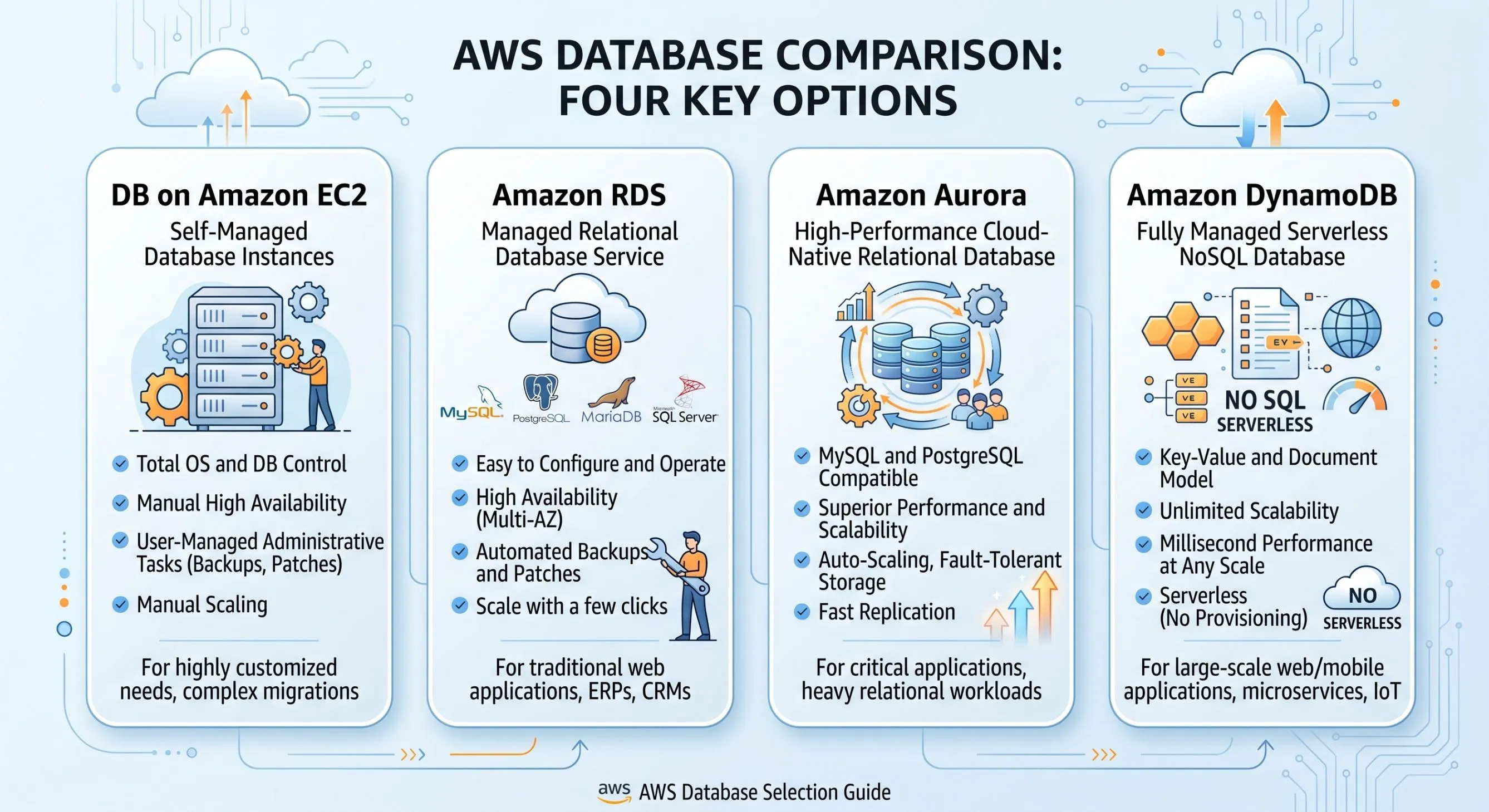
AWS Databases: Shared Responsibility, RDS, Aurora, and DynamoDB
Choosing and managing the right database is one of the most critical decisions when architecting in the cloud. However, in AWS, database management isn't just about picking a technology; it's also about understanding how much control (and administrative work) you want to hand over to AWS. In this article, we will break down the Shared Responsibility Model for databases and explore the core Relational and NoSQL services AWS has to offer

The Shared Responsibility Model for Databases
AWS categorizes its database services into three distinct deployment models based on who manages the underlying administrative tasks:
• Fully Managed Services: AWS handles almost everything—provisioning, scaling, patching, automatic backups, performance tuning, and security patches. Built-in monitoring and metrics are also provided. As a customer, you only need to focus on data structure design and access control.
• Managed Services: AWS takes care of routine tasks like hardware provisioning, patching, and OS backups. However, the customer remains responsible for database configuration, query optimization, and fine-tuning performance decisions.
• Unmanaged Services: The customer is fully responsible for installation, configuration, patching, maintenance, security, backups, high availability, and performance tuning. An example of this is installing a traditional database engine (like MySQL) directly onto an Amazon EC2 instance.
Relational Database Services (SQL)
When your application requires structured data, complex queries, and ACID compliance, AWS offers two premier managed options:
When your application requires structured data, complex queries, and ACID compliance, AWS offers two premier managed options:
_ Amazon Relational Database Service (Amazon RDS)
Amazon RDS is a managed relational database service that removes the high upfront costs of buying and maintaining physical hardware. You pay only for what you consume using a flexible pay-as-you-go model.
• Supported Engines: Amazon Aurora, MySQL, PostgreSQL, Microsoft SQL Server, MariaDB, and Oracle.
• Key Benefits:
Multi-AZ Deployment
Automated & Manual Backups
Security
• Best Used For: E-commerce product inventories, enterprise business workloads, and standard web applications.
_ Amazon Aurora
Amazon Aurora is a enterprise-grade, managed relational database designed specifically for the cloud to eliminate unnecessary input/output (I/O) operations.
• Performance Boost: It delivers up to 5x the performance of standard MySQL and 3x the performance of standard PostgreSQL.
• Key Benefits:
Automated Storage Scaling
Advanced Replication
• Best Used For: High-performance gaming applications, real-time analytics, and massive content management systems.
Non-Relational Database Services (NoSQL)
When your application requires a flexible schema, ultra-low latency, and massive horizontal scaling without complexity, AWS offers a serverless champion:
When your application requires a flexible schema, ultra-low latency, and massive horizontal scaling without complexity, AWS offers a serverless champion:
_ Amazon DynamoDB
DynamoDB is a fully managed NoSQL database service that provides lightning-fast, predictable performance for key-value and document data structures.
• Seamless Scaling: It automatically scales throughput capacity up or down based on real traffic, ensuring consistent performance without manual intervention. You only pay for the resources you actually use.
• Key Benefits:
Single-Digit Millisecond Latency
High Availability
• Best Used For: Global mobile applications, large-scale gaming platforms, and high-frequency financial service apps.
Enjoyed reading this content? Let the author know!
Your likes, comments, shares, and saves help creators reach more builders.

Loading recommendations
Loading article