
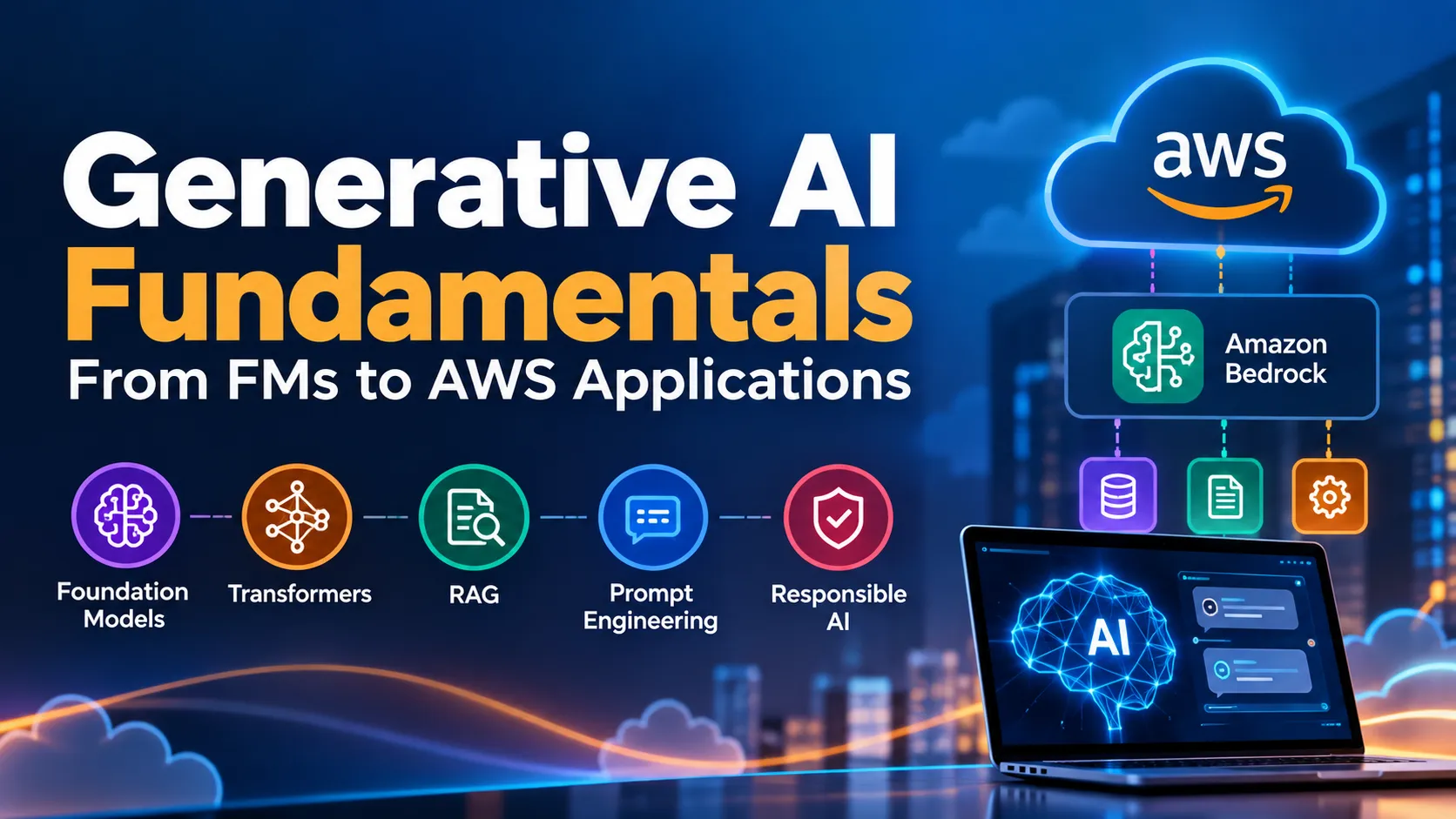
Generative AI Fundamentals: From FMs to AWS Applications
Explore foundation models, transformers, RAG, prompt engineering, responsible AI, and how AWS services like Amazon Bedrock enable generative AI applications.

Introduction
Generative AI has evolved from being a research topic into a core technology powering chatbots, coding assistants, document analysis, image generation, enterprise search, and autonomous AI agents.
Services like ChatGPT, Amazon Q Developer, Amazon Kiro, Claude, and Amazon Nova are all built upon Foundation Models (FMs) large AI models trained on enormous datasets capable of performing many different tasks without being designed specifically for each one.
In this article, you'll learn:

Why Traditional Machine Learning Isn't Enough
Traditional ML follows a straightforward pipeline:
1
2
3
4
5
6
7
8
9
10
Collect Data
      │
      ▼
Label Data
      │
      ▼
Train Model
      │
      ▼
Deploy
Every new task requires:
- New labeled datasets
- New model training
- New deployment
For example:
- Spam detection
- Image classification
- Fraud detection
Each needs its own model. Generative AI changes this entirely.
Foundation Models
A Foundation Model is a massive neural network trained once on trillions of tokens.
Instead of solving one task, it learns:
- Language
- Programming
- Mathematics
- Reasoning
- Images
- Audio
- General world knowledge
Later, the same model can perform:
- Question answering
- Summarization
- Translation
- Coding
- Document analysis
- Chatbots
- Content creation
Examples available through Amazon Bedrock include:
| Model | Company | Best For |
|---|---|---|
| Amazon Nova | AWS | Enterprise AI |
| Claude | Anthropic | Reasoning |
| Llama | Meta | Open-source applications |
| Mistral | Mistral AI | Lightweight inference |
| Stable Diffusion | Stability AI | Image generation |
How Foundation Models Are Trained
Pretraining uses enormous amounts of unlabeled data.
1
2
3
4
5
6
7
8
Books
Wikipedia
Research Papers
GitHub
Web Pages
Images
Videos
Audio
↓
Transformer Training
↓
Foundation Model
No one labels every sentence manually. Instead, the model learns by predicting missing words over billions of examples.
Understanding Tokens
Large Language Models don't read text.
They read tokens.
Example:
1
Amazon Bedrock is awesome.
might become
1
2
3
4
5
6
Amazon
Bed
rock
is
awesome
.
Each token becomes an integer.
1
2
3
4
5
6
1023
194
556
92
812
9
Pricing in most LLM APIs is also token-based.
That means:
- Longer prompts cost more
- Longer outputs cost more
Prompt optimization reduces latency and cost.
Word Embeddings
After tokenization, tokens become vectors.
Instead of storing words directly:
1
Dog
becomes
1
2
3
4
5
[]Words with similar meanings occupy nearby positions in vector space.
1
2
3
4
5
Dog -------- Puppy

Cat -------- Kitten

King ------ Queen
This semantic representation enables reasoning beyond simple keyword matching.
Transformers: The Real Breakthrough
Before 2017, AI relied heavily on recurrent neural networks (RNNs), which processed words one by one.
1
2
3
4
5
6
7
Word 1
↓

Word 2
↓

Word 3
Transformers process every word simultaneously.
1
2
3
4
Entire Sentence
        │
        ▼
Self Attention
Advantages include:
- Parallel GPU execution
- Faster training
- Better context retention
- Scales to trillions of parameters
This architecture powers:
- GPT
- Claude
- Nova
- Gemini
- Llama
- DeepSeek
Self-Attention
Consider:
The programmer fixed the bug because it caused the crash.
What does "it" mean?
- Programmer?
- Bug?
- Crash?
Self-attention evaluates relationships between every word.
1
2
3
Programmer ←→ Bug
Programmer ←→ Crash
Bug ←→ Crash
The model determines that "it" refers to "bug."
This contextual understanding is a key reason transformers generate coherent responses.
From Prompt to Response
Suppose the prompt is:
Write a Python Lambda function.
The processing flow is:
1
2
3
4
5
6
7
8
9
10
11
12
13
14
15
16
17
18
19
20
21
22
23
24
25
Prompt

↓

Tokenization

↓

Embedding

↓

Transformer Layers

↓

Probability Distribution

↓

Decoder

↓

Generated Code
At each step, the model predicts the most probable next token.
Context Windows
Large Language Models maintain temporary memory called the context window.
Example:
1
2
3
4
5
6
7
8
9
User:

My name is Alice.

Assistant:
Hello Alice.

User:
What's my name?
The model answers correctly because the earlier message remains within the current context.
Once the context window fills, older information may be discarded.
This is why long conversations can lose earlier details.
Prompt Engineering
Prompt engineering is often the easiest way to improve output quality.
Instead of:
1
Explain AWS.
Use:
1
2
3
4
5
6
7
8
9
10
11
You are an AWS Solutions Architect.

Explain Amazon VPC to beginners.

Include:
- diagrams
- real-world examples
- interview questions
- best practices

Keep it under 700 words.
Clear prompts consistently produce better results.
Fine-Tuning
Sometimes prompts aren't enough.
Organizations may need:
- Medical terminology
- Banking policies
- Legal documents
- Internal knowledge
Fine-tuning updates model parameters using domain-specific labeled datasets.
Advantages:
- Better accuracy
- Consistent responses
- Specialized expertise
Trade-offs:
- High cost
- Longer training
- Ongoing maintenance
Retrieval-Augmented Generation (RAG)
Fine-tuning isn't always necessary. Instead, many organizations use RAG.
1
2
3
4
5
6
7
8
9
10
11
12
13
14
15
16
17
User Question

↓

Vector Search

↓

Relevant Documents

↓

Foundation Model

↓

Answer
Example:
Employee asks:
What's our leave policy?
Instead of relying on pretrained knowledge, the application retrieves the latest HR policy document and sends it to the model as context.
Benefits:
- Up-to-date answers
- Uses private data
- No retraining
- Lower cost
AWS services commonly used:
- Amazon Bedrock
- Amazon OpenSearch Serverless
- Amazon S3
- Amazon Knowledge Bases
- AWS Lambda
Building with Amazon Bedrock
Typical architecture:
1
2
3
4
5
6
7
8
9
10
11
12
13
14
                  User
                    │
                    ▼
             React / Web App
                    │
              Amazon API Gateway
                    │
                AWS Lambda
                    │
            Amazon Bedrock API
                    │
          Claude / Nova / Llama
                    │
                Response
If using RAG:
1
2
3
4
5
6
7
8
9
10
11
12
13
14
15
16
17
18
19
20
21
22
23
24
25
User

↓

API Gateway

↓

Lambda

↓

Knowledge Base

↓

Amazon OpenSearch Vector Store

↓

Amazon Bedrock

↓

Answer
Sample Python Code (Amazon Bedrock)
1
2
3
4
5
6
7
8
9
10
11
12
13
14
15
16
17
18
19
20
21
22
import boto3

import json


client = boto3.client("bedrock-runtime")


response = client.invoke_model(

    modelId="amazon.nova-lite-v1:0",

    body=json.dumps({

        "messages": [

            {

                "role": "user",

                "content": [

                    {

                        "text": "Explain Amazon EC2 in simple words."

                    }

                ]

            }

        ]

    })

)


print(response["body"].read().decode())
With only a few lines of code, you can invoke a foundation model hosted on Amazon Bedrock without managing infrastructure.
Responsible AI
Generative AI introduces new challenges.
Common risks include:
| Challenge | Example |
|---|---|
| Hallucination | Incorrect facts presented confidently |
| Bias | Gender or cultural stereotypes |
| Toxicity | Harmful or offensive outputs |
| Privacy | Sensitive information leakage |
| Copyright | Content resembling training data |
Mitigation strategies:
- Human review
- Content filtering
- Amazon Bedrock Guardrails
- Prompt validation
- Retrieval-Augmented Generation
- Continuous monitoring
AWS Services for Generative AI
| Service | Purpose |
|---|---|
| Amazon Bedrock | Managed foundation models |
| Amazon Bedrock Guardrails | Safety and content filtering |
| Amazon Bedrock Knowledge Bases | Managed RAG |
| Amazon SageMaker AI | Train and deploy custom ML models |
| AWS Trainium | Cost-efficient AI training |
| AWS Inferentia | High-performance inference |
| Amazon Q Developer | AI coding assistant |
| Amazon Kiro | AI-powered IDE for developers |
Best Practices
- Start with a business problem, not the model.
- Use prompt engineering before considering fine-tuning.
- Prefer RAG for proprietary knowledge instead of retraining.
- Monitor token usage to control costs.
- Build with human oversight for high-impact decisions.
- Apply guardrails, logging, and evaluation throughout the AI lifecycle.
- Regularly review compliance, privacy, and responsible AI practices.
Conclusion
Generative AI has fundamentally changed how we build intelligent applications. Powered by Foundation Models and transformer architectures, these systems can understand language, generate code, summarize documents, and answer complex questions with remarkable fluency.
For most organizations, the fastest path to production is not building or training a model from scratch, but combining Amazon Bedrock, Knowledge Bases, Guardrails, and AWS serverless services to create secure, scalable, and cost-effective AI solutions. By pairing strong technical design with responsible AI practices, you can deliver applications that are not only innovative but also trustworthy, maintainable, and ready for enterprise use.
Thank you for taking the time to read my article! If you found it helpful, feel free to like, share, and drop your thoughts in the comments; I’d love to hear from you.
If you want to connect or dive deeper into cloud, AI and DevOps, feel free to follow me on my socials:
💼 LinkedIn
🛡️Medium
🐙 GitHub
Enjoyed reading this content? Let the author know!
Your likes, comments, shares, and saves help creators reach more builders.

Loading recommendations
Loading article