
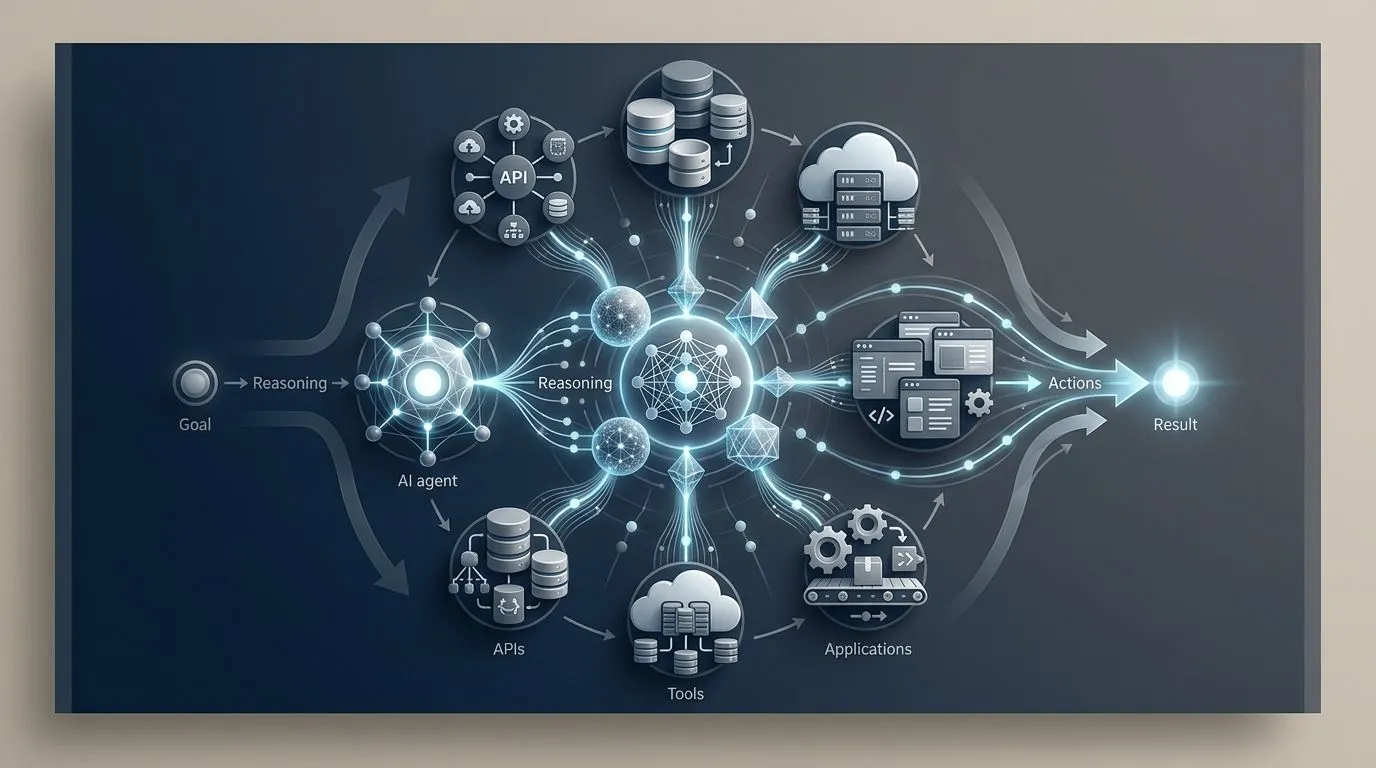
AI Agents: From Chatbots to Systems That Can Take Action
How we can create agents that build useful systems and what that process looks like.

Introduction
AI has changed considerably over the last few years.
Initially, many of us interacted with AI through systems that primarily responded to questions or generated content. Today, we're increasingly seeing systems that can do more than simply provide an answer.
This is where AI agents become interesting.
An AI agent can be thought of as a system that uses AI to reason about a task, interact with tools, and take actions toward achieving a goal.
That difference might sound small, but it changes how we think about AI applications.
From Asking Questions to Taking Actions
A traditional chatbot might work something like:
User → Question → AI → Answer
An agentic system can look more like:
User → Goal → AI → Plan → Tools → Actions → Result
For example, imagine asking an AI system:
"Find the latest sales data, identify the products with declining performance, and prepare a summary."
A simple AI model might explain how you could perform those steps.
An agent could potentially interact with databases, APIs, spreadsheets, or other tools to actually perform parts of the workflow.
This is where I think the concept becomes particularly interesting for software developers.
Agents Still Need Software
One thing I've been learning is that an AI agent isn't simply an AI model with a fancy interface.
There is an entire system surrounding the model.
An agent might need:
- APIs
- Databases
- Authentication
- External tools
- Memory or state
- Business logic
- Monitoring
- Security controls
The AI model might be responsible for reasoning, but the surrounding software determines what the agent is actually capable of doing.
Why Cloud Computing Matters
Cloud platforms provide many of the building blocks required to create these systems.
Applications can use compute resources, databases, APIs, event-driven architectures, authentication systems, logging, and monitoring.
This creates an interesting intersection between AI engineering and cloud architecture.
Instead of asking only:
"How do I build an AI model?"
we can start asking:
"How do I build a reliable system around an AI model?"
The Challenge of Autonomy
There is also an important trade-off.
Giving an AI system more ability to act can make it more useful, but it can also introduce more risk.
If an agent can access a database, send an email, modify information, or call an external API, then mistakes can have real consequences.
This means that building useful agents isn't only about making them smarter.
It's also about making them predictable, observable, secure, and appropriately constrained.
My Takeaway
I'm still learning about agentic systems, but one thing has become clear to me:
The future of AI isn't only about better models. It's also about better systems.
Understanding how AI connects with software engineering, cloud infrastructure, APIs, data, and security is what makes this area particularly interesting to me.
Enjoyed reading this content? Let the author know!
Your likes, comments, shares, and saves help creators reach more builders.

Loading recommendations
Loading article