
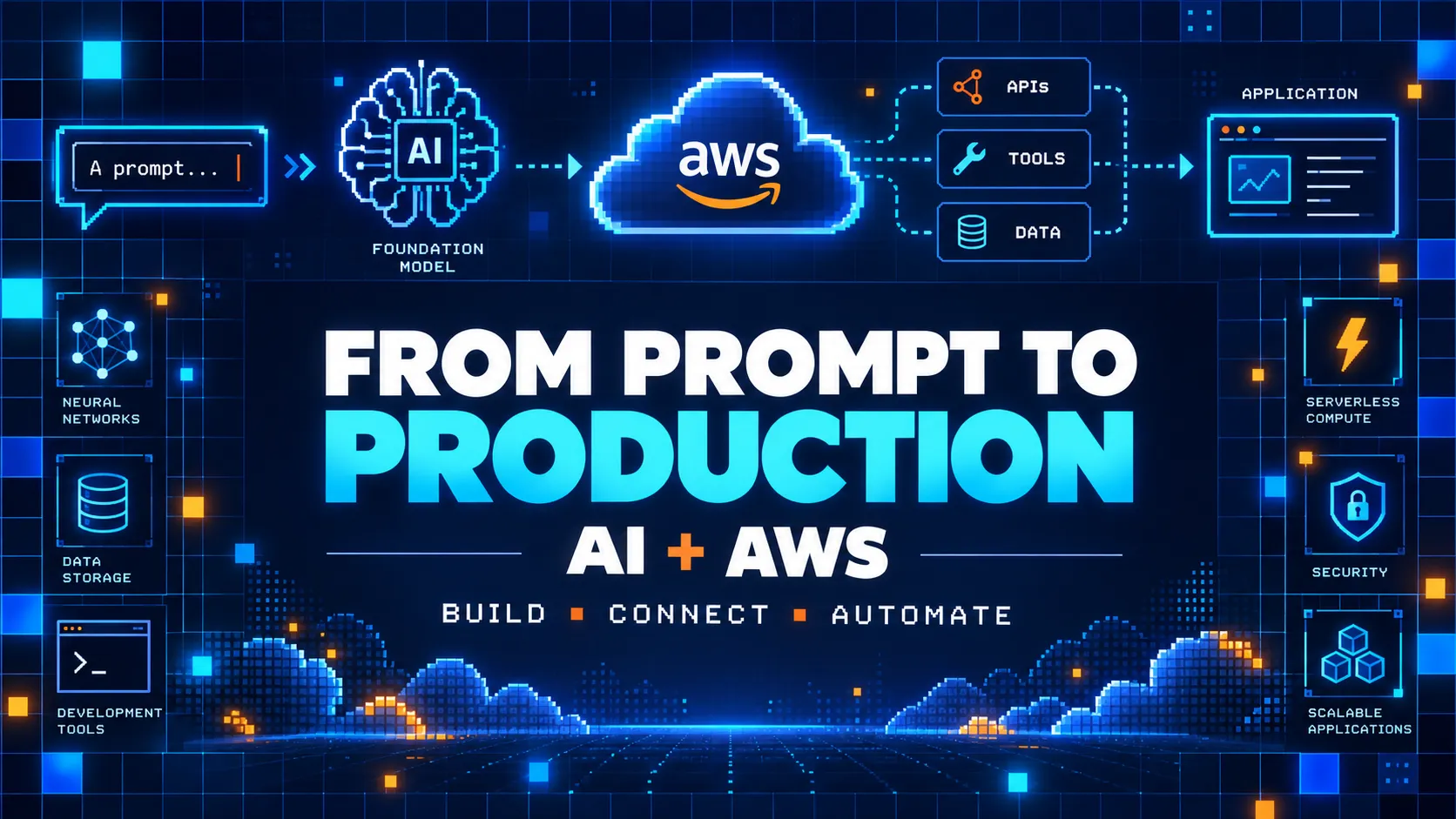
From Prompt to Production: Building Real AI Applications on AWS
Calling an AI model is easy. Building a real AI system is harder. This article explores how Amazon Bedrock, RAG, Knowledge Bases, Guardrails, AgentCore, Lambda, storage, monitoring, and machine learning can work together to turn simple AI experiments into useful, secure, production-ready applications on AWS.

From Prompt to Production: Building Real AI Applications on AWS
Calling an AI model is easy.
Building an AI system that is useful, secure, connected to real data, observable, and ready for users is a different problem.
A production AI application usually needs much more than a prompt and a model. It may need APIs, authentication, business data, retrieval, tools, storage, monitoring, safety controls, scalable infrastructure, and cost control.
That is where AI + AWS becomes interesting.
AWS provides the infrastructure around the model that can turn an experiment into an application.
The Model Is Only One Layer
A beginner AI application often looks like this:
1
2
3
4
5
6
7
User
  ↓
Prompt
  ↓
Foundation Model
  ↓
Response
That is enough for experimentation.
But imagine building an internal company assistant. Now the system may need to answer questions using private documents, respect user permissions, search internal data, call APIs, store state, filter unsafe requests, log activity, handle failures, and scale to many users.
The architecture becomes:
1
2
3
4
5
6
7
8
9
10
11
12
13
User
  ↓
Frontend
  ↓
API
  ↓
Application Logic
  ↓
AI Model
 ↙   ↓   ↘
Data Tools Safety
  ↓
Monitoring
The model is important, but it is only one part of the system.
Amazon Bedrock: The Foundation Model Layer
Amazon Bedrock is a fully managed AWS service for building generative AI applications with foundation models.
A simple architecture could look like:
1
2
3
4
5
6
7
8
9
Web App
   ↓
API Gateway
   ↓
AWS Lambda
   ↓
Amazon Bedrock
   ↓
Foundation Model
The responsibilities are clear:
- API Gateway receives the request
- Lambda executes application logic
- Bedrock provides model inference
- The application returns the result
This is a strong starting point, but a model by itself still does not know your private business data.
RAG: Giving AI Access to Your Data
Most real AI applications need proprietary context:
- Internal documentation
- Product catalogs
- Company policies
- Technical manuals
- Support articles
- Research papers
- Knowledge bases
One common pattern is Retrieval-Augmented Generation (RAG).
Instead of asking the model to answer only from its internal knowledge, the application first retrieves relevant information from a data source and provides that context to the model.
1
2
3
4
5
6
7
8
9
User Question
      ↓
Retrieve Relevant Data
      ↓
Add Context
      ↓
Foundation Model
      ↓
Grounded Response
Amazon Bedrock Knowledge Bases provides managed capabilities for RAG applications.
A simplified architecture:
1
2
3
4
5
6
7
8
9
10
11
Documents
   ↓
Amazon S3
   ↓
Bedrock Knowledge Base
   ↓
Retrieve Relevant Context
   ↓
Foundation Model
   ↓
Answer
Now the AI can answer using the information that matters to the organization.
Example: Technical Documentation Assistant
Imagine a company with hundreds of technical manuals in Amazon S3.
An employee asks:
"What is the recommended maintenance procedure for machine X after 5,000 operating hours?"
The system can retrieve relevant documentation before generating a response.
1
2
3
4
5
6
7
8
9
10
11
12
13
14
15
Employee
   ↓
Web Application
   ↓
API Gateway
   ↓
Lambda
   ↓
Bedrock Knowledge Base
   ↓
Relevant Documentation
   ↓
Foundation Model
   ↓
Answer
The value does not come only from the model.
It comes from connecting the model to real context.
AI That Can Take Actions
Answering questions is only one category of AI application.
The next step is allowing AI systems to use tools and take actions.
An AI agent might:
- Query a database
- Create a support ticket
- Check an order
- Call an internal API
- Generate a report
- Trigger a Lambda function
- Update a business system
The flow changes from:
1
Question → Answer
to:
1
2
3
4
5
6
7
8
9
10
11
Goal
 ↓
Reason
 ↓
Choose Tool
 ↓
Take Action
 ↓
Observe Result
 ↓
Continue
For production agentic applications, AWS provides Amazon Bedrock AgentCore, a platform for building, deploying, operating, and observing AI agents.
AgentCore includes capabilities around runtime, tool access, identity, memory, observability, and secure execution.
Example: AI Support Agent
A customer asks:
"Where is my order?"
A language model alone cannot know the answer.
But an agent connected to company systems could:
1
2
3
4
5
6
7
8
9
10
11
Customer Question
       ↓
AI Agent
       ↓
Identify Intent
       ↓
Call Order API
       ↓
Retrieve Order Status
       ↓
Generate Response
The model provides reasoning and language.
The business system provides the truth.
Models generate. Systems execute. Data grounds the answer.
Serverless + AI
Many AI applications are naturally event-driven.
A user sends a request, something is processed, and a result is returned.
That makes AWS Lambda useful for connecting AI models to application logic.
1
2
3
4
5
6
7
8
9
User
 ↓
API Gateway
 ↓
Lambda
 ↓
Amazon Bedrock
 ↓
Response
Lambda can also validate requests, query DynamoDB, retrieve user profiles, call Bedrock, save results, or emit events.
This is how AI becomes part of a backend architecture instead of an isolated demo.
Storage Still Matters
AI does not replace conventional application infrastructure.
Amazon S3
Useful for:
- Documents
- Images
- Datasets
- Generated files
- Knowledge-base sources
Amazon DynamoDB
Useful for:
- User state
- Conversation metadata
- Configuration
- Session information
Amazon RDS
Useful for:
- Relational business data
- Transactions
- Structured application records
A strong AI architecture knows when to use AI and when to use normal software.
The model should not become your database.
Guardrails: AI Needs Boundaries
Production AI applications need controls.
Users may submit harmful, irrelevant, adversarial, or sensitive information. Models may also generate content that should not be returned.
Amazon Bedrock Guardrails provides configurable safeguards that can evaluate user inputs and model responses.
Depending on the application, guardrails can help with:
- Harmful content
- Denied topics
- Sensitive information
- Word filtering
- Prompt attacks
Conceptually:
1
2
3
4
5
6
7
8
9
User Input
    ↓
Guardrail
    ↓
Foundation Model
    ↓
Guardrail
    ↓
Application Response
Guardrails are not a replacement for testing, secure design, or human judgment.
They are one layer of a larger safety strategy.
Observability: What Is the AI Actually Doing?
AI systems add uncertainty to traditional software.
Two similar requests may produce different outputs. Agents may choose different tools. Retrieval can return the wrong context. Prompts can behave differently when inputs change.
Developers need to understand:
- Which requests are failing?
- How long does inference take?
- Which tools are being called?
- Which data was retrieved?
- How much does the system cost?
- Are answers actually useful?
Amazon CloudWatch can monitor the infrastructure around the application, while AgentCore includes observability capabilities for agentic systems.
Do not deploy an AI system that you cannot understand in production.
Generative AI Is Not All of AI
Some applications need traditional machine learning:
- Fraud detection
- Demand forecasting
- Computer vision
- Classification
- Predictive maintenance
- Recommendation systems
For these workloads, Amazon SageMaker AI provides managed tools to build, train, and deploy machine-learning models.
A useful mental model is:
1
2
3
4
5
Generative AI
→ Amazon Bedrock

Custom ML workflows
→ Amazon SageMaker AI
In some architectures, both can work together.
1
2
3
4
5
6
7
8
9
Customer Data
      ↓
ML Prediction
      ↓
Business Context
      ↓
Generative AI
      ↓
Natural-Language Explanation
One model predicts.
Another explains.
Example: AI + IoT
Imagine industrial sensors measuring:
1
2
3
4
5
Temperature
Vibration
Pressure
Energy Consumption
Machine State
A possible architecture:
1
2
3
4
5
6
7
8
9
10
11
12
13
Sensors
   ↓
AWS IoT Core
   ↓
Data Processing
   ↓
ML Model
   ↓
Anomaly Detection
   ↓
Amazon Bedrock
   ↓
Human-Friendly Explanation
A machine-learning system could detect an abnormal pattern, while generative AI explains the result to a technician.
Now AI is not just generating text.
It becomes the interface to a larger engineering system.
A Good Beginner Project
If you want to learn AI + AWS, build a Personal Knowledge Assistant.
The user uploads documents and asks questions about them.
Stack
1
2
3
4
5
6
7
8
9
10
11
Frontend
   ↓
API Gateway
   ↓
Lambda
   ↓
Amazon Bedrock
   ↓
Knowledge Base
   ↓
Amazon S3
Then add:
1
2
3
4
5
6
7
8
DynamoDB
→ conversation metadata

Guardrails
→ safety controls

CloudWatch
→ monitoring
Later, upgrade it with AgentCore for tools, memory, and external APIs.
The project can grow with your knowledge.
What I Would Learn First
If you are beginning with AI on AWS, study in this order:
- Foundation models — understand what LLMs and other models actually do.
- Prompting — learn how instructions, context, examples, and constraints affect outputs.
- Amazon Bedrock — invoke a model from code.
- Serverless integration — connect Bedrock to Lambda and API Gateway.
- RAG — connect the application to documents and proprietary data.
- Guardrails — add safety controls.
- Observability — track failures, latency, behavior, and cost.
- Agents — allow AI to use tools and complete multi-step tasks.
- Security — apply IAM, least privilege, secure data access, and careful tool permissions.
- Build a real application — because AI becomes much easier to understand when it solves an actual problem.
The Biggest Mistake: Building an AI Demo Instead of an AI Product
It is easy to create something impressive in ten minutes.
1
2
3
4
5
Prompt
+
Model
=
Cool Demo
The difficult part is everything that comes next.
A real product needs:
1
2
3
4
5
6
7
8
9
10
11
12
13
14
15
Useful Problem
+
Reliable Data
+
AI
+
Software Engineering
+
Security
+
Monitoring
+
User Experience
+
Cost Control
That is the real opportunity of AI + cloud.
Cloud infrastructure provides everything around the model that an AI application needs to become a useful system.
Final Thoughts
The future of AI development is not only about finding a better model.
It is about building better systems around models.
A foundation model can generate text, images, code, or reasoning.
An application becomes much more powerful when that model can securely interact with:
- Company data
- APIs
- Databases
- Documents
- Software tools
- Business workflows
- Cloud infrastructure
- Human users
That is why AI + AWS is such an interesting combination.
AWS provides the infrastructure.
AI provides a new interface for intelligence and automation.
The developer's job is to connect the two into something that solves a real problem.
Do not stop at:
"I called the model."
Go further:
"I built the system."
What Would You Build with AI + AWS?
A RAG assistant?
An AI agent?
A document analyst?
An automation tool?
An IoT intelligence system?
Drop your idea in the comments.
If this article helped you think beyond simple AI demos, drop a like and follow @miguelgomescy for more AWS, cloud, software, and builder content.
Build. Connect. Automate. Improve.
Further Reading
Enjoyed reading this content? Let the author know!
Your likes, comments, shares, and saves help creators reach more builders.

Loading recommendations
Loading article