
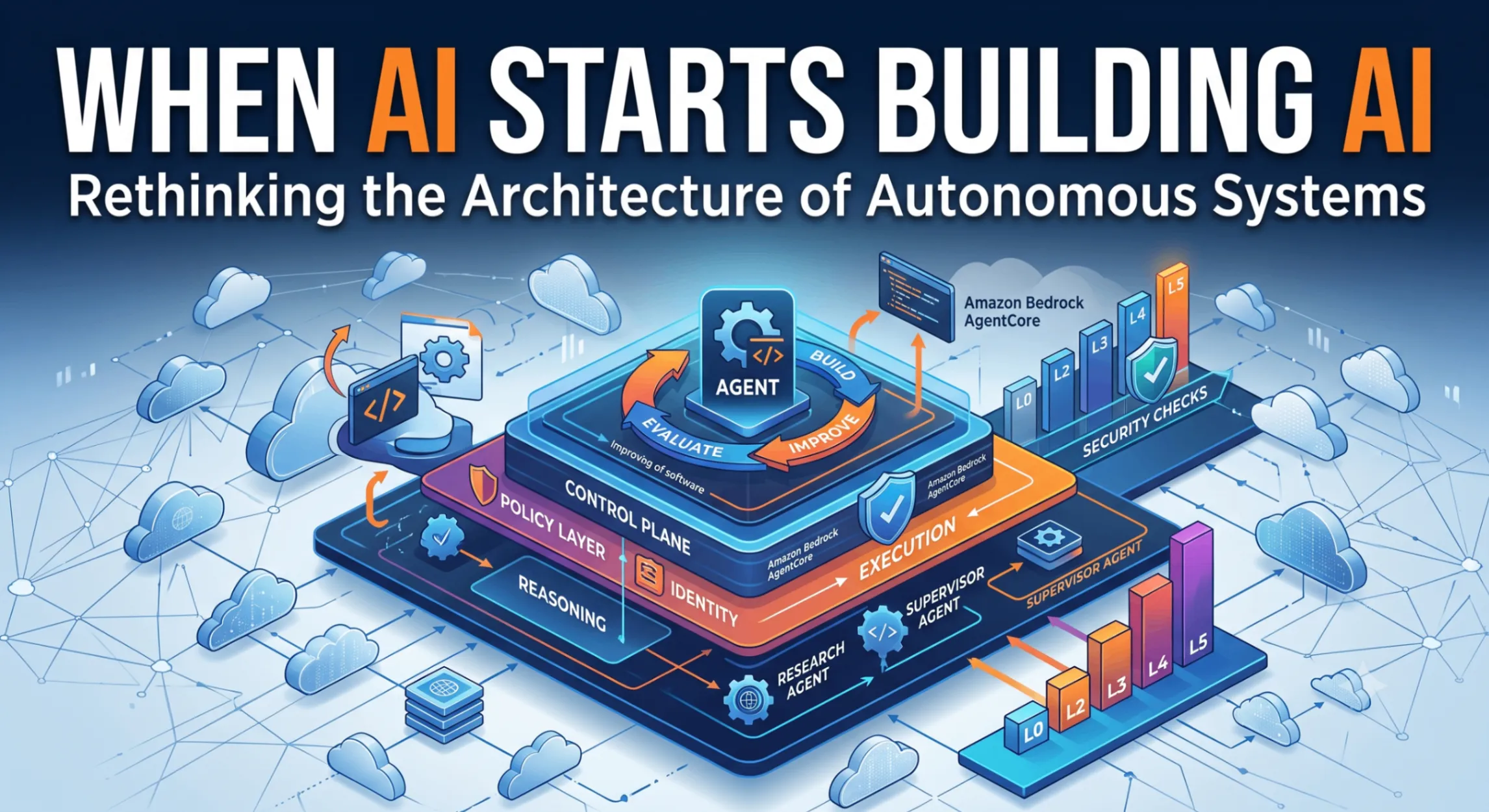
When AI Starts Building AI: Rethinking the Architecture of Autonomous Systems
As AI evolves from chatbots to autonomous agents, a bigger question emerges: what happens when AI can build, evaluate, and improve other AI systems? This article explores the possible path from AI agents toward AGI and ASI, while focusing on an engineering challenge we can solve today—how to give increasingly capable AI systems autonomy without giving them uncontrolled authority.

When AI Starts Building AI: Rethinking the Architecture of Autonomous Systems
Artificial intelligence is moving through an interesting transition.
We started with systems that could recognize patterns. Then came generative AI systems that could create text, images, code, and other content. Today, AI agents can increasingly use tools, access data, execute workflows, and operate for longer periods with less human intervention.
The next question is much bigger:
What happens when AI systems can improve not only their answers, but the AI systems themselves?
This question takes us from today's AI agents toward the longer-term concepts of Artificial General Intelligence (AGI) and Artificial Superintelligence (ASI).
It is important to distinguish today's engineering reality from future possibilities. AGI and ASI do not have universally accepted definitions, and there is substantial uncertainty about whether, when, or how systems with these capabilities could emerge.
However, thinking about these possibilities reveals an important engineering problem that we can already work on today:
As AI becomes more autonomous, how do we make sure that increasing intelligence does not automatically mean increasing uncontrolled access?
This may become one of the most important architectural questions in the agentic AI era.
1. From AI to AI Agents
Traditional AI systems generally wait for an input and produce an output.
A simplified model looks like this:
Input → Model → Output
Generative AI expanded what could happen inside that box.
A model could write code, summarize documents, analyze data, generate images, or reason over complex instructions.
AI agents take another step.
Instead of simply producing an answer, an agent can potentially:
- understand a goal,
- plan a sequence of actions,
- select tools,
- access external information,
- execute actions,
- observe results,
- and continue until the task is completed.
The architecture starts looking more like:
Goal → Plan → Tool → Observe → Decide → Act
This is a significant change.
The model is no longer just generating content.
It is participating in a system that can do things.
2. The Road From Agents to AGI
AGI is generally used to describe a hypothetical AI system capable of performing a broad range of intellectual tasks at approximately human-level or beyond-human capability across many domains.
There is no single universally accepted definition of AGI.
But conceptually, the transition might look like:
Narrow AI
↓
Generative AI
↓
AI Agents
↓
Highly capable autonomous systems
↓
AGI
↓
ASI
The final two stages remain hypothetical.
Recent research has explored possible pathways from AGI toward ASI, including scaling, new AI paradigms, recursive improvement, and large-scale multi-agent systems.
That uncertainty is important.
The goal of this article is not to predict when ASI will arrive.
Instead, it is to ask:
What can today's cloud architecture teach us about operating increasingly autonomous AI systems?
3. The Interesting Part: AI Improving AI
Imagine an AI agent that can write software.
That already exists in various forms.
Now imagine extending the workflow:
- Agent receives a software problem.
- Agent writes a solution.
- Another agent evaluates it.
- Testing infrastructure measures its performance.
- The system identifies weaknesses.
- The agent proposes an improved version.
- The improved version is tested again.
- A human or automated policy decides whether to deploy it.
The loop becomes:
Build → Evaluate → Improve → Test → Deploy
Now imagine that the same concept is applied to AI systems themselves.
A future system could potentially work on:
Model architecture → training strategy → prompts → tools → evaluation → deployment
This is where the idea of recursive improvement becomes interesting.
But there is an important distinction:
An AI system improving a prompt or agent workflow is not the same thing as an AI system recursively improving itself without meaningful human or system-level constraints.
The second scenario is far more speculative.
Still, the engineering lesson is already relevant.
If AI can continuously modify software, prompts, tools, or workflows, every modification needs to pass through a controlled system.
4. The Architecture Changes When AI Can Act
Consider a traditional application.
A user clicks a button.
The application performs a predefined operation.
The developer controls most of the execution path.
An autonomous AI agent is different.
The developer may define the goal and available tools, but the model can determine which tool to use and what parameters to provide.
For example:
1
2
3
4
5
6
7
8
9
10
11
12
13
User
  ↓
AI Agent
  ↓
Choose Tool
  ↓
API / Database / Code / Browser
  ↓
Result
  ↓
AI Agent
  ↓
Next Action
This creates a new security boundary.
The most important question is no longer only:
"What can the model generate?"
It becomes:
"What is the model allowed to do?"
5. Intelligence Is Not the Same as Authority
This distinction may become one of the foundational principles of agentic systems.
A highly capable model does not necessarily need highly privileged access.
For example, an AI coding agent might be capable of modifying an entire production system.
That does not mean it should automatically receive:
- production database credentials,
- unrestricted network access,
- administrator privileges,
- unrestricted deployment permissions,
- access to every customer record.
Instead, capability and authority should be separated.
A useful architecture is:
1
2
3
4
5
6
7
8
9
10
11
12
13
14
15
16
17
18
                 AI AGENT
                    │
                    ↓
              Policy Layer
                    │
          ┌─────────┼─────────┐
          ↓         ↓         ↓
       Identity   Tool      Data
          │       Access     Access
          └─────────┼─────────┘
                    ↓
               Execution
                    ↓
               Monitoring
                    ↓
              Evaluation
                    ↓
             Human Approval
The agent can be intelligent.
The policy layer decides what the agent is actually permitted to do.
6. Where AWS Agent Infrastructure Fits
This is where the discussion becomes relevant to cloud developers today.
Amazon Bedrock AgentCore provides infrastructure for building and operating AI agents, with capabilities spanning runtime, memory, gateway, identity, tools, observability, and evaluations.
These components address many of the problems that emerge when agents move from experiments into production.
For example:
Runtime
Provides an environment for executing agents without requiring developers to manage all of the underlying infrastructure.
Identity
Helps establish controlled identities and access for agents and their interactions with systems.
Gateway
Provides a way to connect agents with tools and APIs.
Memory
Allows agents to retain relevant context.
Observability
Provides visibility into how agents behave and execute tasks.
Evaluations
Allows teams to measure agent quality and validate changes.
These capabilities are important because autonomous systems require more than a powerful model.
They require an operational control plane around the model.
7. The Observe → Evaluate → Improve Loop
An increasingly important idea in agentic AI is continuous improvement of deployed agents.
A production agent generates traces and outcomes.
Those results can be analyzed to identify failure patterns and potential improvements.
Conceptually:
1
2
3
4
5
6
7
8
9
10
11
12
13
14
15
16
17
18
19
20
21
22
23
24
25
26
          Production Agent
                 │
                 ↓
            Observe
                 │
                 ↓
            Evaluate
                 │
                 ↓
          Find Problems
                 │
                 ↓
       Generate Improvement
                 │
                 ↓
            Test Change
                 │
                 ↓
        ┌──────Approved?──────┐
        │                     │
       YES                    NO
        │                     │
        ↓                     ↓
     Deploy                Reject
        │
        └──────────→ Observe
This resembles a controlled version of self-improvement.
But there is an important difference.
The system is not simply changing itself without constraints.
There are evaluation datasets, validation steps, controlled experiments, and approval mechanisms.
That distinction is critical.
8. The Future May Be About "Controlled Autonomy"
A useful way to think about future AI systems is not:
Human vs AI
but:
Human + AI + Control Systems
Humans define objectives and boundaries.
AI systems perform increasingly complex reasoning and execution.
Infrastructure enforces permissions.
Evaluation systems measure outcomes.
Observability systems provide visibility.
Together they create controlled autonomy.
For example:
1
2
3
4
5
6
7
8
9
10
11
12
13
14
15
16
17
18
19
20
21
22
23
24
25
26
27
28
29
                    HUMAN
                      │
               Goals & Policies
                      ↓
              ┌──────────────┐
              │ AI Supervisor│
              └──────┬───────┘
                     ↓
              ┌──────────────┐
              │  AI Agents   │
              └──────┬───────┘
                     ↓
          ┌──────────┼──────────┐
          ↓          ↓          ↓
       Research    Coding     Analysis
          │          │          │
          └──────────┼──────────┘
                     ↓
                  Tools
                     ↓
             Policy Enforcement
                     ↓
                 Execution
                     ↓
                Evaluation
                     ↓
                Monitoring
                     ↓
                 HUMAN
This architecture could become increasingly important as agents become more capable.
9. What Happens If AI Can Build Better Agents?
Now we reach the more speculative part.
Imagine a future AI system capable of creating specialized agents.
One agent could research.
Another could write code.
Another could test the code.
Another could search for vulnerabilities.
Another could optimize the system.
A supervisor could coordinate all of them.
This creates a multi-agent architecture:
1
2
3
4
5
6
7
8
9
10
11
12
13
                    SUPERVISOR
                        │
        ┌───────────────┼───────────────┐
        ↓               ↓               ↓
   Research Agent   Coding Agent   Security Agent
        │               │               │
        └───────────────┼───────────────┘
                        ↓
                 Evaluation Agent
                        ↓
                  Policy Layer
                        ↓
                   Deployment
Instead of one enormous model doing everything, intelligence could emerge from collections of specialized systems.
This is one possible direction discussed in research around the path from AGI to ASI.
But this remains a research question rather than an established prediction.
10. The New Attack Surface
More autonomous AI also means a larger attack surface.
Consider an agent with access to:
- source code,
- internal documents,
- databases,
- APIs,
- cloud resources,
- browsers,
- deployment systems,
- other AI models.
A compromised or misbehaving agent could potentially cause significantly more damage than a chatbot that only generates text.
This introduces questions such as:
What if an agent follows a malicious instruction hidden inside retrieved data?
What if an agent calls the wrong tool?
What if a tool returns manipulated information?
What if an agent attempts an unauthorized action?
What if a new agent version performs better on normal tasks but behaves dangerously in unusual situations?
These are not purely future questions.
They are already relevant to production agent systems.
11. Graduated Autonomy
Instead of giving an agent unrestricted authority from day one, imagine progressively increasing its permissions.
1
2
3
4
5
6
7
8
9
10
11
12
13
14
15
16
17
LEVEL 0
Observe Only
      ↓
LEVEL 1
Recommend Actions
      ↓
LEVEL 2
Execute Low-Risk Actions
      ↓
LEVEL 3
Execute Approved Workflows
      ↓
LEVEL 4
Autonomous Operations
      ↓
LEVEL 5
Highly Autonomous System
The transition between levels should depend on evidence.
For example:
- successful evaluations,
- low failure rates,
- security checks,
- policy compliance,
- human approval history,
- predictable tool usage,
- absence of dangerous behavior.
This creates an important principle:
Autonomy should be earned through evidence, not granted simply because a model is powerful.
12. The AI Control Plane
This leads to an architectural idea I find particularly interesting:
The AI Control Plane
Cloud infrastructure already has control planes for managing resources.
As AI agents become more autonomous, we may need an equivalent control plane for managing AI actions.
A future AI control plane could answer:
Identity
Who is this agent?
Authorization
What is this agent allowed to do?
Context
What information is it allowed to access?
Tools
Which tools can it call?
Policy
Which actions require approval?
Evaluation
How reliable has this agent been?
Observability
What exactly did the agent do?
Rollback
How can a bad change be reversed?
Governance
Which policies apply to this agent?
The architecture becomes:
1
2
3
4
5
6
7
8
9
10
11
12
13
14
15
16
17
18
19
                 AI SYSTEM
                     │
                     ↓
            ┌─────────────────┐
            │  AI CONTROL     │
            │     PLANE       │
            ├─────────────────┤
            │ Identity        │
            │ Authorization   │
            │ Policy          │
            │ Evaluation      │
            │ Observability   │
            │ Governance      │
            │ Rollback        │
            └────────┬────────┘
                     ↓
              Cloud Resources
                     ↓
            Real-World Actions
This may become just as important as the AI model itself.
13. The Developer's Role Will Change
If AI systems become increasingly capable, developers may spend less time manually implementing every individual function.
Instead, developers may increasingly work on:
- system architecture,
- agent workflows,
- tool interfaces,
- evaluation frameworks,
- security policies,
- permissions,
- observability,
- failure handling,
- human-in-the-loop mechanisms.
The developer's job could shift from:
"Write every operation."
toward:
"Design the environment in which autonomous systems can safely operate."
That is a significant change.
14. What Should We Build Today?
We don't need ASI to start preparing for this architecture.
A developer building an AI agent today can already apply several principles:
1. Give agents minimum necessary permissions
Do not give an agent administrator access simply because it might be convenient.
2. Separate reasoning from execution
Let the model propose an action while another layer decides whether the action is permitted.
3. Evaluate before deployment
A successful demo does not prove that an agent is reliable.
4. Monitor production behavior
Real-world inputs are different from development test cases.
5. Keep humans in high-impact decisions
Financial transactions, production deployments, sensitive data operations, and irreversible actions may require additional approval.
6. Make actions auditable
When something goes wrong, developers should be able to determine what happened.
7. Treat prompts and tools as software
A prompt change or tool-definition change can alter system behavior and should therefore be tested.
15. The Real Question About ASI
The most interesting question about ASI may not be:
"When will ASI arrive?"
We currently do not know.
A more practical question is:
If AI systems become substantially more capable, can our infrastructure keep pace with their autonomy?
Model intelligence can improve quickly.
But organizations still need:
- security,
- identity,
- governance,
- observability,
- testing,
- compliance,
- rollback mechanisms,
- human accountability.
The infrastructure surrounding AI may therefore become as important as the AI itself.
16. AI May Become a Software Engineering Loop
The traditional software lifecycle looks something like:
1
2
3
4
5
6
7
8
9
Human writes code
       ↓
Human tests code
       ↓
Human deploys code
       ↓
Human monitors system
       ↓
Human improves code
An increasingly agentic lifecycle could become:
1
2
3
4
5
6
7
8
9
10
11
12
13
14
15
AI proposes change
       ↓
Automated evaluation
       ↓
Security / policy checks
       ↓
Sandbox testing
       ↓
Human or policy approval
       ↓
Controlled deployment
       ↓
Production observation
       ↓
AI proposes next improvement
The important word is controlled.
The goal should not be to remove humans from the system simply because AI becomes more capable.
The goal should be to design systems where humans can supervise increasingly complex AI behavior without becoming a bottleneck for every low-risk decision.
17. From Artificial Intelligence to Artificial Infrastructure
The AI discussion is often centered on models.
Which model is smarter?
Which model has better reasoning?
Which model writes better code?
But as AI becomes more agentic, another layer becomes increasingly important:
Infrastructure.
The future AI stack may look something like:
1
2
3
4
5
6
7
8
9
10
11
12
13
14
15
16
17
18
19
20
21
┌───────────────────────────────┐
│          HUMAN GOALS          │
└───────────────┬───────────────┘
                ↓
┌───────────────────────────────┐
│       FOUNDATION MODELS       │
└───────────────┬───────────────┘
                ↓
┌───────────────────────────────┐
│          AI AGENTS            │
└───────────────┬───────────────┘
                ↓
┌───────────────────────────────┐
│       AI CONTROL PLANE        │
│ Identity • Policy • Evaluation│
│ Observability • Governance    │
└───────────────┬───────────────┘
                ↓
┌───────────────────────────────┐
│       CLOUD / TOOLS / DATA    │
└───────────────────────────────┘
The model provides intelligence.
The agent provides autonomy.
The control plane provides boundaries.
The cloud provides execution.
Final Thoughts
AGI and ASI remain uncertain future concepts.
We should be careful not to confuse today's increasingly capable AI agents with hypothetical superintelligence.
But we can still learn something valuable by thinking about that future.
If AI systems become capable of creating software, operating tools, coordinating other agents, and continuously improving their workflows, then autonomy becomes an architectural property, not simply a model capability.
The systems that succeed will need to balance:
Capability + Autonomy + Security + Evaluation + Human Oversight
For developers building AI systems today, the important question is not only:
"How do I build a smarter agent?"
It is also:
"How do I build an environment where a smarter agent can operate safely?"
That is a question we can start solving today—even before AGI or ASI becomes reality.
And perhaps that is the more interesting path from AI to ASI:
Not simply building increasingly intelligent machines,
but building the infrastructure capable of responsibly operating them.
References
- Google DeepMind — From AGI to ASI
- AWS Prescriptive Guidance — Amazon Bedrock AgentCore
- AWS — Amazon Bedrock AgentCore optimization capabilities
- AWS — Amazon Bedrock AgentCore Evaluations
- AWS Architecture Blog — Closing the AI agent trust gap with graduated autonomy
Enjoyed reading this content? Let the author know!
Your likes, comments, shares, and saves help creators reach more builders.

Loading recommendations
Loading article