
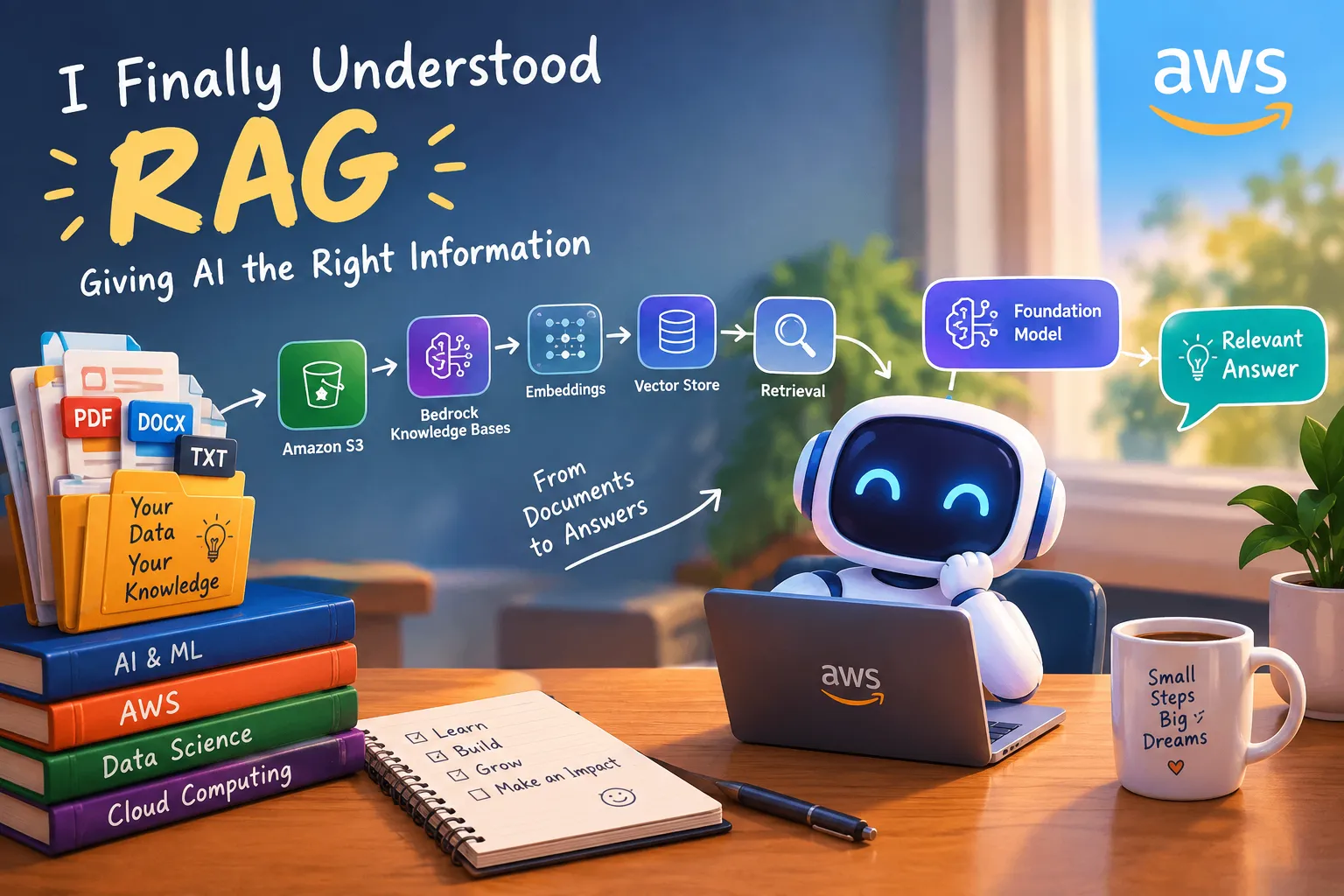
I Finally Understood RAG: Giving AI the Right Information 🤖☁️
A beginner-friendly journey into understanding RAG and how it can give AI access to the right information at the right time. Explore embeddings, retrieval, Amazon Bedrock Knowledge Bases, and how I’m connecting AWS, AI, and my own project ideas as a student.

I Finally Understood RAG: Giving AI the Right Information 🤖☁️
When I started learning about Generative AI, I had a simple question:
How can AI answer questions using information that isn't part of its original knowledge?
That question led me to RAG — Retrieval-Augmented Generation.
As a second-year AI & Data Science student exploring AWS, I found RAG interesting because it changed the way I think about AI applications.
I initially thought that building a useful AI application was mostly about choosing a powerful model.
But RAG showed me that there is another important part:
Giving the model the right information at the right time.
🤔 The Problem
Imagine building a chatbot for a college.
If I ask:
“What is machine learning?”
A general AI model can probably answer.
But what if I ask:
“What is the attendance requirement for my department?”
The model doesn't automatically know my college's latest rules.
The information might be available in a PDF, document, or internal knowledge base.
Instead of expecting the model to already know everything, we can retrieve the relevant information when the question is asked.
That's where RAG becomes useful.
🔍 What Is RAG?
RAG stands for Retrieval-Augmented Generation.
The basic idea is:
Question → Retrieve relevant information → Give it to the AI → Generate an answer
The system first searches a knowledge source for information related to the user's question.
The most relevant information is then provided to the language model as context.
The model can use that context to generate the response.
This approach can be useful for applications working with:
- Company documentation
- Technical manuals
- FAQs
- College notes
- Internal policies
- Product documentation
- Reports
- Other private or specialized documents
☁️ Where AWS Comes In
While learning AWS, I found Amazon Bedrock Knowledge Bases particularly interesting.
A simplified RAG architecture can look like this:
Documents
↓
Amazon S3
↓
Amazon Bedrock Knowledge Bases
↓
Chunking + Embeddings
↓
Vector Store
↓
Semantic Search
↓
Relevant Context
↓
Foundation Model
↓
Answer
What I like about this approach is that the AI model isn't treated as the entire application.
The model becomes one component in a larger system.
🧩 Understanding the Basic Flow
Let's imagine I have several technical documents stored in Amazon S3.
A user asks:
“How does our authentication system work?”
The system doesn't need to send every document to the model.
Instead, it can search for the parts of the documents that are most relevant to the question.
The relevant content is retrieved and passed to the model.
The model then uses that context to generate an answer.
So the overall idea becomes:
Ask → Search → Retrieve → Understand → Answer
That simple flow made RAG much easier for me to understand.
🧠 What Are Embeddings?
One concept that initially sounded complicated to me was embeddings.
The basic idea is that text can be represented as numerical vectors.
Consider these two sentences:
“How can I cancel my subscription?”
and
“I want to terminate my plan.”
The words are different, but the meaning is similar.
Embeddings help represent the meaning of these sentences numerically.
Content with similar meanings can therefore be identified through semantic similarity.
This is important because RAG doesn't have to depend only on exact keyword matching.
It can search for information based on meaning.
📚 A Student Example
This is where RAG became especially interesting to me.
Imagine uploading my semester notes into a knowledge base.
Later, I ask:
“Explain the difference between supervised and unsupervised learning.”
Instead of simply asking an AI model for a general answer, the application could retrieve the relevant section from my notes and provide that information as context.
The model can then generate an answer based on the retrieved content.
This could be useful for building a personal study assistant.
The data could include:
Lecture Notes → PDFs → Study Materials → Documentation
Then I could ask questions using normal language.
🚀 Why Retrieval Matters
One thing I started understanding from RAG is that the quality of the retrieved information matters.
Imagine the model is very powerful but receives irrelevant context.
The final answer may still be poor.
This gave me a simple way to remember it:
Good Model + Bad Context = Potentially Bad Answer
So building a RAG application isn't only about selecting a good language model.
We also need to think about:
- What data we provide
- How documents are divided
- How information is represented
- How relevant content is retrieved
- How many results are retrieved
- Whether the source information is reliable
- How the final responses are evaluated
🔐 What About Private Data?
Another interesting part is the possibility of working with private or specialized information.
For example, a company might have internal:
- Documentation
- Policies
- Technical guides
- FAQs
- Reports
A RAG application can retrieve relevant information from those sources when answering a question.
But this also means security and access control become important.
Not every user should automatically have access to every document.
So I realized that RAG isn't only an AI concept.
It connects several areas:
AI + Data + Cloud + Security + Software Architecture
🛠️ What I Want to Build
As an AI & Data Science student, one project I would like to try is a RAG-based study assistant.
The basic idea would be:
- Upload my study documents.
- Store the documents in AWS.
- Connect them to a knowledge base.
- Retrieve relevant information for a question.
- Provide the retrieved context to a foundation model.
- Generate an answer based on that context.
I wouldn't start with hundreds of documents.
I'd start with a small collection of notes and focus on understanding every step.
💡 My Biggest Learning
Before learning about RAG, I thought:
Better AI = Bigger or more powerful model.
Now I'm starting to think:
Better AI application = Model + Data + Context + Retrieval + Good Architecture
The model is important.
But the information we provide to it can be just as important for the application.
That changed the way I look at Generative AI.
☁️ What RAG Taught Me About AWS
One reason I enjoy learning AWS is that it connects different areas of technology.
A RAG application can involve:
Amazon S3 for storing documents.
Amazon Bedrock Knowledge Bases for helping build the retrieval workflow.
Embeddings for representing information.
Vector search for finding semantically relevant content.
Foundation models for generating responses.
And around all of this, we still need to think about:
Security, permissions, cost, monitoring, and evaluation.
That's a lot of concepts coming together in one application.
🎓 My Beginner Takeaway
I'm still learning AWS and Generative AI, so I don't consider myself an expert in RAG.
But one idea has really stayed with me:
AI doesn't always need to know everything. Sometimes we just need to help it find the right information.
For me, that is what makes RAG so interesting.
It turns a collection of documents into something that an AI application can retrieve information from and use as context.
And it shows how AI is becoming more than just a model.
It's becoming an entire system built around data, retrieval, cloud services, security, and intelligence.
🚀 What's Next for Me?
My next goal is to move from simply understanding the concept to actually building a small RAG project.
I'd like to start with my own study materials and see what happens when I connect:
My Documents → AWS → Retrieval → AI → Answers
The best part is that I don't need to build everything at once.
I can start small, make mistakes, understand them, and improve the project step by step.
That's how I'm approaching my AWS and AI learning journey.
💬 What Would You Build?
If you had a collection of your own documents and access to Amazon Bedrock, what would you build first?
📚 A study assistant
💼 A company documentation chatbot
🛠️ A technical support assistant
📄 A document analysis tool
💼 A company documentation chatbot
🛠️ A technical support assistant
📄 A document analysis tool
I'd love to know what other students and builders would choose. 🚀☁️
Enjoyed reading this content? Let the author know!
Your likes, comments, shares, and saves help creators reach more builders.

Loading recommendations
Loading article