
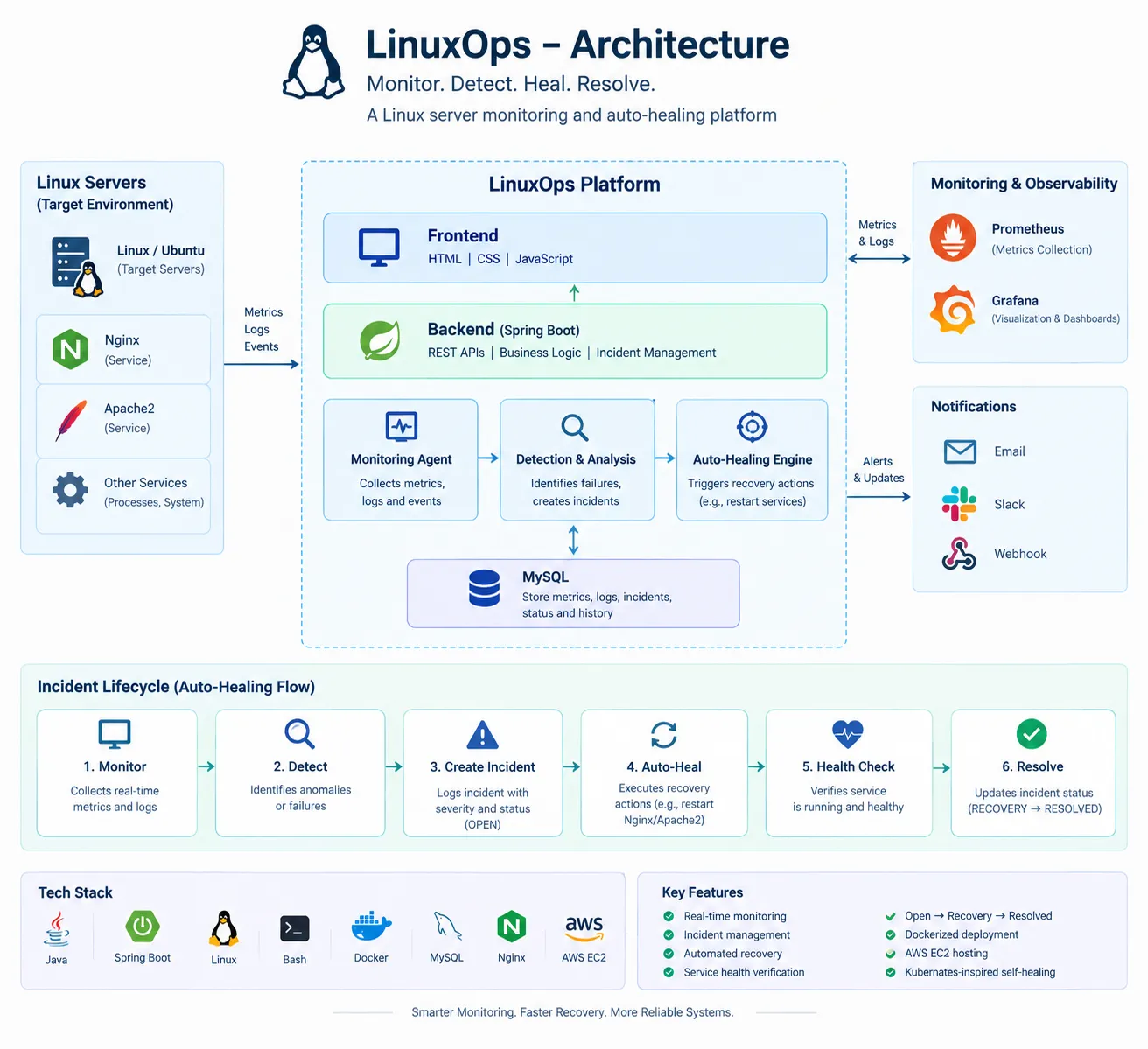
Building LinuxOps: A Linux Server Monitoring & Auto-Healing Platform on AWS EC2
LinuxOps is a Linux server monitoring and auto-healing platform deployed on AWS EC2. It monitors system resources and service health, creates incidents when failures occur, automatically recovers supported services, verifies recovery, and records the incident lifecycle.

Introduction
What happens when a critical service such as Nginx suddenly goes down on a Linux server?
I wanted to build a system that could detect the failure, create an incident, automatically recover the service, and verify the recovery.
That's how I built LinuxOps, a Linux server monitoring and auto-healing platform deployed on AWS EC2.
The Problem
In a server environment, failures can happen at any time:
- High CPU usage
- High memory usage
- High disk usage
- Services going down
- Infrastructure-related failures
Manually identifying and recovering from these issues can take time.
LinuxOps automates part of this process.
Architecture
Linux Server
↓
LinuxOps Agent
↓
Detection and Analysis
↓
Incident Management
↓
Auto-Healing
↓
Health Verification
↓
Resolved
↓
LinuxOps Agent
↓
Detection and Analysis
↓
Incident Management
↓
Auto-Healing
↓
Health Verification
↓
Resolved
The platform is deployed on AWS EC2 and uses Docker for containerized services.
Monitoring
LinuxOps monitors:
- CPU usage
- Memory usage
- Disk usage
- Nginx/service health
- System-level events
When a configured threshold is reached, the monitoring agent reports the problem to the backend.
Incident Lifecycle
Monitor
↓
Detect
↓
Create Incident
↓
Auto-Heal
↓
Health Check
↓
Resolve
↓
Detect
↓
Create Incident
↓
Auto-Heal
↓
Health Check
↓
Resolve
For example, when Nginx goes down:
Nginx DOWN
↓
Incident created
↓
Docker restart
↓
Check service health
↓
Recovery confirmed
↓
Incident → RESOLVED
↓
Incident created
↓
Docker restart
↓
Check service health
↓
Recovery confirmed
↓
Incident → RESOLVED
The incident remains stored in MySQL so the system maintains a history of failures and recoveries.
Technology Stack
- AWS EC2
- Linux / Ubuntu
- Bash
- Java
- Spring Boot
- MySQL
- Docker
- Nginx
- HTML / CSS / JavaScript
What I Learned
Building LinuxOps helped me understand:
- Linux server monitoring
- Bash automation
- REST API development
- Docker deployment
- Incident lifecycle management
- AWS EC2 deployment
- Automated remediation
- Health verification
This project helped me understand how monitoring, incident management, automated recovery, and cloud deployment can work together as an infrastructure workflow.
Source Code
GitHub:
https://github.com/pranesh2006-doc/linuxOps-auto-healing-
https://github.com/pranesh2006-doc/linuxOps-auto-healing-
What's Next?
I plan to explore:
- More monitoring capabilities
- Better observability
- Notifications
- Additional automated recovery actions
- Scaling the architecture
I would like to hear suggestions from other AWS builders on how LinuxOps could be made more production-ready.
Conclusion
LinuxOps was a hands-on project to understand Linux infrastructure, AWS EC2, Docker, backend development, monitoring, and automated remediation by building and deploying a working system.
Enjoyed reading this content? Let the author know!
Your likes, comments, shares, and saves help creators reach more builders.

Loading recommendations
Loading article