
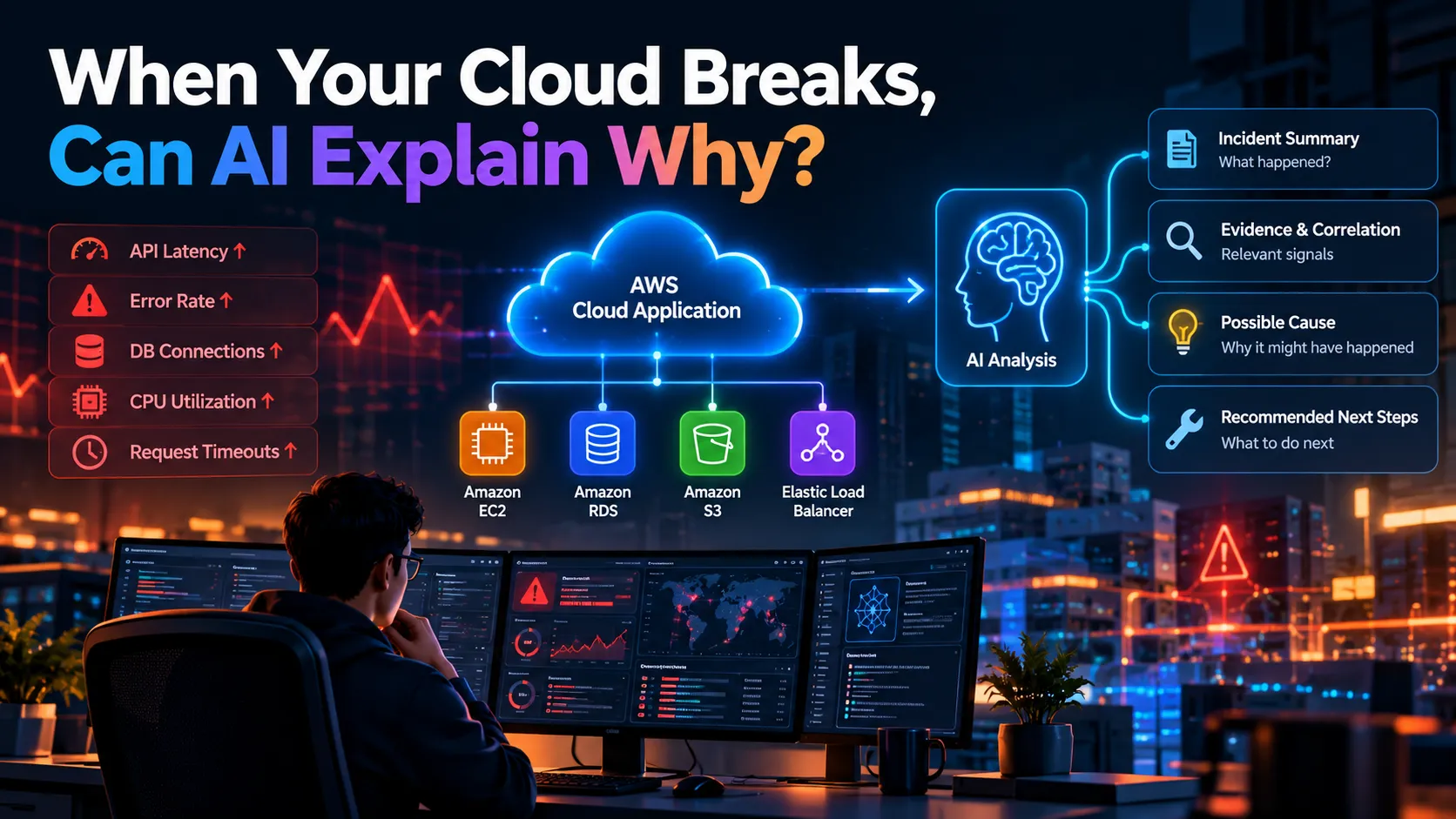
When Your Cloud Breaks, Can AI Explain Why?
Cloud platforms generate enormous amounts of telemetry, but finding the reason behind an incident can still require significant manual investigation. This article explores how AI can correlate metrics, logs, events, and application context to help engineers move from simple alerts toward evidence-based incident diagnosis.

When Your Cloud Breaks, Can AI Explain Why?
A cloud application rarely fails with a single obvious error.
One service becomes slow. A few requests start timing out. Database connections increase. Error rates climb. Perhaps a deployment happened a few minutes earlier.
Suddenly, an operations dashboard is filled with alerts.
But there is still one question that matters most:
What actually caused the problem?
Modern cloud platforms are very good at telling us what is happening.
The harder problem is understanding why it is happening.
This is where AI-assisted incident diagnosis becomes interesting.
Monitoring Can Tell Us What Changed
Consider a typical application running in the cloud.
An operations team might receive several alerts:
- API latency increased
- CPU utilization crossed a threshold
- Database connections are increasing
- Request timeouts are rising
- Error rates have increased
- Traffic changed significantly
Each alert provides useful information.
However, treating every alert as an independent event can make incident investigation difficult.
The problem is not necessarily a lack of data.
The problem is connecting the data with the right context.
An engineer investigating an incident may need to look at:
- Metrics
- Application logs
- Infrastructure logs
- Deployment history
- Service dependencies
- Traffic patterns
- Database behavior
- Previous incidents
Only after combining these signals can a useful hypothesis be formed.
So the question becomes:
Can AI help connect these signals?
From Alerts to an Incident Story
Imagine the following sequence:
1
2
3
4
5
10:02 AM  → New application deployment

10:05 AM  → Database connections begin increasing

10:07 AM  → API latency increases

10:08 AM  → Request timeouts rise

10:10 AM  → Error rate crosses the threshold
A traditional monitoring system may produce several alerts.
An AI-assisted diagnostic system could organize the same information into an incident timeline:
Deployment
↓
Database connection increase
↓
API latency increase
↓
Request timeouts
↓
Higher error rate
↓
Database connection increase
↓
API latency increase
↓
Request timeouts
↓
Higher error rate
This does not automatically prove that the deployment caused the incident.
Instead, it provides engineers with a possible chain of related events that deserves investigation.
That distinction is extremely important.
AI should help engineers investigate.
It should not turn correlation into certainty.
A Possible AWS Architecture
A practical architecture could combine cloud observability with an AI reasoning layer.

From cloud telemetry to evidence-based incident explanations: an AI-assisted approach to understanding cloud incidents.
Amazon CloudWatch can collect telemetry from applications and infrastructure, including metrics and logs. CloudWatch also supports collecting telemetry through mechanisms such as the CloudWatch agent and OpenTelemetry.
The important architectural idea is that the AI layer should not replace observability.
It should consume relevant observability data and add contextual reasoning on top of it.
What Would AI Actually Do?
AI can potentially assist with several stages of an incident investigation.
1. Correlation
The first task is finding events that may be related.
For example:
"API latency increased approximately three minutes after a deployment."
This is useful information.
However, it is still only a correlation.
The system should avoid presenting it as confirmed causation unless sufficient evidence exists.
2. Pattern Detection
Current incidents can also be compared with historical behavior.
Suppose a previous incident contained this pattern:
High database connections +Increasing API latency +Request timeoutsIf a similar pattern appears again, the system could flag the similarity.
This can reduce the amount of time an engineer spends searching through previous incidents manually.
3. Contextual Reasoning
A single metric can be misleading.
For example, high CPU utilization does not automatically mean that the CPU is the root cause.
High CPU may be completely normal during a legitimate traffic spike.
But if the following occur together:
Traffic ↑CPU ↑API latency ↑Error rate ↑the combined evidence becomes more meaningful.
AI can help analyze these signals together rather than treating every metric independently.
4. Building an Evidence-Based Explanation
This is where the idea becomes more interesting.
Instead of displaying:
Database failure detected.
an AI-assisted system could produce something like:
Observed: API latency increased significantly after a recent application deployment.Evidence: Database connection utilization increased during the same period.Possible contributing factor: Increased database connection demand may be contributing to application latency.Investigate: Check connection pool configuration, slow queries, database metrics, and changes introduced by the deployment.
The wording matters.
It says:
"Possible contributing factor."
It does not say:
"This is definitely the root cause."
That difference is essential when AI is being used in production operations.
From Data to Explanation
A useful diagnostic pipeline could look like this:
Telemetry
↓
Detection
↓
Filtering
↓
Correlation
↓
Evidence collection
↓
AI analysis
↓
Hypothesis generation
↓
Human validation
↓
Remediation
↓
Detection
↓
Filtering
↓
Correlation
↓
Evidence collection
↓
AI analysis
↓
Hypothesis generation
↓
Human validation
↓
Remediation
Each stage has a different responsibility.
The AI model should not be expected to magically solve the entire incident from raw logs.
Instead, the surrounding architecture should provide the model with relevant and trustworthy context.
Where Amazon Bedrock Fits
Generative AI can be useful when an incident contains large amounts of operational information.
For example, an AI system could receive selected information such as:
- Relevant CloudWatch metrics
- Application logs
- Recent deployment information
- Service dependencies
- Previous incident summaries
- Known troubleshooting procedures
Amazon Bedrock provides access to foundation models through managed APIs and can be used to build generative AI applications.
In this architecture, Bedrock could act as the reasoning and explanation layer.
The system might provide a structured incident context to a foundation model and ask it to:
- Summarize the incident
- Identify important correlations
- Separate observations from hypotheses
- Compare the incident with historical patterns
- Suggest areas for investigation
- Explain the reasoning in human-readable language
The important part is that the model should work from retrieved evidence, rather than inventing an explanation from incomplete information.
Why Simply Sending Logs to an LLM Is Not Enough
It might be tempting to build a system like this:
Logs → LLM → Root CauseBut production systems are rarely that simple.
Cloud environments can generate enormous amounts of telemetry.
Sending everything to an AI model can introduce several problems:
- Excessive data volume
- Irrelevant information
- Higher inference cost
- Increased latency
- Missing important context
- Conflicting signals
- Potentially sensitive information
A better approach is:
Raw Telemetry ↓Filtering ↓Relevant Signals ↓Incident Context ↓AI AnalysisThe AI model should receive the right information, not necessarily all information.
The Difference Between Correlation and Causation
This is probably the most important challenge in AI-assisted incident diagnosis.
Suppose two events occur at almost the same time:
Deployment │ ├───────────────┐ │ │ ▼ ▼Latency ↑ Traffic ↑It would be dangerous to immediately conclude:
"The deployment caused the latency."
The deployment might have contributed to the problem.
Or the traffic increase could have been the actual cause.
Or both could be unrelated.
Therefore, an AI diagnostic system should communicate uncertainty.
For example:
Strong evidence
"The error increase began immediately after the configuration change and affected only the modified service."
Moderate evidence
"The timing suggests a possible relationship between the deployment and increased latency."
Insufficient evidence
"The available telemetry is not sufficient to determine the root cause."
This type of uncertainty-aware explanation is much more useful than an AI system that confidently guesses.
Explainability Matters
If an AI system recommends an investigation path, engineers should be able to understand why.
A useful format could be:
OBSERVATION
API latency increased by 42%.
API latency increased by 42%.
EVIDENCE
Database connection utilization increased
during the same period.
Database connection utilization increased
during the same period.
CORRELATION
The increase began shortly after a deployment.
The increase began shortly after a deployment.
HYPOTHESIS
The deployment may have introduced behavior
that increased database demand.
The deployment may have introduced behavior
that increased database demand.
NEXT CHECK
Inspect connection pools, slow queries,
and recent application changes.
Inspect connection pools, slow queries,
and recent application changes.
This creates a chain:
Observation → Evidence → Hypothesis → Investigation
Instead of:
Alert → AI answer
That difference can make AI much more useful for real operational environments.
Human-in-the-Loop Is Essential
A practical system should not immediately allow an AI-generated hypothesis to modify production infrastructure.
A safer workflow is:
Telemetry
↓
Incident Detection
↓
Context Collection
↓
AI Analysis
↓
Evidence + Hypothesis
↓
Engineer Review
↓
Approved Action
↓
Remediation
↓
Incident Detection
↓
Context Collection
↓
AI Analysis
↓
Evidence + Hypothesis
↓
Engineer Review
↓
Approved Action
↓
Remediation
The engineer remains responsible for deciding what action should be taken.
AI acts as an assistant that reduces investigation effort.
This approach also creates an opportunity for engineers to provide feedback:
AI Hypothesis ↓Engineer Review ↓Correct / Incorrect ↓Incident Record ↓Future ContextOver time, these records can become valuable sources of operational knowledge.
What Happens During a Real Incident?
Let's walk through a simplified example.
Imagine an e-commerce application suddenly starts returning timeout errors.
Step 1: Detection
Monitoring identifies:
API latency ↑
Timeouts ↑
Error rate ↑
DB connections ↑
Timeouts ↑
Error rate ↑
DB connections ↑
Step 2: Timeline Construction
The system finds:
Step 3: Correlation
The deployment and database behavior become relevant investigation points.
Step 4: AI Analysis
The AI receives the selected telemetry and incident context.
It produces:
"The incident began approximately five minutes after the deployment. Increased database connection utilization occurred before the timeout spike. The deployment should be investigated as a potential contributing factor, particularly changes affecting database access."
Step 5: Engineer Review
The engineer checks:
- Recent code changes
- Database queries
- Connection pool settings
- Application logs
- Database performance metrics
Step 6: Resolution
The engineer identifies the actual issue and applies the appropriate remediation.
AI did not "fix the cloud."
It helped reduce the time needed to understand the incident.
The Architecture Can Become More Intelligent
Once the basic diagnostic pipeline works, additional capabilities can be added.
Historical Incident Memory
Previous incidents can be stored with:
- Symptoms
- Root causes
- Evidence
- Resolution
- Impact
- Timeline
A future incident can then be compared with historical cases.
Dependency Awareness
A cloud application is rarely a single service.
It can look more like:
Users ↓API ↓Application ↓Database ↓External ServicesA problem in one layer can appear as an error in another.
Understanding dependencies can therefore improve incident analysis.
What-If Analysis
The system could eventually move beyond diagnosis.
For example:
"What could happen if database capacity remains at this level for the next 30 minutes?"
This changes the role of the system from:
What happened?
to:
What might happen next?
That opens the door to predictive cloud operations.
The Challenges We Still Have to Solve
AI-assisted cloud diagnosis sounds promising, but it is not a magic solution.
Several challenges remain.
Data Quality
Poor telemetry leads to poor conclusions.
If important signals are missing, AI cannot reconstruct information it never received.
False Correlations
Events occurring together do not necessarily have a causal relationship.
Hallucinations
Generative AI can produce plausible but unsupported explanations.
Security and Privacy
Logs may contain sensitive information and must be handled according to the application's security requirements.
Cost
Large-scale telemetry processing and AI inference can become expensive if the architecture is not carefully designed.
Trust
Engineers need to know when an AI explanation is based on strong evidence and when it is only a hypothesis.
A Better Goal for AI in Cloud Operations
The goal should not be:
"Build an AI that fixes every cloud failure."
A more realistic goal is:
"Build an AI system that helps engineers understand incidents faster."
That changes the design philosophy.
Instead of autonomous decision-making everywhere, we can focus on:
Observe ↓Understand ↓Explain ↓Recommend ↓Validate ↓ActThe human remains part of the loop.
From Observability to Understanding
Cloud operations have evolved through several stages.
Stage 1 — Monitoring
Is the system running?
Stage 2 — Observability
What is happening inside the system?
Stage 3 — Intelligent Diagnosis
What events are related to this incident?
Stage 4 — Assisted Reasoning
What could explain the observed behavior?
Stage 5 — Predictive Operations
What might happen next?
The interesting opportunity for AI is not simply replacing monitoring.
It is helping transform large amounts of operational data into contextual understanding.
Final Thoughts
Cloud applications generate enormous amounts of information.
Metrics tell us what changed.
Logs tell us what happened.
Events tell us when something occurred.
But engineers still need to connect those pieces.
AI can potentially help bridge that gap by correlating signals, identifying patterns, summarizing evidence, and presenting possible explanations.
However, trustworthy AI-assisted diagnosis requires more than a powerful model.
It requires:
- High-quality telemetry
- Relevant context
- Reliable evidence
- Clear separation between facts and hypotheses
- Explainable reasoning
- Human validation
The future of cloud operations may not be a system that automatically fixes every failure.
Enjoyed reading this content? Let the author know!
Your likes, comments, shares, and saves help creators reach more builders.

Loading recommendations
Loading article