
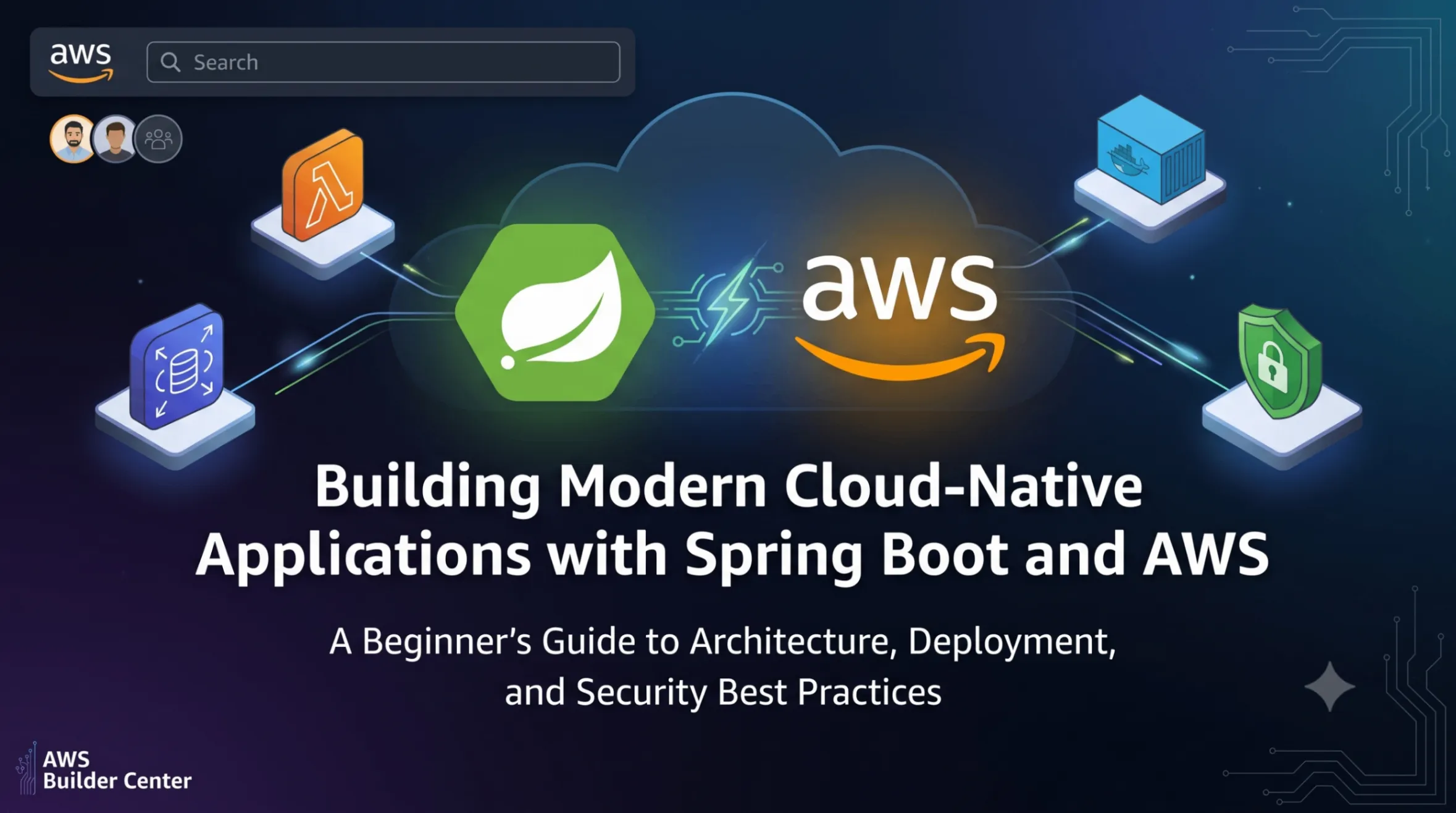
Building Modern Cloud-Native Applications with Spring Boot and AWS
A theoretical guide exploring how to seamlessly integrate Spring Boot applications with AWS infrastructure, from deployment models to native cloud services.

Building Modern Cloud-Native Applications with Spring Boot and AWS
Spring Boot has long been the gold standard for building enterprise Java applications due to its auto-configuration capabilities and developer-friendly ecosystem. When paired with the global infrastructure of Amazon Web Services, developers can transition from building simple web applications to designing highly resilient, globally scalable cloud-native architectures. Understanding how these two ecosystems interact is essential for any Java developer looking to modernize their applications.
The Bridge Between Framework and Cloud
The most effective way to integrate AWS services into a Spring Boot application is by leveraging the Spring Cloud AWS framework. Rather than writing extensive boilerplate code using the standard AWS SDK for Java, Spring Cloud AWS provides an abstraction layer that aligns perfectly with familiar Spring idioms. This means developers can interact with managed cloud services using standard Spring annotations and dependency injection. By treating cloud infrastructure as an extension of the Spring context, development teams can focus on business logic rather than low-level API communication.
Choosing a Deployment Strategy
When bringing a Spring Boot application to AWS, architects must decide between containerized and serverless deployment models. The containerized approach typically involves packaging the application using Docker and orchestrating it via Amazon Elastic Container Service or Amazon Elastic Kubernetes Service. Using AWS Fargate alongside these orchestrators allows developers to run their containers without managing the underlying virtual machines, making it an excellent choice for traditional, long-running microservices.
Alternatively, the serverless approach involves deploying the application using AWS Lambda. Historically, Java applications struggled in serverless environments due to a phenomenon known as cold starts, where the initialization of the Java Virtual Machine and the Spring context caused noticeable latency during the first invocation. However, innovations like AWS Lambda SnapStart have largely eliminated this hurdle by taking a snapshot of the initialized environment and resuming it on demand. This allows heavy Spring Boot APIs to run in a purely event-driven, pay-per-execution model with incredibly fast startup times.
Integrating Managed Storage and Databases
A true cloud-native application decouples its storage and state from the application lifecycle. For unstructured data like user uploads or static media, Spring Boot applications can seamlessly connect to Amazon Simple Storage Service (S3). Through Spring's resource abstractions, reading from and writing to S3 buckets feels identical to interacting with a local file system.
For relational data persistence, Amazon Relational Database Service (RDS) or Amazon Aurora can be integrated using standard Spring Data JPA and JDBC drivers. If the application requires a highly flexible, low-latency NoSQL data model, developers can utilize Amazon DynamoDB. Spring Data DynamoDB extensions allow developers to define domain models and repositories using the same familiar patterns they would use for a traditional SQL database, reducing the learning curve of adopting distributed NoSQL architecture.
Managing Configurations and Secrets Securely
Security and configuration management change significantly when moving from local servers to the cloud. Hardcoding credentials in application properties or relying on local environment variables is a major security risk. AWS provides robust solutions for this through AWS Secrets Manager and AWS Systems Manager Parameter Store.
Spring Boot applications can be configured to fetch database passwords, API keys, and environment-specific settings directly from these services during startup. By assigning an IAM Role to the application's compute environment—whether it is an ECS task or a Lambda function—the Spring Boot application can securely authenticate with Secrets Manager without ever requiring manual credential management. This ensures that sensitive data remains encrypted in transit and at rest, fulfilling strict enterprise security requirements.
Conclusion
Combining Spring Boot with AWS infrastructure transforms traditional Java development into a highly elastic and secure cloud-native experience. By utilizing purpose-built frameworks like Spring Cloud AWS, choosing the right deployment model, and decoupling state using managed databases and secret managers, developers can build enterprise-grade applications that scale effortlessly across the globe.
Enjoyed reading this content? Let the author know!
Your likes, comments, shares, and saves help creators reach more builders.

Loading recommendations
Loading article