
Private AI Cloud: Bringing Cost, Security, and AI Infrastructure Under Enterprise Control
As AI moves from experimentation to production, enterprises need greater control over GPU resources, token costs, data, and autonomous agents. Explore how VMware’s Private AI Cloud and AI Factory approach these challenges through shared infrastructure, automation, security, governance, and observability.

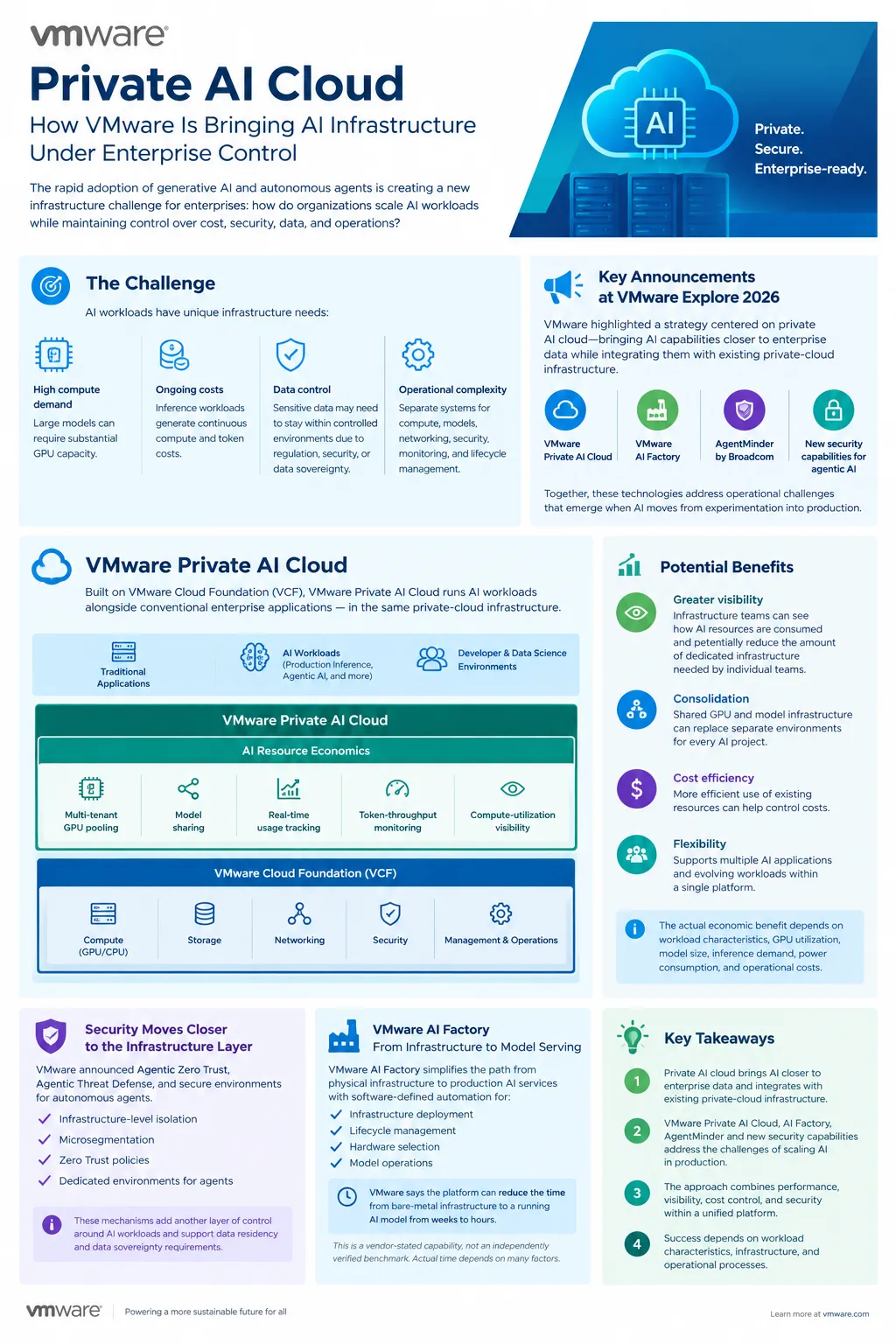
The rapid adoption of generative AI and autonomous agents is creating a new infrastructure challenge for enterprises: how do organizations scale AI workloads while maintaining control over cost, security, data, and operations?
At VMware Explore 2026, VMware highlighted a strategy centered on private AI cloud—bringing AI capabilities closer to enterprise data while integrating them with existing private-cloud infrastructure.
The announcements included VMware Private AI Cloud, VMware AI Factory, AgentMinder by Broadcom, and new security capabilities focused on agentic AI. Together, these technologies address operational challenges that emerge when AI moves from experimentation into production.
Why private AI infrastructure matters
AI workloads have infrastructure requirements that differ from many traditional enterprise applications.
Large models can require substantial GPU capacity, while inference workloads generate ongoing compute and token costs. Enterprises may also need to keep sensitive data within controlled environments because of regulatory, security, or data-sovereignty requirements.
Running AI in a separate infrastructure environment can create additional operational complexity. Organizations may have to manage separate systems for compute, models, networking, security, monitoring, and lifecycle management.
VMware's approach is to bring these capabilities together within a private-cloud environment.
VMware Private AI Cloud
VMware Private AI Cloud is built on VMware Cloud Foundation (VCF) and is designed to run AI workloads alongside conventional enterprise applications.
VMware describes the platform as supporting production inference, agentic AI, and other enterprise workloads within the same private-cloud infrastructure.
One notable aspect of the announcement is its focus on AI resource economics.
VMware highlights capabilities including:
- Multi-tenant GPU pooling
- Model sharing
- Real-time usage tracking
- Token-throughput monitoring
- Compute-utilization visibility
The objective is to give infrastructure teams greater visibility into how AI resources are consumed and potentially reduce the amount of dedicated infrastructure required by individual AI teams.
For organizations operating multiple AI applications, shared GPU and model infrastructure can also provide a way to consolidate resources instead of deploying separate environments for every project.
However, the actual economic benefit depends on workload characteristics, GPU utilization, model size, inference demand, power consumption, and the operational cost of managing the environment.
Security moves closer to the infrastructure layer
AI introduces security considerations beyond those associated with conventional applications.
Autonomous agents can interact with applications, data, APIs, and other systems with less direct human intervention. Controlling what those agents can access therefore becomes an important part of enterprise AI architecture.
VMware announced capabilities around Agentic Zero Trust and Agentic Threat Defense, as well as secure environments intended for autonomous agents.
The broader architectural concept is to make security controls part of the infrastructure rather than relying exclusively on application-level controls.
Infrastructure-level isolation, microsegmentation, Zero Trust policies, and dedicated environments for agents can provide additional boundaries between workloads and services.
These mechanisms do not eliminate application-level security requirements, but they can add another layer of control around AI workloads and the infrastructure on which they operate.
For enterprises handling sensitive information, the approach also aligns with requirements around data residency and data sovereignty.
VMware AI Factory: From infrastructure to model serving
A second major announcement was VMware AI Factory, which VMware describes as a foundation for its private AI cloud strategy.
The goal is to simplify the path from physical infrastructure to production AI services.
According to VMware, AI Factory provides software-defined automation for infrastructure deployment, lifecycle management, hardware selection, and model operations.
VMware says the platform can reduce the time required to move from bare-metal infrastructure to a running AI model from weeks to hours.
That figure should be understood as a vendor-stated capability rather than an independently verified benchmark. Actual deployment time will depend on hardware, networking, storage, software configuration, security requirements, and the organization's operational processes.
The underlying idea is nevertheless important: as enterprises move beyond individual AI pilots, manually configuring infrastructure for every project becomes increasingly difficult to scale.
A standardized platform can allow infrastructure teams to provide reusable services to developers and data scientists while retaining centralized control over the underlying environment.
Hardware flexibility
AI infrastructure is evolving quickly, and organizations may not want to commit to a single hardware configuration.
VMware says AI Factory will support certified AI servers from vendors including Dell, Cisco, Lenovo, Supermicro, and AMD.
VMware also announced a partnership with MetalSoft focused on heterogeneous bare-metal automation.
The objective is to automate physical infrastructure provisioning while allowing enterprises to operate different hardware configurations through a common software-defined framework.
This can be relevant for organizations building private AI environments where GPU availability, accelerator generations, and workload requirements change over time.
At the same time, hardware diversity introduces its own operational considerations. Different accelerators can have different performance characteristics, software dependencies, memory configurations, and optimization requirements.
Consequently, hardware flexibility should be evaluated not only in terms of procurement options, but also in terms of the operational complexity it introduces.
AgentMinder and governance for autonomous AI
Another announcement, AgentMinder by Broadcom, focuses on governance and compliance for autonomous AI agents.
As enterprises deploy more agents, deploying a model is only one part of the problem. Organizations also need mechanisms for determining which agents can perform particular tasks, what resources they can access, and how their activity is monitored.
VMware describes AgentMinder as providing governance and intelligent task routing for autonomous agents.
This reflects a broader shift in enterprise AI architecture: the unit being managed is increasingly not just the model, but the agent and the actions that the agent can take.
An enterprise AI environment may therefore need controls covering:
- Agent identity
- Authorization and permissions
- Data access
- API access
- Task routing
- Activity monitoring
- Policy enforcement
- Auditability
This becomes especially important as agents move from generating information to taking actions on behalf of users or applications.
The larger infrastructure picture
Taken together, VMware's announcements point toward an architecture in which AI becomes another workload managed by the enterprise private cloud rather than an isolated technology stack.
A simplified view looks like this:
1
2
3
4
5
6
7
8
9
10
11
12
13
Physical infrastructure
        ↓
Bare-metal automation
        ↓
VMware Cloud Foundation
        ↓
GPU + compute pooling
        ↓
AI models and services
        ↓
Agents and enterprise applications
        ↓
Governance, security and observability
The architectural goal is to connect infrastructure management with AI operations.
That can provide operational consistency across compute, networking, security, lifecycle management, monitoring, and AI services.
The model also changes how infrastructure teams may think about AI. Instead of treating GPUs and models as specialized resources managed by a separate AI team, they can become resources governed through the same broader infrastructure-management practices used for other enterprise workloads.
What enterprises should evaluate
Private AI infrastructure is not automatically the right architecture for every organization.
Enterprises evaluating this approach should consider several factors.
Cost
GPU infrastructure, model inference, storage, networking, electricity, cooling, and software licensing can all affect the economics of private AI.
Organizations should measure actual workload utilization rather than assuming that GPU pooling or consolidation will automatically reduce costs.
The relevant metric is not simply how much GPU capacity is installed, but how effectively that capacity is being used over time.
Security
AI agents introduce new access patterns and potential attack surfaces.
Enterprises should evaluate identity, isolation, model security, data protection, API permissions, agent authorization, and auditability as part of the overall architecture.
Infrastructure-level controls should complement application-level security rather than replace it.
Hardware availability
The AI hardware market changes rapidly.
Support for multiple hardware vendors and accelerator generations can provide flexibility, but it can also introduce additional requirements for testing, drivers, software compatibility, monitoring, and performance optimization.
Model strategy
Organizations need to determine which models they will operate privately, which services they may consume externally, and how models will be evaluated, updated, monitored, and retired.
A private AI strategy is therefore not only an infrastructure decision. It is also a model lifecycle and application architecture decision.
Observability
Traditional infrastructure metrics are not enough for AI workloads.
Organizations may need visibility into:
- GPU utilization
- GPU memory consumption
- Token throughput
- Inference latency
- Requests per second
- Model errors
- Cost per inference
- Model performance
- Agent activity
These metrics can help infrastructure and application teams understand whether an AI service is meeting both technical and economic requirements.
Private AI does not mean isolated AI
An important architectural consideration is that private and public AI environments do not necessarily have to be mutually exclusive.
An enterprise might run sensitive workloads or models on private infrastructure while using external cloud services for other workloads. The appropriate division can depend on data sensitivity, latency requirements, model availability, cost, regulatory requirements, and operational capabilities.
This makes interoperability and workload placement important considerations when evaluating a private AI platform.
The question is not simply whether an organization can run a model privately. It is whether the resulting architecture provides the required combination of performance, security, economics, flexibility, and operational control.
From AI experimentation to production infrastructure
The significant shift in enterprise AI may be that the central question is moving beyond:
Can we run this model?
The more difficult operational questions are becoming:
- How much does each AI workload actually cost?
- Who is consuming GPU capacity?
- Where does the data reside?
- Which models are being used?
- What can an autonomous agent access?
- How are AI workloads monitored at scale?
- How quickly can infrastructure be deployed and updated?
- How are models and agents governed throughout their lifecycle?
VMware's Explore 2026 announcements are aimed at these operational questions.
The company's private AI cloud strategy essentially treats AI as an infrastructure discipline: something that requires lifecycle management, security, governance, utilization monitoring, and observability in addition to model development.
For organizations considering private AI, that may be the more important architectural question not simply where a model runs, but how the entire AI environment will be operated once it becomes part of production infrastructure.
Enjoyed reading this content? Let the author know!
Your likes, comments, shares, and saves help creators reach more builders.

Loading recommendations
Loading article