
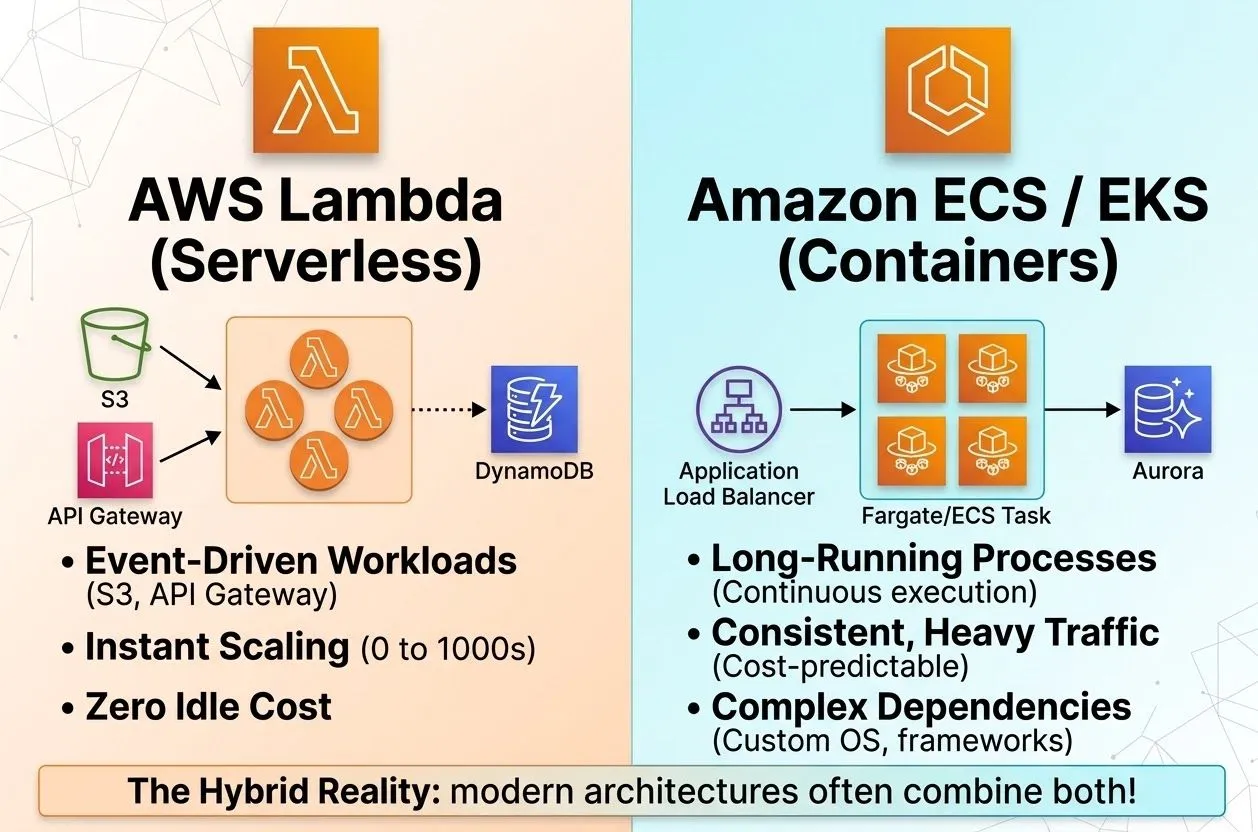
Serverless or Containers in 2026? How to Choose the Right Compute Strategy
The debate between AWS Lambda and containerized services (ECS/EKS) isn't about which is better—it's about matching architectural goals with workload demands.

One of the most common questions developers face when starting a new AWS project is: "Should I deploy this using AWS Lambda (Serverless) or containerize it with Amazon ECS/EKS?"
Both approaches have evolved dramatically, and today, the choice comes down to workload predictability, startup time requirements, and architectural complexity.
When to Choose AWS Lambda (Serverless):
Event-Driven Workloads: Perfect for handling S3 file uploads, API Gateway requests, or asynchronous background queues.
Variable Traffic: Scales instantly from zero to thousands of concurrent requests without manual intervention.
Zero Idle Cost: You only pay for the exact milliseconds your code executes.
When to Choose Containers (ECS / EKS):
Long-Running Processes: Ideal for microservices that need to run continuously without execution time limits.
Consistent, Heavy Traffic: When baseline traffic is steady, running container tasks can be more predictable and cost-effective than continuous high-volume Lambda executions.
Complex Dependencies: Useful when your application stack requires custom OS packages or legacy frameworks.
The Hybrid Reality:
In practice, modern architectures often combine both—using Lambda for rapid event handling and lightweight APIs, while relying on ECS/EKS for persistent core microservices.
Which compute pattern do you lean toward for new projects? Drop your thoughts below! ⚡
Enjoyed reading this content? Let the author know!
Your likes, comments, shares, and saves help creators reach more builders.

Loading recommendations
Loading article